On this page
How to identify it
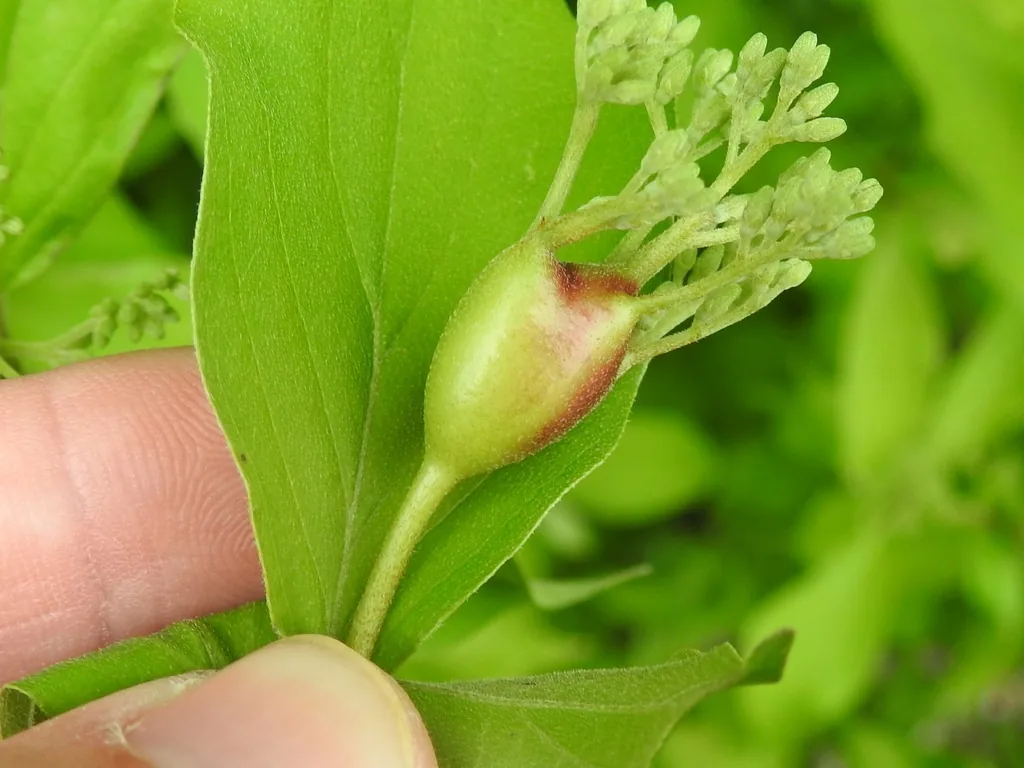
- Galls are club- or spindle-shaped tubular swellings at the tips or along the stems of dogwood twigs; NC State and Clemson give 1/2 to 1 inch long, while the Connecticut station gives 3/8 inch to 2 inches.[1][3][2]
- Each gall has a central cavity holding from 1 to 39 maggots, which leave by chewing small round holes through the sides.[1][3]
- From 30 to 120 galls per tree have been reported. Clemson says the first signs are wilted, deformed leaves at the shoot tip.[1][3][4]
- The adult is a delicate fly about 1/16 inch long with a bright orange abdomen and wings mottled with black and yellow hairs; the larvae are tiny orange maggots.[1][3]
Where it lives
NC State says dogwood seems to be its only host. It is described by Extension and state sources in North Carolina, South Carolina, Virginia and Connecticut, and Virginia and Clemson describe it on flowering dogwood.[1][3][4][2]
Biology and life cycle
Maggots overwinter in the soil or under sod and plant debris beneath the tree, and pupate the following spring; NC State says adults emerge in late spring, and the Connecticut station says June.[1][2]
Females lay eggs among the tiny terminal leaves just as the buds open. The young maggots work into the leaf bases or petioles and down toward the stem, and a tough gall swells up around them as they feed.[4][1][2]
Maggots develop inside the gall until late summer, then chew exit holes and drop to the ground; see where the sources disagree on timing.[1][4][3]
Damage and signs
Health risk
NC State, Virginia Extension, Clemson and the Connecticut station describe damage to dogwood twigs only and don't mention any risk to people or pets.[1][4][3][2]
Control
Traps and physical control
Inspect dogwoods for galled shoots, then prune out and destroy the galled twigs during the season, before the maggots leave, to limit next year's population.[2][3][1]
Pesticides
Once a gall has formed, pesticides can't reach the maggots inside. NC State says a contact pesticide applied just as the leaf buds are breaking could give adequate control; after that, pruning is probably the only option.[1]
Where the sources disagree
Gall length: NC State and Clemson say 1/2 to 1 inch; the Connecticut station says 3/8 inch to 2 inches.[1][3][2]
When maggots leave the galls: NC State says autumn; Virginia Extension says by late summer; Clemson says early fall.[1][4][3]
Adult emergence: NC State says late spring as new dogwood growth begins; the Connecticut station says June.[1][2]
Common questions
- What are the swollen tips on my dogwood twigs?
- Likely dogwood clubgall midge galls: club- or spindle-shaped swellings with orange midge maggots feeding inside. Wilted, deformed leaves at the shoot tip are often the first sign.[1][3]
- Can I spray to kill dogwood club galls?
- Not once they've formed; the maggots are protected inside. NC State says a contact pesticide could help only if applied as the leaf buds break; otherwise prune and destroy the galled twigs before the maggots leave.[1][2][3]
Sources
- NC State Extension, “Dogwood Clubgall Midge.” content.ces.ncsu.edu/dogwood-clubgall-midge (accessed 2026-11-13)
- Connecticut Agricultural Experiment Station, “Plant Pest Handbook: Dogwood (Cornus).” portal.ct.gov/caes/home/plant-pest-handbook/pphd/dogwood-cornus (accessed 2026-11-13)
- Clemson Cooperative Extension, Home & Garden Information Center, “Dogwood Diseases and Insect Pests, HGIC 2003 (updated Aug 11, 2026).” hgic.clemson.edu/factsheet/dogwood-diseases-insect-pests/ (accessed 2026-11-13)
- Virginia Cooperative Extension, “Galls Made by Aphids, Adelgids, Phylloxerans, Psyllids, and Midges, ENTO-146NP (ENTO-506NP) (E. Day and T. A. Dellinger, June 2, 2022).” pubs.ext.vt.edu/ENTO/ENTO-146/ENTO-146.html (accessed 2026-11-13)
- Global Biodiversity Information Facility (GBIF), “Resseliella clavula (Beutenmüller, 1892) (GBIF Backbone Taxonomy).” api.gbif.org/v1/species/1599122 (accessed 2026-11-13)
- iNaturalist, “Resseliella clavula taxon page (order and family).” www.inaturalist.org/taxa/538154 (accessed 2026-10-06)