On this page
How to identify it
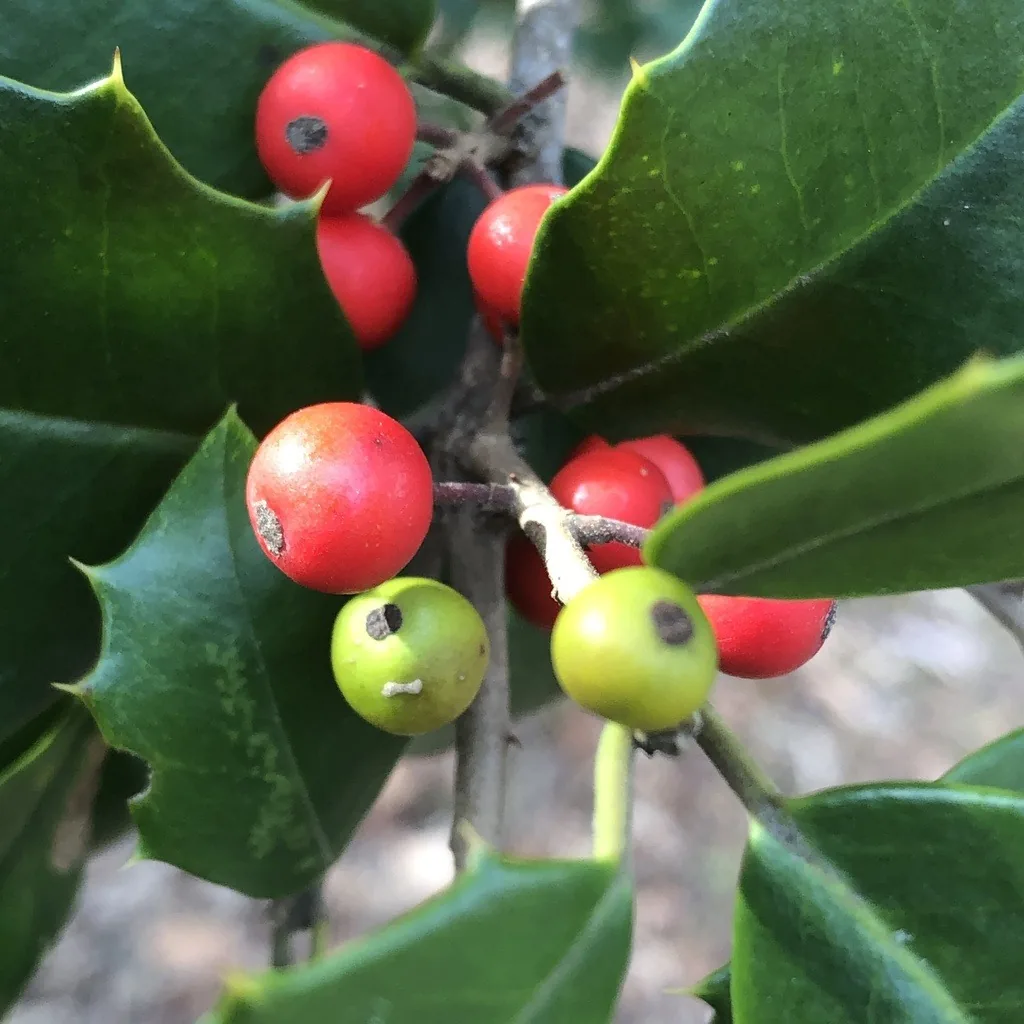
- Infested berries grow to about normal size but stay green through fall and winter, sometimes with a reddish blush or a lopsided shape.[1][3]
- Inside you may find a tiny yellow maggot, under 2 mm long according to the University of Maryland, or later a chestnut-brown pupa; a papery pupal case may stick out of the berry after the adult leaves.[1][3]
- The adult is a small, gray, mosquito-like fly about 1/8 inch long.[1][3]
Where it lives
NC State says it has been reported from American holly. It is described in North Carolina and Maryland landscapes.[1][3]
Biology and life cycle
Adults lay eggs in the young fruit while the petals are still on the flowers, and the maggots feed inside the developing berry; see where the sources disagree on what they eat.[1][3][2]
Most berries hold one maggot, which destroys one seed; about a third hold two, and a few hold three.[1]
Maggots spend the winter in the berry and pupate there as the hollies start to bloom the next spring, when the new adults emerge; NC State notes that in Maryland larvae pupated in early May and adults emerged in late May. NC State reports one generation a year in North Carolina.[1][2]
Damage and signs
- Infested berries don't turn red as they ripen, and NC State says the seed a maggot feeds on is destroyed.[1][2]
- The larvae and an associated fungus keep the berry green. In the 1989 study, green infested berries were eaten less during winter and spring than red ones, and the University of Maryland says birds and squirrels were much less likely to eat them, which protects the maggots.[2][3]
Health risk
NC State and the University of Maryland describe holly berries only and don't mention any risk to people or pets.[1][3]
Control
Prevention
NC State says early-blooming trees are more likely to be attacked and some resistant cultivars are available; ask a local nursery which are sold in your area.[1]
Biological control
Parasites cause high mortality: NC State says a tiny parasitic wasp attacks maggots inside the berries and can become abundant enough that a local midge population collapses, sometimes for years.[1]
Pesticides
NC State says spraying is hampered because the flies emerge while hollies bloom, so sprays would also kill bees and other pollinators; there may be a window just after the female flowers stop attracting bees, using an insecticide labeled for landscape use.[1]
Where the sources disagree
What the maggots eat: NC State says they feed on and destroy the seeds; the University of Maryland says they consume the tissue of the fleshy fruit.[1][3]
Common questions
- Why are some berries on my American holly still green in winter?
- A holly berry midge maggot is probably inside, eating the seed; infested berries never turn red.[1][3]
- What keeps holly berry midges in check?
- Parasitic wasps attack the maggots inside the berries and can become abundant enough to make a local midge population collapse.[1]
Sources
- NC State Extension, “Holly Berry Gall Midge.” content.ces.ncsu.edu/holly-berry-gall-midge (accessed 2026-11-13)
- American Midland Naturalist; abstract via University of Minnesota Experts@Minnesota, “Selective avoidance by vertebrate frugivores of green holly berries infested with a cecidomyiid fly (Diptera: Cecidomyiidae) (V. Krischik, E. S. McCloud and J. A. Davidson, American Midland Naturalist 121(2):350-354, 1989).” experts.umn.edu/en/publications/selective-avoidance-by-vertebrate-frugivores-of-green-holly-berri/ (accessed 2026-11-13)
- University of Maryland, Bug of the Week, “Green is good for holly berry midge, Asphondylia ilicicola (Bug of the Week, M. J. Raupp).” bugoftheweek.com/blog/2023/12/18/deck-the-halls-with-boughs-of-holly-adorned-with-cheery-red-and-green-berries-green-is-good-for-holly-berry-midge-asphondylia-ilicicola (accessed 2026-11-13)
- Global Biodiversity Information Facility (GBIF), “Asphondylia ilicicola Foote, 1953 (GBIF Backbone Taxonomy).” api.gbif.org/v1/species/1592833 (accessed 2026-11-13)
- iNaturalist, “Asphondylia ilicicola taxon page (order and family).” www.inaturalist.org/taxa/1274244 (accessed 2026-10-06)