On this page
How to identify it
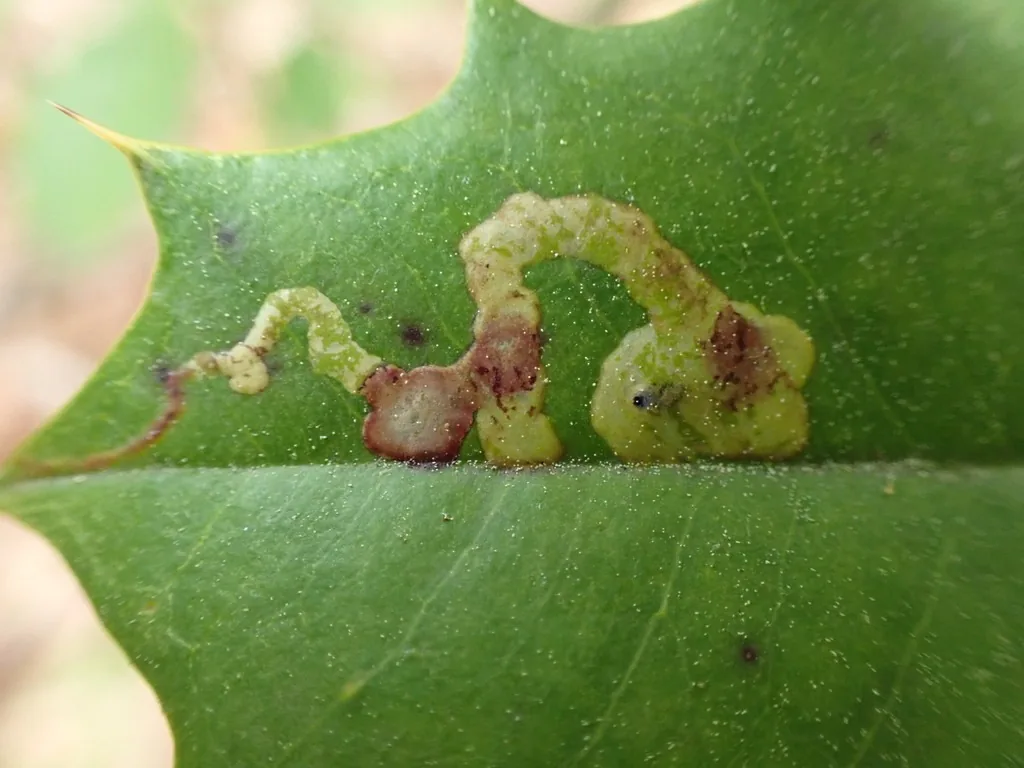
- Mines start slender and seldom over 1.3 cm long, then broaden into yellow serpentine or blotch mines (Penn State). UMass says the first sign is a tiny green blister on the leaf underside, and that current-year mines are easy to overlook.[1][3]
- Larvae are yellow maggots, 1.5 mm when grown; adults are tiny black flies, about 1 to 1.6 mm long.[1][3]
Look-alikes
Where it lives
It's found throughout eastern North America wherever American holly grows.[1][3]
Biology and life cycle
Larvae overwinter in the mines and pupate in spring (March and April, per UMass). Sources time adult emergence a little differently: Penn State says May, while UMass says by mid-May, over about six weeks, and by June in Massachusetts. Females lay eggs in slits on the undersides of new leaves.[1][3]
There's one generation a year, with about three larvae per leaf on average and 12 or more in some leaves.[1][3]
Sources differ on hosts. Penn State says it feeds only on American holly and its cultivars; UMass says it also feeds on Japanese holly and has been reported on English holly, but lays eggs only in American holly, and larvae may not complete development elsewhere.[1][3]
Damage and signs
Health risk
It feeds inside holly leaves, and no cited source describes any risk to people or pets.[1][3]
Control
Sanitation
Rake up and destroy mined leaves, including those that drop early, before adults emerge in May.[1][3]
Biological control
A native braconid wasp, Opius striativentris, parasitized 3 to 58 percent of leafminers within a tree in a Kentucky study.[2][3]
Pesticides
Penn State says registered foliar sprays in early May, or systemic soil treatments early in the season with adequate soil moisture, can help. UMass suggests timing treatment with yellow sticky cards that catch the adults, and choosing reduced-risk products to spare the parasitoid wasp; it notes neonicotinoids have been state restricted use on trees and shrubs in Massachusetts since July 2022. Follow the label.[1][3]
More from the research literature
A 1985 Oecologia study on cultivated American hollies found that parasitism by a native braconid wasp ranged from 3% to 58% within a tree, that mined leaves were more likely to drop early (about 14% fell before the adult flies emerged), and that both the leafminer and its parasitoid died at high rates inside fallen leaves.[2]
Common questions
Sources
- Penn State Extension, “Native Holly Leafminer.” extension.psu.edu/native-holly-leafminer (accessed 2026-11-13)
- Peer-reviewed literature (PubMed), “Population regulation of the native holly leafminer, Phytomyza ilicicola Loew (Diptera: Agromyzidae), on American holly (Potter DA, Oecologia, 1985).” pubmed.ncbi.nlm.nih.gov/28310789/ (accessed 2026-11-13)
- UMass Extension Landscape, Nursery and Urban Forestry Program, “Phytomyza ilicicola (Insect & Mite Guide).” www.umass.edu/agriculture-food-environment/landscape/publications-resources/insect-mite-guide/phytomyza-ilicicola (accessed 2026-11-13)
- Global Biodiversity Information Facility (GBIF), “Phytomyza ilicicola Loew, 1863 (GBIF Backbone Taxonomy).” api.gbif.org/v1/species/1551671 (accessed 2026-11-13)