On this page
How to identify it
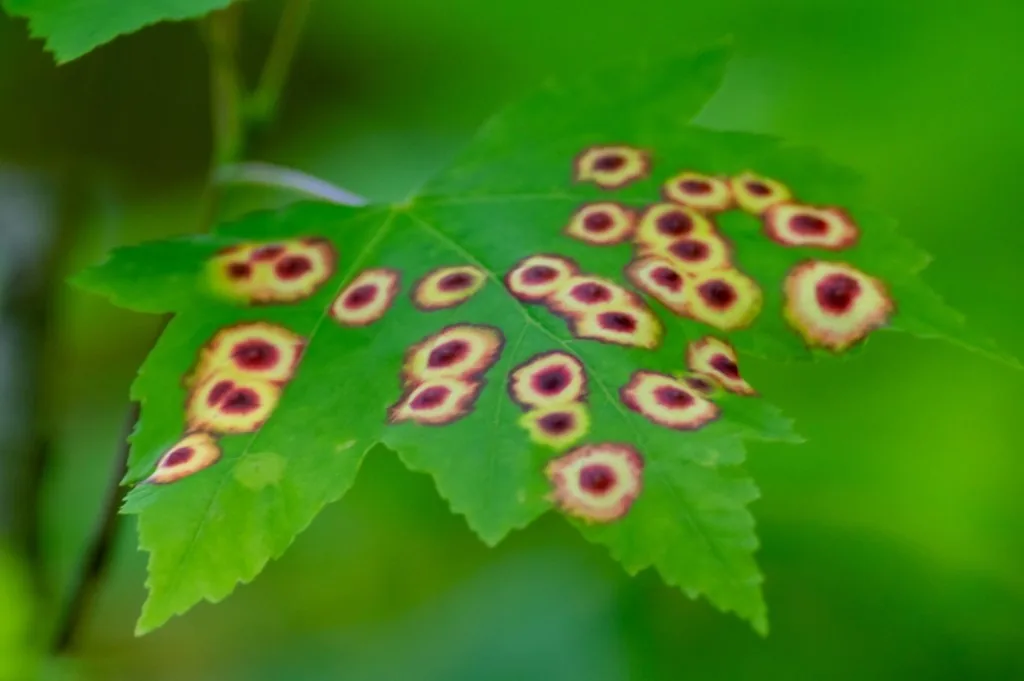
- The galls are round spots about 1/4 inch across that start as small yellow-green circles and mature into a red center ringed with green, then red deepening to maroon.[1][2]
- The colors show brightest on the upper side of the leaf; a single tiny, clear larva sits in the middle of the spot on the underside.[3][1]
- Penn State says the galls form in spring, and Kentucky says the colored rings usually develop in June and the spot later turns brown; Wisconsin DNR notes the spots stay on the leaves through the growing season.[1][2][3]
Look-alikes
| Look-alike | How to tell them apart |
|---|---|
| Maple bladdergall mite | Maple bladder galls are hollow, roughly spherical growths on short stalks on the upper side of silver and red maple leaves, while eyespot galls are colored, ringed spots, mostly on red maple.[2][1] |
| Leaf spot diseases and tar spot | Wisconsin DNR says fungal leaf diseases such as anthracnose and septoria leaf spot, and tar spot, which starts as brown spots and develops raised black spots, can look similar; eyespot galls have a single tiny larva at the center of each ringed spot on the underside of the leaf.[3] |
Where it lives
Extension and forestry agencies from Pennsylvania and Kentucky to Wisconsin describe it on their maples. Red maple is the preferred host, the galls also turn up on sugar and silver maple, and Penn State adds striped, mountain and Freeman's maple.[1][2][3]
Biology and life cycle
Adults are small flies that emerge in spring and lay eggs on the underside of maple leaves.[2][1][3]
Sources give slightly different feeding times: Penn State says the larva feeds for about a week, Wisconsin DNR says 8 to 10 days, and Kentucky says it completes development in about 10 days. Kentucky says the larva produces a growth-regulating hormone that makes the leaf form the bright rings around it.[1][3][2]
The full-grown larva, about 1/16 inch long, drops to the ground and spends the rest of the year in the soil, pupating and emerging as an adult the next spring.[3][1][2]
There is one generation a year.[2]
Damage and signs
Health risk
It feeds on maple leaves, and no cited source describes any risk to people or pets.[1][2][3]
Control
Prevention
No control is needed: Wisconsin DNR calls the damage cosmetic and says no control is necessary, Kentucky says no control is available, and Penn State says maple leaf galls rarely warrant control. Each larva feeds for only a week or so before dropping to the soil.[3][2][1]
Common questions
- Is the bull's-eye spotting on my red maple a disease?
- No. It's a gall made by a tiny fly larva feeding under each spot, and it is cosmetic only.[3][1]
- Should I spray the spotted leaves?
- Spraying isn't needed or useful, since the larvae leave the leaf after about a week to 10 days and spend the rest of the year in the soil.[2][3]
Sources
- Penn State Extension, “Leaf Galls on Maple.” extension.psu.edu/leaf-galls-on-maple (accessed 2026-11-13)
- University of Kentucky Entomology, “Common Maple Galls, ENTFACT-404 (L. Townsend and E. Eliason).” entomology.mgcafe.uky.edu/files/ef404.pdf (accessed 2026-11-13)
- Wisconsin Department of Natural Resources, Forest Health, “Gall Causes Bull's-eye Spots On Maple Leaves (L. Williams, July 3, 2025).” forestrynews.blogs.govdelivery.com/2025/07/03/gall-causes-bulls-eye-spots-on-maple-leaves/ (accessed 2026-11-13)
- Global Biodiversity Information Facility (GBIF), “Acericecis ocellaris (Osten Sacken, 1862) (GBIF Backbone Taxonomy).” api.gbif.org/v1/species/1596254 (accessed 2026-11-13)