On this page
How to identify it
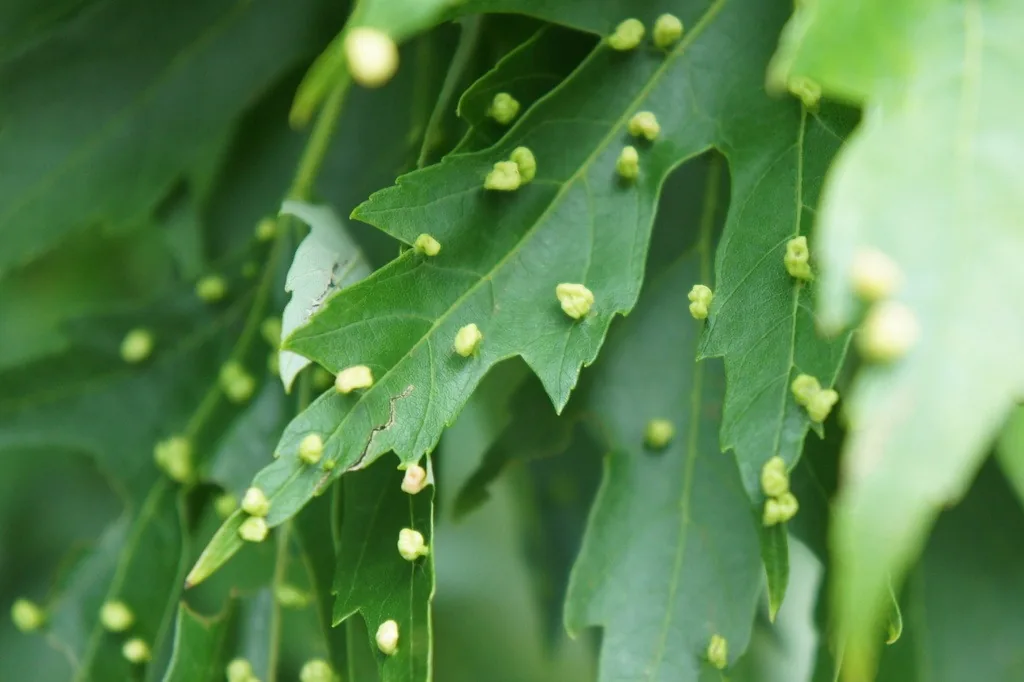
- The galls are hollow, round bumps 1/16 to 1/8 inch across on the upper leaf surface; they start pale green, turn pink to red, then brown to black as the season goes on.[2][1]
- Each gall sits on a short stalk like a tiny mushroom, and the mites leave it through a hairy opening on the underside of the leaf.[2][3]
- The mites themselves are too small to see without magnification; NC State says eriophyid mites have only two pairs of legs, and Wisconsin describes the young as whitish-orange and carrot-shaped.[1][2]
Look-alikes
| Look-alike | How to tell them apart |
|---|---|
| Maple spindlegall mite | Its close relative, Vasates aceriscrumena, makes slender, spindle-shaped galls rather than round bladders; Wisconsin and Ohio State say they are most common on sugar maple.[2][4] |
| Maple erineum mites | Other eriophyid mites make velvety, felt-like patches on the undersides of sugar, silver and red maple leaves instead of raised bladders.[2] |
Where it lives
Natural Resources Canada describes it as a native mite found across eastern Canada and in several eastern U.S. states. It attacks only maples, especially silver maple, and red maple less often.[3][1][2]
Biology and life cycle
Adult mites spend the winter in roughened areas of the bark, under bud scales and in other protected spots on the trunk and branches; Ohio State adds loosened bark and the callus around wounds and pruning scars.[2][1][5][4]
As buds open in spring, the mites crawl onto the new leaves to feed; their feeding makes the leaf grow a gall around them, and inside it they feed, lay eggs and multiply.[1][3]
New mites leave the gall and start galls on fresher leaves. Once the tree stops putting out new growth, usually in early summer, they can no longer make galls and move back to the bark.[2][3]
There are several generations a year. Gall numbers vary from tree to tree, branch to branch and year to year, and leaves nearest the trunk and larger branches, where the mites overwinter, are hit hardest.[3][2]
Damage and signs
Health risk
It lives and feeds only on maples. NC State, Wisconsin, Natural Resources Canada, Ohio State and Penn State describe leaf damage only and don't mention any risk to people or pets.[1][2][3][4][5]
Control
Traps and physical control
On a small tree, picking off galled leaves reduces the mite population. Once galls have formed, the mites are sealed inside, so sprays won't reach them.[2]
Pesticides
Control is usually unnecessary: Wisconsin and Ohio State call the galls cosmetic and Natural Resources Canada says no control is required. Treatment timing and dormant oil are where the sources disagree most; see below.[2][4][3]
Ohio State says Norway maples and some named cultivars with strong red or yellow leaf color appear resistant, and suggests pruning out affected twigs and bagging the infested tissue.[4]
Where it sits in mite classification
GBIF places Eriophyidae in Trombidiformes; DNA studies have placed eriophyoid mites with sarcoptiform mites (2017) or beside Nematalycidae, in Endeostigmata (2018).[6][7][8]
Where the sources disagree
When to treat: NC State says late fall after the leaves drop; Wisconsin says a dormant oil before bud break, or early-spring sprays as leaves expand (which it calls of limited value); Penn State says a registered pesticide in mid-April before bud swell; Ohio State says sprays must go on precisely as the new buds open and that most have little effect because the window is so short.[1][2][5][4]
Dormant oil: Wisconsin says it can be quite effective but should not be used on sugar maple, Japanese maple, birch, hickory or walnut; Ohio State discourages dormant oil on maples unless the tree is truly dormant, though it notes reports of success with trunk drenches.[2][4]
Gall size: Wisconsin and Ohio State give 1/16 to 1/8 inch; Penn State gives about 2.5 to 3 mm.[2][4][5]
Common questions
- Are the red bumps on my maple leaves hurting the tree?
- Almost never. They're maple bladder galls, and NC State and Wisconsin Extension both say they do little or no measurable harm to an established tree, even when leaves are covered.[1][2]
- Can I spray the galls I see now?
- It won't help: the mites are sealed inside the galls. The sources give different timings (late fall after leaf drop, dormant oil before bud break, or just as the buds open), and most say control is rarely worth it.[2][1][4][5]
Sources
- NC State Extension, “Maple Bladdergall Mite (PDIC Factsheet).” content.ces.ncsu.edu/maple-bladdergall-mite (accessed 2026-11-13)
- University of Wisconsin-Madison Extension, Wisconsin Horticulture, “Maple Gall Mites (Eriophyidae).” hort.extension.wisc.edu/articles/maple-gall-mites-eriophyidae/ (accessed 2026-11-13)
- Natural Resources Canada, Canadian Forest Service, “Maple bladdergall mite (Trees, insects and diseases of Canada's forests, factsheet 94).” tidcf.nrcan.gc.ca/en/insects/factsheet/94 (accessed 2026-11-13)
- Ohio State University Extension, “Galls of Maple Trees in Ohio, ENT-60 (Ohioline; D. J. Shetlar).” ohioline.osu.edu/factsheet/ENT-60 (accessed 2026-11-13)
- Penn State Extension, “Leaf Galls on Maple (G. Hoover, revised by M. Skvarla).” extension.psu.edu/leaf-galls-on-maple (accessed 2026-11-13)
- Global Biodiversity Information Facility (GBIF), “Eriophyidae, family (GBIF Backbone Taxonomy species record).” api.gbif.org/v1/species/2816 (accessed 2026-11-13)
- Molecular Phylogenetics and Evolution, 2017 (via PubMed), “The phylogenetic position of eriophyoid mites (superfamily Eriophyoidea) in Acariformes inferred from the sequences of mitochondrial genomes and nuclear small subunit (18S) rRNA gene (abstract).” pubmed.ncbi.nlm.nih.gov/28119107/ (accessed 2026-11-13)
- Molecular Phylogenetics and Evolution, 2018 (via PubMed), “Comprehensive phylogeny of acariform mites (Acariformes) provides insights on the origin of the four-legged mites (Eriophyoidea), a long branch (abstract).” pubmed.ncbi.nlm.nih.gov/29074461/ (accessed 2026-11-13)
- Global Biodiversity Information Facility (GBIF), “Vasates quadripedes Shimer, 1869 (GBIF Backbone Taxonomy).” api.gbif.org/v1/species/4543837 (accessed 2026-11-13)