On this page
How to identify it
- The mites are microscopic, pale, and carrot-shaped or wormlike, with just two pairs of legs at the head end instead of the four pairs most arachnids have.[2][1][5]
- They are usually white, yellow or pinkish; Wisconsin describes maple gall mite nymphs as whitish orange.[1][5][4]
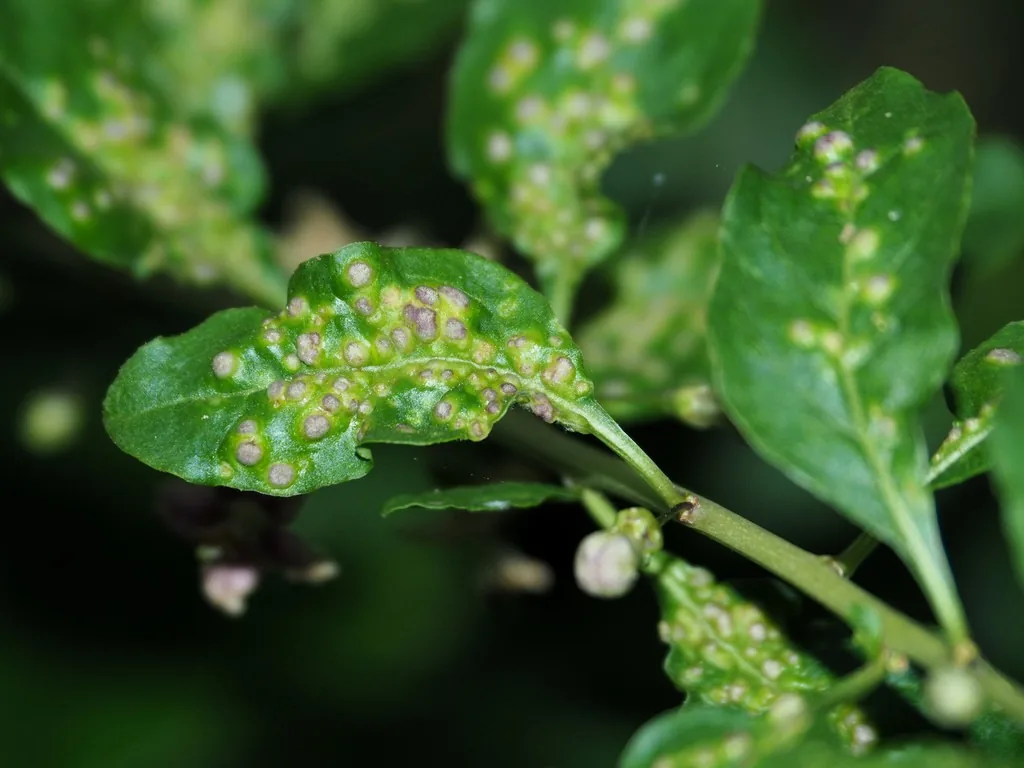
- Maple bladder galls are round bumps 1/16 to 1/8 inch across on the upper leaf surface, held up on short stalks; they start green and turn pink, red and finally black.[4]
- Spindle galls are small, pencil-lead-thin growths about 1/5 inch long, tapered at both ends; erineum galls are velvety, felt-like patches on the leaf underside that often turn bright red.[4][3]
- Other mite galls include finger-like or pocket galls, bud galls on birch, distorted ash flowers, and rolled or blistered leaves.[5][3]
Look-alikes
| Look-alike | How to tell them apart |
|---|---|
| Insect galls | Gall wasps, midges, aphids and psyllids also make galls; the mites themselves are visible only with magnification.[2][3] |
| Maple eyespot gall midge | Its galls on red maple are round spots with bright red and yellow rings, and they are made by a small fly, not a mite.[4] |
Where it lives
Gall-making eriophyid mites are reported on many trees, shrubs and flowers: ash, maple, birch and linden in Minnesota, maples and boxelder in Wisconsin, birch, mountain ash and willow in Colorado, and fuchsia and grape in California. GBIF holds about 45,000 US records since 1990 from 48 states, counting the District of Columbia, most from California, Texas and New York.[3][4][5][2][7]
Biology and life cycle
They spend the winter on the host plant, in rough bark, under bud scales or in other sheltered spots, and become active in very early spring as buds open.[3][4][5]
As the mites feed on new leaf tissue, chemicals they produce interact with plant hormones and trigger abnormal growth that encloses them. Each species makes a characteristic gall shape, and the gall shields the mites from predators and sprays.[4][5]
On maples, adults lay eggs inside the gall once the leaf is fully grown and then die. Nymphs feed on gall tissue, mature within a few weeks, leave through an opening on the leaf underside and move to new leaves; once the tree stops putting out new growth in early summer they head back to the bark to overwinter.[4]
There are often several overlapping generations a season, going through egg, two nymphal stages and adult.[2][5][4]
Most species feed on one kind of plant. A review of described eriophyoid mites found 80 percent recorded on only one host species and 99 percent on one plant family.[5][6]
Ash flower galls start green and turn brown by late summer, and can stay on the tree up to two years. In combination with powdery mildew, eriophyid mites also cause hackberry witches'-broom.[3]
Damage and signs
- They distort, stunt and discolor leaves, shoot tips or buds, which may drop early, and can cause broom-like growth.[1][5]
- Galls seldom harm plant health. Heavy infestations can deform leaves or cause early yellowing and leaf drop, and many galls on very young or newly planted trees, or for years in a row, can be a real stress.[3][2][4][5]
- Numbers are patchy and vary from year to year; on maples the leaves nearest the mites' overwintering spots on the bark are hit hardest.[4][3]
Health risk
These mites feed only on plants; none of the sources describes any concern for people.[2][3][5]
Control
Prevention
Usually no control is needed; mite galls are mostly cosmetic. Keeping trees watered and fertilized as needed is a better use of effort than spraying.[3][2][4][5]
Sanitation
On flowers such as fuchsia, start with pest-free plants and dispose of infested ones, since mites feeding inside plant tissue are hard to reach.[1]
Traps and physical control
Handpicking damaged leaves, or pruning infested leaves and twigs in early spring and bagging them for the trash, removes some mites.[4][5]
Pesticides
Sprays are only worth considering for severe infestations, and only before galls close over the mites; once galls form, sprays won't work. Minnesota gives horticultural oil before spring activity for mites that winter on the plant.[3][4][5]
Don't use dormant oil on sugar maple, Japanese maple, birch, hickory or walnut, which oil can injure.[4]
Where sources disagree
Do sprays pay off? Wisconsin says dormant oil before bud break can be quite effective because the mites winter on the tree, yet calls early-spring preventive treatment generally of limited value. Colorado State says chemical control of gall-forming eriophyids is generally not warranted and would time any miticide for early bud break; Minnesota gives horticultural oil before spring activity.[4][5][3]
Size: Colorado State says eriophyid mites usually measure under 1 mm; Wisconsin says maple gall mites are less than 2 mm long. Both agree you need magnification to see them.[5][4]
GBIF places Eriophyidae in Trombidiformes; DNA studies have placed eriophyoid mites with sarcoptiform mites (2017) or beside Nematalycidae, in Endeostigmata (2018).[8][9][10]
Common questions
- What are the red bumps on my maple leaves?
- Probably maple bladder galls, caused by eriophyid mites. They start green and turn red, then black, and they're cosmetic on established trees.[3][4]
- Can I see the mites?
- Not without magnification. They're microscopic and wormlike, with four legs near the head.[2][1][5]
- Should I spray galls I can see now?
- No. Once galls have formed, the mites are sealed inside and sprays won't reach them.[3][4][5]
- Will the mites spread to my other plants?
- Not usually. Most eriophyid mites feed on a single plant species, and a review found 95 percent recorded on just one plant genus.[5][6]
Sources
- University of California Statewide IPM Program, “Gall and Bud Mites (Pests in Gardens and Landscapes).” ipm.ucanr.edu/PMG/GARDEN/FLOWERS/INVERT/gallmite.html (accessed 2026-11-11)
- University of California Statewide IPM Program, “Gall Makers (Pests in Gardens and Landscapes).” ipm.ucanr.edu/PMG/GARDEN/PLANTS/INVERT/gallmakers.html (accessed 2026-11-11)
- University of Minnesota Extension, “Insect and mite galls (Yard and garden insects).” extension.umn.edu/yard-and-garden-insects/insect-and-mite-galls (accessed 2026-11-11)
- University of Wisconsin-Madison Extension (Wisconsin Horticulture), “Maple Gall Mites (Eriophyidae).” hort.extension.wisc.edu/articles/maple-gall-mites-eriophyidae/ (accessed 2026-11-11)
- Colorado State University Department of Agricultural Biology, “Insect and mite galls (IPM pests).” agsci.colostate.edu/agbio/ipm-pests/insect-and-mite-galls/ (accessed 2026-11-11)
- Experimental and Applied Acarology, via PubMed, “Host-plant specificity and specialization in eriophyoid mites (Skoracka et al. 2010).” pubmed.ncbi.nlm.nih.gov/19789985/ (accessed 2026-11-11). Cited from the PubMed abstract.
- Global Biodiversity Information Facility (GBIF), “Eriophyidae: US occurrence records since 1990 by state (GBIF occurrence search API).” api.gbif.org/v1/occurrence/search?taxonKey=2816&country=US&hasGeospatialIssue=false&occurrenceStatus=PRESENT&year=1990%2C2026&facet=stateProvince&facetLimit=400&limit=0 (accessed 2026-11-11). State counts are records reported (iNaturalist research-grade, museum specimens, surveys), not abundance.
- Global Biodiversity Information Facility (GBIF), “Eriophyidae, family (GBIF Backbone Taxonomy species record).” api.gbif.org/v1/species/2816 (accessed 2026-11-13)
- Molecular Phylogenetics and Evolution, 2017 (via PubMed), “The phylogenetic position of eriophyoid mites (superfamily Eriophyoidea) in Acariformes inferred from the sequences of mitochondrial genomes and nuclear small subunit (18S) rRNA gene (abstract).” pubmed.ncbi.nlm.nih.gov/28119107/ (accessed 2026-11-13)
- Molecular Phylogenetics and Evolution, 2018 (via PubMed), “Comprehensive phylogeny of acariform mites (Acariformes) provides insights on the origin of the four-legged mites (Eriophyoidea), a long branch (abstract).” pubmed.ncbi.nlm.nih.gov/29074461/ (accessed 2026-11-13)