On this page
How to identify it
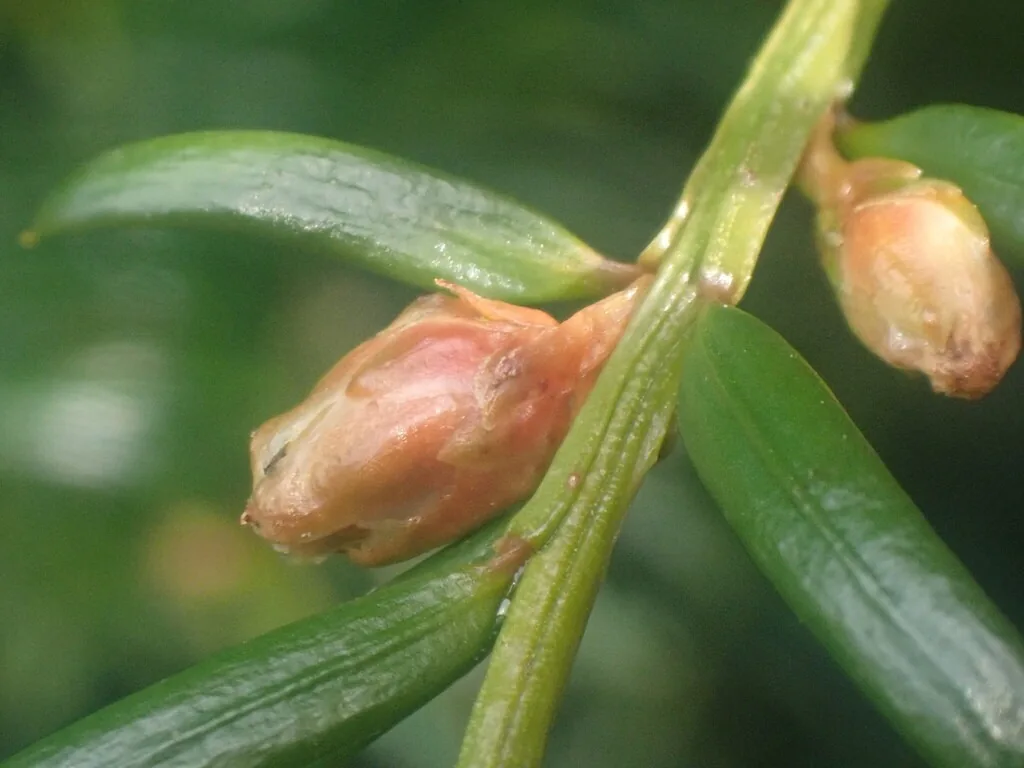
- The giveaway is enlarged, swollen buds that may wither and drop ("blast") or fail to grow in spring; lighter infestations distort the new needles and shoots.[1][2]
- The mites themselves need magnification: under a dissecting microscope the larvae are tiny and white or translucent, the nymphs a little larger, and the adults orange-brown.[1]
Look-alikes
| Look-alike | How to tell them apart |
|---|---|
| Gall mites | Taxus bud mite belongs to the same group of eriophyid mites as the gall mites on other trees and shrubs, but it lives hidden inside yew buds.[1] |
Where it lives
Common in several northeastern states and widespread in Europe; it also occurs on Pacific yew in British Columbia, where it was probably introduced from English yew. UMass Extension covers it in Massachusetts; the cited source does not name the other states.[1]
Biology and life cycle
The mites pass through egg, larva, nymph and adult stages and overwinter between the bud scales; as many as 1,000 may live in a single bud.[1][2]
Feeding and reproduction pick up by late summer and fall, when damage peaks, and the mites move into the new buds that form in summer.[1][2]
In a British Columbia study on Pacific yew, mite numbers were high from May to August, peaked in June and were lowest in March and October.[1]
Damage and signs
Health risk
It feeds only on yew; neither source reports any harm to people or pets.[1][2]
Control
Prevention
Check buds for swelling or decay; seeing the mites or their eggs requires magnification.[1]
Traps and physical control
Prune out and destroy infested branches.[1]
Biological control
Predatory mites, including phytoseiid mites, are among its natural enemies, and predation and cool temperatures may keep numbers low in early spring and fall.[1]
Pesticides
UMass lists products including horticultural oil and abamectin for bud mites on yew; follow the label.[1]
Where it sits in mite classification
GBIF places Eriophyidae in Trombidiformes; DNA studies have placed eriophyoid mites with sarcoptiform mites (2017) or beside Nematalycidae, in Endeostigmata (2018).[3][5][6]
Common questions
- Why are the buds on my yew swollen?
- Enlarged buds that later wither, drop or put out distorted needles are typical of taxus bud mite; the mites can only be seen with magnification.[1][2]
- Can taxus bud mites kill my yew?
- They kill infested buds, and heavily infested buds won't grow in spring, but the sources describe damage to buds, needles and shoots rather than to the whole plant.[1][2]
Sources
- UMass Extension Landscape, Nursery and Urban Forestry Program (Landscape Insect & Mite Guide), “Cecidophyopsis psilaspis (Taxus Bud Mite).” www.umass.edu/agriculture-food-environment/landscape/publications-resources/insect-mite-guide/cecidophyopsis-psilaspis (accessed 2026-11-12)
- University of Kentucky Entomology, “Common Insect Pests of Yew/Taxus (Tree Pest Guide).” uky.edu/Ag/Entomology/treepestguide/taxus.html (accessed 2026-10-17)
- Global Biodiversity Information Facility (GBIF), “Eriophyidae, family (GBIF Backbone Taxonomy species record).” api.gbif.org/v1/species/2816 (accessed 2026-11-13)
- Global Biodiversity Information Facility (GBIF), “Cecidophyopsis psilaspis (Nalepa, 1893) (GBIF Backbone Taxonomy).” api.gbif.org/v1/species/4543448 (accessed 2026-11-13)
- Molecular Phylogenetics and Evolution, 2017 (via PubMed), “The phylogenetic position of eriophyoid mites (superfamily Eriophyoidea) in Acariformes inferred from the sequences of mitochondrial genomes and nuclear small subunit (18S) rRNA gene (abstract).” pubmed.ncbi.nlm.nih.gov/28119107/ (accessed 2026-11-13)
- Molecular Phylogenetics and Evolution, 2018 (via PubMed), “Comprehensive phylogeny of acariform mites (Acariformes) provides insights on the origin of the four-legged mites (Eriophyoidea), a long branch (abstract).” pubmed.ncbi.nlm.nih.gov/29074461/ (accessed 2026-11-13)