On this page
How to identify it
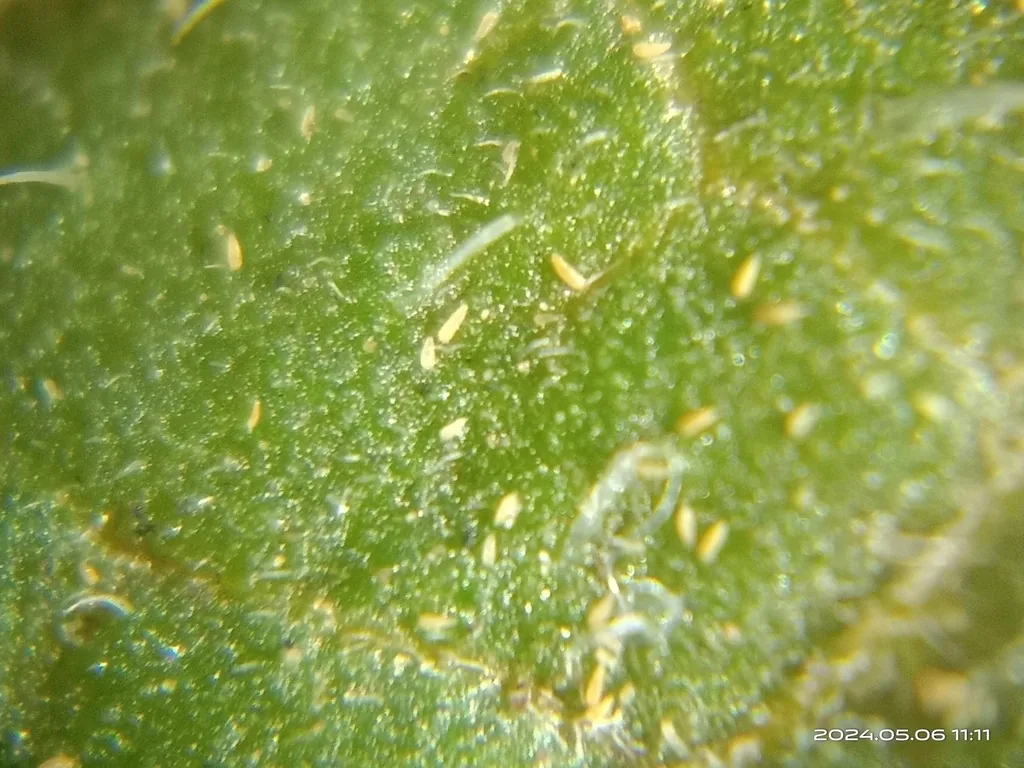
- Mites are only about 1/5 mm long, less than half the size of a two-spotted spider mite, so you need at least a 14X hand lens or a microscope; the bronzing usually gets noticed before the mites.[6][5]
- They are slender, cone- or cigar-shaped and yellowish, tan, cream or pink, depending on the source (see below). UMass notes they have only two pairs of legs, located at the front of the body.[6][4][5]
- Check the green leaves just above the damage, where mites move as they spread up the plant. Unlike many mites, they tolerate strong sunlight and live on both the tops and undersides of leaves.[6][5]
Look-alikes
| Look-alike | How to tell them apart |
|---|---|
| Spider mites | Spider mites are rounder and larger, usually have two spots and often make webbing; russet mites make no webbing. Fast-moving clear mites are predatory mites.[6][5] |
Where it lives
UMass says it is most common in greenhouses and high tunnels, and a 2023 genetic study calls it a key pest of cultivated tomato worldwide. Genetic evidence supports a South American origin.[5][8]
Biology and life cycle
It has many overlapping generations a year. In warm, dry conditions the life cycle can take about 7 days, and populations can double every 3 to 4 days at around 80°F and 30% humidity.[4][5]
Utah State says it overwinters as adults in crop debris. UMass says it has no dormant overwintering stage and needs living host plants, so infestations in Massachusetts likely start from greenhouses and nurseries that stay in production over winter.[4][5]
Eggs are laid on stems, petioles and leaf undersides low on the plant. UMass says mites in the upper leaves may be blown on wind currents to other plants and are easily carried on clothing and equipment.[5]
Damage usually shows in mid- to late summer when plants are half grown or larger, and populations explode in hot, dry weather.[6][4]
Damage and signs
- Utah State lists potato, tomato, pepper and eggplant as hosts. UC IPM and UMass add petunias, and UMass says nightshade-family weeds and bindweed can also serve as hosts. A 2025 study notes it has been seen on other plants in the Solanaceae and Convolvulaceae and tested it on potato, black nightshade, sweet potato and hedge bindweed.[4][6][5][9]
- Leaves and stems turn greasy-looking, then bronze, curl, yellow and drop, often starting with browning on the stem near the soil. Fruit may crack and bronze, defoliated fruit can sunburn, and unchecked mites can kill plants.[6][4][5]
- In a 2025 study it carried tomato fruit blotch virus from plant to plant, the first evidence that it can spread this virus.[10]
Health risk
It is a plant-feeding mite. UC IPM, Utah State and UMass don't mention any risk to people or pets.[6][4][5]
Control
Prevention
Use clean transplants, and don't grow tomatoes near petunias, potatoes or other nightshade-family plants. Control nightshade, horsenettle, jimsonweed and bindweed nearby.[4][6][5]
Water adequately and watch lower leaves for bronzing during hot, dry spells; in high tunnels and greenhouses, use shade cloth and ventilation to avoid hot, dry conditions.[5][4]
Sanitation
Promptly remove or destroy infested plant debris, and clean tools used on infested plants before using them on healthy plants. Utah State also advises avoiding planting during hot, dry periods.[4]
Biological control
The predatory mite Amblyseius andersoni can help in greenhouses and high tunnels. In a greenhouse trial, the predatory mite Pronematus ubiquitus, set up before the pest arrived, cut russet mite numbers by 98%.[5][7]
Pesticides
UC IPM says sulfur dust and wettable sulfur are effective. UMass says sulfur products such as Microthiol Disperss are effective but should not be used when plants are flowering or when temperatures will exceed 90°F; EPA's product search lists Microthiol Disperss with an active registration. UMass says neem oil or azadirachtin may also be effective, and that all of these must contact the mites, so good coverage of the foliage is essential.[6][5][11]
Utah State also lists abamectin, and EPA's product search lists abamectin products with active registrations; follow the label. A 2025 study identified a field strain with strongly decreased susceptibility to both abamectin and spiromesifen.[4][12][9]
Where it sits in mite classification
GBIF places Eriophyidae in Trombidiformes; DNA studies have placed eriophyoid mites with sarcoptiform mites (2017) or beside Nematalycidae, in Endeostigmata (2018).[1][2][3]
Where the sources disagree
Overwintering: Utah State says adults overwinter in crop debris; UMass says the mite has no dormant overwintering form and needs living host plants, so Massachusetts infestations likely start from greenhouses and nurseries in production over winter.[4][5]
Color: UC IPM says yellowish, tan or pink; Utah State says yellowish-tan or pink; UMass says cream, tan or yellow.[6][4][5]
Seeing the mites: UC IPM says you need at least a 14X lens; UMass says a microscope or powerful hand lens; Utah State says a microscope.[6][5][4]
Sulfur: UC IPM and UMass call sulfur effective; in a greenhouse trial, a sulfur treatment stopped the mite's progress but populations remained high.[6][5][7]
Hosts: Utah State lists potato, tomato, pepper and eggplant; UC IPM and UMass add petunias, and UMass adds bindweed.[4][6][5]
Common questions
- Why are my tomato stems and lower leaves turning bronze?
- Often tomato russet mites, which are too small to see without a lens. Check the green leaves just above the damage.[6][4]
- How do I tell russet mites from spider mites?
- Russet mites are tiny and cone-shaped with no webbing; spider mites are rounder, larger and spin webs.[6][5]
- What controls tomato russet mites?
- UC IPM says sulfur dust and wettable sulfur are effective, and UMass says not to use sulfur when plants are flowering or when temperatures will exceed 90°F. Clean transplants, weed control and removing infested plant debris help prevent problems.[6][5][4]
Sources
- Global Biodiversity Information Facility (GBIF), “Eriophyidae (family) (GBIF Backbone Taxonomy).” api.gbif.org/v1/species/2816 (accessed 2026-11-13). ACCEPTED
- Molecular Phylogenetics and Evolution, 2017 (via PubMed), “The phylogenetic position of eriophyoid mites (superfamily Eriophyoidea) in Acariformes inferred from the sequences of mitochondrial genomes and nuclear small subunit (18S) rRNA gene (abstract).” pubmed.ncbi.nlm.nih.gov/28119107/ (accessed 2026-11-13)
- Molecular Phylogenetics and Evolution, 2018 (via PubMed), “Comprehensive phylogeny of acariform mites (Acariformes) provides insights on the origin of the four-legged mites (Eriophyoidea), a long branch (abstract).” pubmed.ncbi.nlm.nih.gov/29074461/ (accessed 2026-11-13)
- Utah State University Extension (Integrated Pest Management), “Tomato Russet Mite (vegetable pest fact sheet).” extension.usu.edu/planthealth/ipm/notes_ag/veg-tomato-russet-mite.php (accessed 2026-11-13)
- UMass Amherst Center for Agriculture, Food, and the Environment, “Tomato Russet Mite, Vegetable fact sheet (Shokoohi and Madeiras, 2024).” www.umass.edu/agriculture-food-environment/vegetable/fact-sheets/tomato-russet-mite (accessed 2026-11-13)
- UC Statewide IPM Program, “Tomato Russet Mite (Home and Landscape).” ipm.ucanr.edu/home-and-landscape/tomato-russet-mite/ (accessed 2026-11-13)
- Pest Management Science, via PubMed, “The predatory mite Pronematus ubiquitus curbs Aculops lycopersici damage under greenhouse conditions (Maret et al. 2024).” pubmed.ncbi.nlm.nih.gov/38062929/ (accessed 2026-11-13). Cited from the PubMed abstract.
- Experimental and Applied Acarology, via PubMed, “Genetic analysis of the tomato russet mite provides evidence of oligophagy and a widespread pestiferous haplotype (Duarte et al. 2023).” pubmed.ncbi.nlm.nih.gov/36795266/ (accessed 2026-11-13). Cited from the PubMed abstract.
- Pest Management Science, via PubMed, “Acaricide resistance mechanisms and host plant responses in the tomato specialist Aculops lycopersici (Vervaet et al. 2025).” pubmed.ncbi.nlm.nih.gov/39473234/ (accessed 2026-11-13). Cited from the PubMed abstract.
- Scientific Reports, via PubMed, “Transmission of tomato fruit blotch virus by the tomato russet mite (Bertin et al. 2025).” pubmed.ncbi.nlm.nih.gov/40204916/ (accessed 2026-11-13). Cited from the PubMed abstract.
- U.S. EPA Pesticide Product Label System, “Pesticide Product Label System: product-name search 'Microthiol'.” ordspub.epa.gov/ords/pesticides/cswu/ProductSearch/partialprodsearch/v2/riname/Microthiol (accessed 2026-11-13). 9 product-name rows, 2 with product status Active, including 70506-187 MICROTHIOL DISPERSS; saved 2026-11-13.
- U.S. EPA Pesticide Product Label System, “Pesticide Product Label System: product-name search 'Abamectin'.” ordspub.epa.gov/ords/pesticides/cswu/ProductSearch/partialprodsearch/v2/riname/Abamectin (accessed 2026-11-13). 71 product-name rows, 52 with product status Active (for example 5481-616 ABAMECTIN 0.15 EC); saved 2026-11-13.
- Global Biodiversity Information Facility (GBIF), “Aculops lycopersici (Tryon, 1917) (GBIF Backbone Taxonomy).” api.gbif.org/v1/species/2128536 (accessed 2026-11-13). ACCEPTED; order Trombidiformes, family Eriophyidae