On this page
How to identify it
- The mite itself is too small to see without a microscope; what you see is the damage. UF/IFAS describes it as a typical eriophyid: tube-shaped, with two pairs of legs and approximately 150 µm long. It can't be seen with a hand lens; a stereomicroscope is needed.[1][4][5]
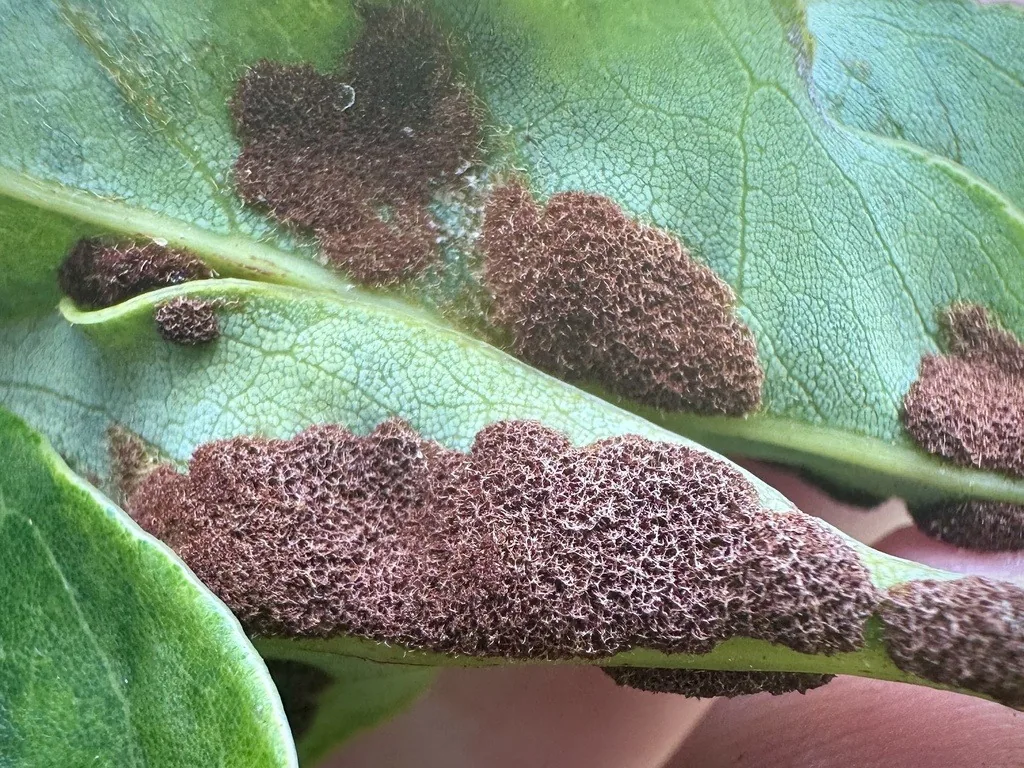
- The earliest sign is often a single tiny gall: a dark green patch on the leaf underside with a thin coat of white hairs, with nothing visible on top yet.[4]
- As the gall matures it bulges on the upper side, and the hairs turn from white to amber and then dark brown, so infested leaves end up with a reddish-brown, velvety underside. Leaves often curl. UF/IFAS adds that dense white erinea hold fewer mites than amber ones, and dark brown or black erinea have few or none, because the mites have used up the leaf and moved on to new flush on the same tree.[4][1][5]
- Researchers describe four erineum stages by color (hyaline, white, amber and dark brown), each lasting about 50 days. Mite numbers build through the first three and drop sharply once the erineum turns dark brown.[6]
- As infestations grow, galls spread from leaves to stems, flowers and fruit. UF/IFAS lists petioles, stems, panicles, flower buds and fruit.[4][7][5]
Look-alikes
| Look-alike | How to tell them apart |
|---|---|
| Aceria dimocarpi (a longan mite) | A close relative that attacks longan. UF/IFAS says the lychee erinose mite is highly host-specific and that longan planted alongside infested lychee in Brazil and Florida never developed symptoms.[5] |
Where it lives
A major lychee pest in Australia, Brazil and much of South Asia, with populations studied from India, Taiwan and Hawaii. In Florida it was found in Lee County in 2018 and has since spread to all of the state's lychee-producing counties. UF/IFAS calls it native to Asia, lists reports from India, Pakistan, Bangladesh, Thailand, China, Taiwan, Hawaii and Australia, and says it has spread to all major lychee-producing areas of Brazil.[4][7][2][5]
Biology and life cycle
The mite lives, feeds and breeds inside the erineum, which shelters it from predators, weather and sprays.[7][3]
It goes for new growth. In Florida's first find, it was on young leaves, stems and flower clusters of young trees with abundant new growth, and in choice tests new leaf shoots were the lychee tissue that attracted it most.[7][8]
In a South Florida orchard study, spread followed rising temperatures, flushing and flowering. Most of it was tree to tree by walking, though riding on pollinators during bloom likely also played a part; the first 10 percent of trees were infested in about 79 days and the rest over the next 100. UF/IFAS adds wind and air-layers taken from infested trees as ways it travels, and a 2021 UF/IFAS paper adds moving infested fruit and contaminated pruning tools.[2][5][9]
Heat works against it: in lab tests mite populations were lower at 35 °C than at 15 or 25 °C.[6]
In southern Brazil numbers peaked in November and June and were low from January to March.[10]
Eggs are laid only after erinea form, at their base. UF/IFAS says eggs are about 32 μm long and hatch in three to four days; larvae molt to nymphs after two to three days and nymphs become adults in five to seven days, so egg to adult takes about 14 days and generations overlap through the year.[5]
Young trees are more susceptible, UF/IFAS says, and every lychee variety grown in Florida has proved susceptible. The 2021 paper adds that trees that flush often are more attractive to the mite than dormant trees.[5][9]
Damage and signs
- It is the main pest of lychee in several countries, causing yield losses of up to 80 percent. UF/IFAS cites an estimated 70 to 80 percent yield loss in Brazil along with a 20 percent rise in production costs, and an 80 percent loss reported from India.[3][5]
- Unchecked, it can severely damage the tree, flowers and fruit.[1][4]
- Infested leaves change from water-repellent to extremely water-repellent, which changes how spray droplets wet and stick to them. The erineum itself also shields the mites from miticides.[11][3]
- Florida is the leading U.S. lychee producer, with an estimated 700 acres across at least eight counties in 2021, and Miami-Dade County grows about 70 percent of the crop, which is why the mite's spread there after February 2020 worried growers.[9]
Health risk
It is a pest of lychee trees. None of the sources reports any risk to people or pets.[1][7]
Control
Prevention
Check new flushes often. The first gall is easy to miss, and spread inside an orchard tracks new growth and bloom.[4][2]
Sanitation
Don't carry the mite to clean trees. FDACS asks that tools, clothing and skin that touched an infested lychee be wiped down with alcohol before you leave the site.[4]
Traps and physical control
Worldwide, the main approach is pruning combined with chemical protection of new growth. UF/IFAS says pruning out and burning infested branches must be followed by protective treatment of the new flush, because pruning alone, including routine pruning after harvest, may make the spread worse.[5]
Biological control
Predatory mites are common on infested lychee, but in Brazilian field trials released predators failed to establish on most plants and did not explain differences in erinea, and a native predator in São Paulo orchards did not prevent visible damage. UF/IFAS says predation has been confirmed for only a few predatory mites, including Amblyseius largoensis in China and Phytoseius intermedius in Brazil; P. intermedius was the one most often found with the mite.[12][13][10][5]
Pesticides
Research on control is ongoing. In lab tests from Brazil, pyridaben was the most effective of the miticides tried against mites in the erineum, and some spray adjuvants improved results.[3]
Treatments are preventive. UF/IFAS says the miticides used against it protect leaves before an infestation but don't kill mites once the erineum has formed, and the 2021 paper says sulfur likewise protects new growth from reinfestation rather than killing the mite.[5][9]
UF/IFAS researchers developed a paraffinic oil dip for harvested fruit that clears the mite without lowering fruit quality, and FDACS approved it so growers in quarantine areas could move fruit within Florida.[5][9]
When to call a professional
In Florida, FDACS suspended its eradication program statewide on November 1, 2022 and no longer surveys or treats trees. Its Division of Plant Industry will still identify a sample if you can't diagnose the tree yourself (helpline 1-888-397-1517).[1]
Florida's regulatory history
Florida eradicated the mite twice before: in Sarasota County in 1957 and in Miami-Dade County in 1993.[1]
It returned in February 2018 in a commercial orchard on Pine Island, Lee County. In May 2021 FDACS listed Brevard, Broward, Charlotte, Collier, Hendry, Lee, Martin, Miami-Dade, Palm Beach, Pinellas, Polk and Sarasota counties as positive, with Highlands, Orange and St. Lucie no longer positive.[7][4]
On November 1, 2022, citing a lack of funding and the pest's wide spread, FDACS ended eradication and lifted the Lee County quarantine on moving lychee. Although Hawaii has the mite, it remains a priority quarantine pest for the rest of the U.S. and its territories.[1][7]
Under the eradication program as described in 2021, FDACS confirmed each find, painted the trunk with diluted white latex paint to prevent sunscald, pruned off the infested parts, disposed of the branches by burning, burying or chipping and protected the regrowth with sulfur, at no charge to the owner.[9]
Where sources disagree
Longan: FDACS's identification sheet says the galls form on lychee and possibly also longan; none of the other sources here reports the mite on longan.[4]
GBIF places Eriophyidae in Trombidiformes; DNA studies have placed eriophyoid mites with sarcoptiform mites (2017) or beside Nematalycidae, in Endeostigmata (2018).[14][15][16]
First Florida find: a 2021 UF/IFAS paper dates it to 1955 in a lychee grove at Nokomis, Sarasota County, while FDACS says Sarasota County in 1957.[9][1]
Longan: UF/IFAS calls the single report of the mite on longan, from Taiwan, most likely an anomaly and says longan planted beside infested lychee in Brazil and Florida never showed symptoms; the 2021 paper says it is not a danger to longan. FDACS's identification sheet says galls form on lychee and possibly longan.[5][9][4]
Weather: UF/IFAS notes that high temperature, high humidity and heavy rain were unfavorable for the mite in Pakistan, but that no such link was found in Brazil.[5]
Counties in 2021: the 2021 paper lists 13 infested counties, including Manatee, and says the mite was eradicated in Glades and Orange counties, while FDACS's May 2021 list of positive counties does not include Manatee.[9][4]
Common questions
- What are the fuzzy brown patches on my lychee leaves?
- Felt-like patches of hair on the undersides of lychee leaves that turn from white to amber to dark brown are the erinea of the lychee erinose mite. In Florida, FDACS's Division of Plant Industry can confirm a sample.[4][1]
- Can it spread to my longan tree?
- Possibly. FDACS's identification sheet says galls form on lychee and possibly longan, so watch longan planted near infested lychee. UF/IFAS, though, says longan planted beside infested lychee in Brazil and Florida never developed symptoms.[4][5]
- Will Florida's agriculture department treat my tree?
- No longer. FDACS stopped surveying and treating for this mite on November 1, 2022, but it will still identify samples.[1]
- Can I see the lychee erinose mite with a magnifying glass?
- No. UF/IFAS says it can't be seen with a hand lens and needs high magnification, such as a stereomicroscope. Look for the felt-like erinea instead.[5]
Sources
- Florida Department of Agriculture and Consumer Services, Division of Plant Industry, “Lychee Erinose Mite (program page).” www.fdacs.gov/Agriculture-Industry/Pests-and-Diseases/Plant-Pests-and-Diseases/Lychee-Erinose-Mite (accessed 2026-11-14)
- Scientific Reports, via PubMed, “Spatiotemporal infestation patterns of Aceria litchii in a lychee orchard in South Florida (Ataide et al. 2026).” pubmed.ncbi.nlm.nih.gov/41691010/ (accessed 2026-11-14)
- Experimental and Applied Acarology, via PubMed, “Adjuvant-enhanced acaricidal solutions to overcome foliar hydrophobicity for controlling the litchi erinose mite (Dimon et al. 2026).” pubmed.ncbi.nlm.nih.gov/41746448/ (accessed 2026-11-14)
- Florida Department of Agriculture and Consumer Services, Division of Plant Industry, “Pest Alert: Aceria litchii, lychee erinose mite (FDACS-P-01791, updated May 2021), with identification sheet.” ccmedia.fdacs.gov/content/download/91055/file/PEST-ALERT-Aceria-litchii-lychee-erinose-mite.pdf (accessed 2026-11-14)
- University of Florida/IFAS Extension (EDIS), “The Lychee Erinose Mite Aceria litchii (Keifer) (Acari: Eriophyidae), ENY2077/IN1347.” ask.ifas.ufl.edu/publication/IN1347 (accessed 2026-11-14). Sulfur brand, label number and spray intervals are not used (no brand names or rates); quarantine lines are given as history.
- Experimental and Applied Acarology, via PubMed, “Influence of temperature on the population size of Aceria litchii and the development of its galls (Ataide et al. 2024).” pubmed.ncbi.nlm.nih.gov/38085417/ (accessed 2026-11-14)
- Insects, via PubMed, “Detection of the lychee erinose mite, Aceria litchii, in Florida, USA: a comparison with other alien populations (Carrillo et al. 2020).” pubmed.ncbi.nlm.nih.gov/32283590/ (accessed 2026-11-14)
- Biomolecules, via PubMed, “Volatile characterization of lychee plant tissues and the effect of key compounds on the behavior of the lychee erinose mite (Ataide et al. 2023).” pubmed.ncbi.nlm.nih.gov/37371513/ (accessed 2026-11-14)
- Florida State Horticultural Society, “The Lychee Erinose Mite: A New Serious Pest of Lychee in Florida (Proc. Fla. State Hort. Soc. 134:9-10, 2021; Wasielewski, Carrillo, Revynthi and Crane, UF/IFAS).” journals.flvc.org/fshs/en/article/download/133421/137324/245302 (accessed 2026-11-14). Describes the 2021 eradication program, which FDACS ended on November 1, 2022; used as history.
- Journal of Economic Entomology, via PubMed, “Population dynamics of Aceria litchii and its predators on litchi trees in southern Brazil (De Azevedo et al. 2014).” pubmed.ncbi.nlm.nih.gov/24665721/ (accessed 2026-11-14)
- Pest Management Science, via PubMed, “The effect of Aceria litchii infestation on the surface properties of litchi leaf hosts (Song et al. 2024).” pubmed.ncbi.nlm.nih.gov/38394076/ (accessed 2026-11-14)
- Experimental and Applied Acarology, via PubMed, “Arthropods associated with the lychee erinose mite on lychee trees in Minas Gerais, Brazil (Ferraz et al. 2022).” pubmed.ncbi.nlm.nih.gov/36370241/ (accessed 2026-11-14)
- Experimental and Applied Acarology, via PubMed, “First trials exploring the potential of phytoseiid mites in managing lychee erinose mite (Ferraz et al. 2024).” pubmed.ncbi.nlm.nih.gov/38967735/ (accessed 2026-11-14)
- Global Biodiversity Information Facility (GBIF), “Eriophyidae, family (GBIF Backbone Taxonomy species record).” api.gbif.org/v1/species/2816 (accessed 2026-11-14)
- Molecular Phylogenetics and Evolution, 2017 (via PubMed), “The phylogenetic position of eriophyoid mites (superfamily Eriophyoidea) in Acariformes inferred from the sequences of mitochondrial genomes and nuclear small subunit (18S) rRNA gene (abstract).” pubmed.ncbi.nlm.nih.gov/28119107/ (accessed 2026-11-14)
- Molecular Phylogenetics and Evolution, 2018 (via PubMed), “Comprehensive phylogeny of acariform mites (Acariformes) provides insights on the origin of the four-legged mites (Eriophyoidea), a long branch (abstract).” pubmed.ncbi.nlm.nih.gov/29074461/ (accessed 2026-11-14)
- Global Biodiversity Information Facility (GBIF), “Aceria litchii (Keifer, 1943) (GBIF Backbone Taxonomy).” api.gbif.org/v1/species/4651573 (accessed 2026-11-14)