On this page
How to identify it
- Adults are wormlike or carrot-shaped, about 1/100 inch (0.25 mm) long, with two pairs of legs at the front. You need a 20x hand lens or microscope to see them. The PNW handbook calls them light to amber yellow; UC IPM says pale yellow to pinkish or whitish.[1][2]
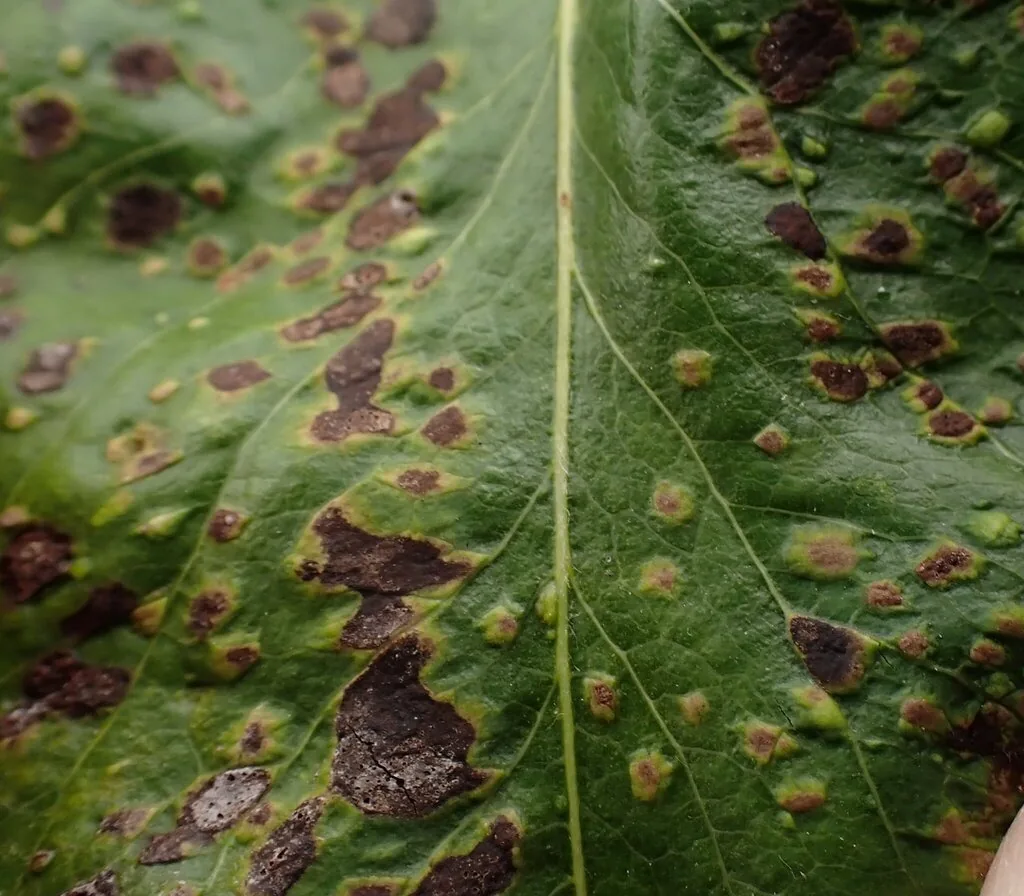
- Blisters bulge on the upper leaf surface where mites feed underneath. They start pale green, pinkish or reddish and darken to brown or black by late season. Each has a small hole in its raised center that mites use to come and go.[1][2]
Where it lives
UC IPM covers it on pear fruit trees in California, and the PNW handbook covers it on flowering pears in Pacific Northwest landscapes.[2][1]
Biology and life cycle
Mature females overwinter under bud scales, most often in terminal buds, and can feed through the winter. As buds swell in spring they move inside, so blisters are already there when leaves unfold.[1][2]
Females lay about 1 to 2 dozen eggs each inside the blisters. Egg to adult takes 10 to 30 days, faster when it's warm, and several generations develop through the season, spreading to new leaves, growing tips and fruit. Before leaf drop they return to the buds.[2][1]
Mites spread from tree to tree on the wind or carried by birds and insects.[1]
German researchers found European mountain ash ringspot-associated virus in pearleaf blister mites (under the name Phytoptus pyri) collected from diseased plants and suggested the mite may spread that virus.[3]
Damage and signs
- Leaves may drop early, and losing foliage weakens trees and cuts shoot growth and flowering.[1]
- Winter feeding can blacken, dry and drop buds. Feeding in blossoms can kill them, and fruit that does set may be misshapen with brown, scabby russet scars. Naturally russeted varieties such as Bosc and Hardy generally don't show the fruit scarring.[2]
Health risk
It feeds on pear trees, and no cited source describes any risk to people or pets.[1][2]
Control
Prevention
Spraying once blisters show doesn't help this year: the mites are already inside, and once fruit sets the damage is done. Plan any action for the following fall or winter.[1][2]
Water trees properly, since drought-stressed trees are more susceptible, avoid excess nitrogen, and keep broadleaf weeds such as mallow, bindweed, white clover and knotweed down.[1]
Traps and physical control
Hose mites and dust off small trees with a strong stream of water, and control ants, which helps natural enemies work.[1][2]
Biological control
Predatory mites almost always keep it in check if broad-spectrum insecticides are avoided, according to the PNW handbook; UC IPM adds the spider mite destroyer lady beetle and sixspotted thrips. Heavy rain and cold also cut numbers.[1][2]
Pesticides
If damage has been common, UC IPM suggests horticultural or neem oil (or azadirachtin) after harvest in late October or November, with soil moist first, drenching the shoot tips. The alternative is sulfur on buds at the delayed-dormant stage or in November. Don't use sulfur within a month before or after oil, or the tree can be injured.[2]
Where it sits in mite classification
GBIF places Eriophyidae in Trombidiformes; DNA studies have placed eriophyoid mites with sarcoptiform mites (2017) or beside Nematalycidae, in Endeostigmata (2018).[5][6][7]
Common questions
- What are the red blisters on my pear tree's leaves?
- Likely pearleaf blister mite, a microscopic mite that feeds inside the leaf.[1]
- Should I spray when I see pearleaf blisters?
- No. By then the mites are inside the leaves. UC IPM's options are oil after harvest in fall or sulfur at the delayed-dormant stage, aimed at next season.[1][2]
- Why do some of my pears have rough, scabby skin?
- Pearleaf blister mite feeding can leave brown, scabby russet scars and misshapen fruit, though naturally russeted varieties such as Bosc generally don't show it.[2]
Sources
- Pacific Northwest Pest Management Handbooks (OSU, WSU, University of Idaho), “Pear, flowering (Pyrus): Pearleaf blister mite (Insect Management Handbook).” pnwhandbooks.org/insect/hort/landscape/hosts-pests-landscape-plants/pear-flowering-pyrus-pearleaf-blister-mite (accessed 2026-11-13)
- UC Statewide IPM Program (UC IPM), “Pearleaf Blister Mite (Home and Landscape).” ipm.ucanr.edu/home-and-landscape/pearleaf-blister-mite/ (accessed 2026-11-13)
- Archives of Virology (via PubMed), “Detection of European mountain ash ringspot-associated virus-specific RNA and protein P3 in the pear leaf blister mite Phytoptus pyri (Eriophyidae). Mielke-Ehret et al. 2010 (abstract).” pubmed.ncbi.nlm.nih.gov/20401694/ (accessed 2026-11-13)
- Global Biodiversity Information Facility (GBIF), “Eriophyes pyri (H.A.Pagenstecher, 1857) (GBIF Backbone Taxonomy).” api.gbif.org/v1/species/5774728 (accessed 2026-11-13)
- Global Biodiversity Information Facility (GBIF), “Eriophyidae, family (GBIF Backbone Taxonomy species record).” api.gbif.org/v1/species/2816 (accessed 2026-11-13)
- Molecular Phylogenetics and Evolution, 2017 (via PubMed), “The phylogenetic position of eriophyoid mites (superfamily Eriophyoidea) in Acariformes inferred from the sequences of mitochondrial genomes and nuclear small subunit (18S) rRNA gene (abstract).” pubmed.ncbi.nlm.nih.gov/28119107/ (accessed 2026-11-13)
- Molecular Phylogenetics and Evolution, 2018 (via PubMed), “Comprehensive phylogeny of acariform mites (Acariformes) provides insights on the origin of the four-legged mites (Eriophyoidea), a long branch (abstract).” pubmed.ncbi.nlm.nih.gov/29074461/ (accessed 2026-11-13)