On this page
How to identify it
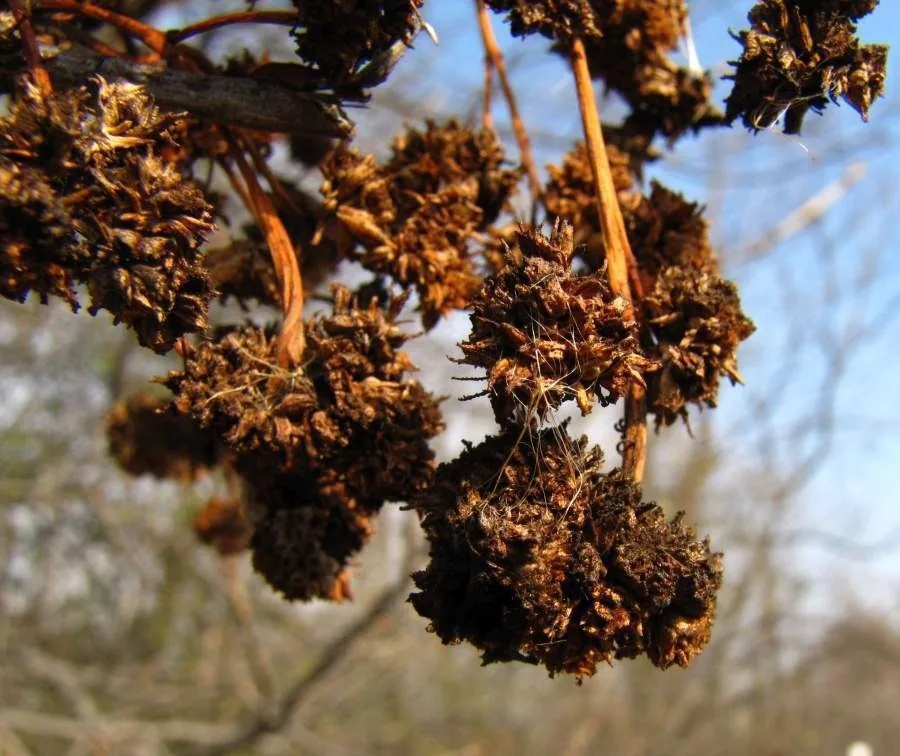
- Galls are irregular, fringed, lumpy clusters, roughly 1/4 inch to 1 inch across depending on the source, that start yellow-green and turn dark brown to black by late summer.[1][2]
- The dried galls often stay on the tree after the leaves fall, sometimes until the next spring, which is when most people notice them.[1][2]
- The mites are cigar-shaped, under 0.5 mm long, with only two pairs of legs, far too small to see without magnification.[1][2]
Look-alikes
| Look-alike | How to tell them apart |
|---|---|
| Other gall mites | Related eriophyid mites make bladder, spindle and felt-like galls on leaves; the ash flower gall mite galls only the flowers of male ash.[1] |
Where it lives
NC State says it is native to North America. It attacks all ash species, but only the flowers of male trees; ash bears male and female flowers on separate trees.[1][2]
Biology and life cycle
Adult females spend the winter on the bark, in crevices and under bud scales, then move to the developing male flower buds in spring to feed and lay eggs.[1][2]
Their feeding makes the flower tissue swell into galls around the mites, and several generations develop inside the galls through the summer.[1][2]
In the fall the last generation produces the females that will overwinter on the tree.[2][1]
Damage and signs
Health risk
NC State Extension and Agriculture and Agri-Food Canada describe tree damage only and don't mention any risk to people or pets.[1][2]
Control
Prevention
Where galls are a recurring eyesore, consider replacing heavily affected trees with female ash or another species; NC State notes that ash trees are also susceptible to the emerald ash borer.[1][2]
Traps and physical control
NC State says management usually isn't needed, since the galls are mostly cosmetic. If you want fewer galls, prune them off; see where the sources disagree on timing.[1][2]
Pesticides
NC State says that if chemical treatment is pursued, timing is critical: horticultural oil or an insecticide (it names avermectin and carbaryl) applied when the blossoms first begin to form can reduce galls, and once a gall starts growing the mites are protected inside it. Agriculture and Agri-Food Canada, a Canadian federal agency, says no insecticides are registered for control of this mite.[1][2]
Where it sits in mite classification
GBIF places Eriophyidae in Trombidiformes. DNA studies disagree: a 2017 study grouped eriophyoid mites with sarcoptiform mites and said their placement in Trombidiformes should be reviewed; a 2018 study placed them beside the soil-dwelling family Nematalycidae (Endeostigmata) in its combined analysis, though one set of nuclear genes put them within Trombidiformes.[3][4][5]
Where the sources disagree
Gall size: NC State says about 1/2 to 1 inch across; Agriculture and Agri-Food Canada gives 6 to 22 mm, roughly 1/4 to 7/8 inch.[1][2]
When to prune: NC State says late winter or early spring, before the mites become active; Agriculture and Agri-Food Canada says to prune out and destroy the newly developed galls in spring.[1][2]
Sprays: NC State describes timing oil or insecticide sprays to early blossom formation; Agriculture and Agri-Food Canada says no insecticides are registered for this mite.[1][2]
Common questions
- What are the brown clumps hanging on my ash tree in winter?
- Most likely ash flower galls, the dried remains of male flowers deformed by a microscopic mite; they can hang on until spring.[1][2]
- Will ash flower galls kill my tree?
- No. NC State says the galls don't usually affect the tree's long-term health, and Agriculture and Agri-Food Canada says they cause no permanent damage.[1][2]
Sources
- NC State Extension, “Ash Flower Gall Mite.” content.ces.ncsu.edu/ash-flower-gall-mites (accessed 2026-11-13)
- Agriculture and Agri-Food Canada, “Ash Flower Gall Mite (agroforestry diseases and pests).” agriculture.canada.ca/en/agricultural-production/crop-protection/diseases-and-pests-agroforestry/ash-flower-gall-mite (accessed 2026-11-13)
- Global Biodiversity Information Facility (GBIF), “Eriophyidae, family (GBIF Backbone Taxonomy species record).” api.gbif.org/v1/species/2816 (accessed 2026-11-13)
- Molecular Phylogenetics and Evolution, 2017 (via PubMed), “The phylogenetic position of eriophyoid mites (superfamily Eriophyoidea) in Acariformes inferred from the sequences of mitochondrial genomes and nuclear small subunit (18S) rRNA gene (abstract).” pubmed.ncbi.nlm.nih.gov/28119107/ (accessed 2026-11-13)
- Molecular Phylogenetics and Evolution, 2018 (via PubMed), “Comprehensive phylogeny of acariform mites (Acariformes) provides insights on the origin of the four-legged mites (Eriophyoidea), a long branch (abstract).” pubmed.ncbi.nlm.nih.gov/29074461/ (accessed 2026-11-13)
- Global Biodiversity Information Facility (GBIF), “Aceria fraxiniflora (Felt, 1906) (GBIF Backbone Taxonomy).” api.gbif.org/v1/species/6912571 (accessed 2026-11-13)