On this page
How to identify it
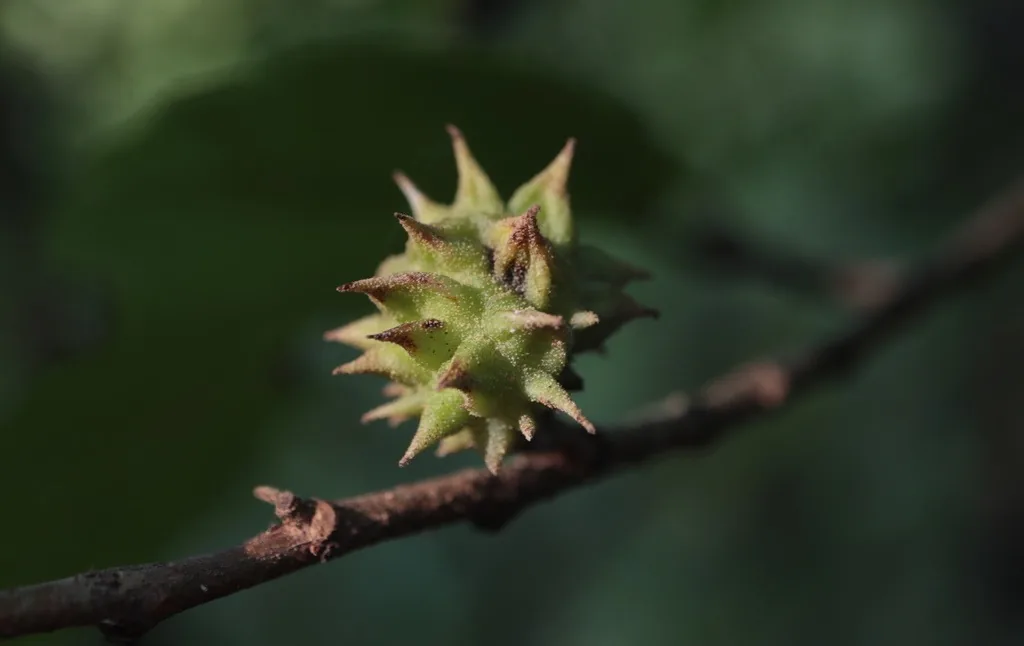
- On witchhazel, stem mothers make hollow, spiny, globular galls on the buds: flower buds per NC State, and flower or leaf buds per a 2022 taxonomic study. On birch, leaves get raised ribs on the upper surface, with furrows below where the aphids live.[1][2][3]
- On birch the aphids are covered in white, waxy, fluffy material, and NC State says the aphids in the corrugated birch galls are the stage people notice most.[2][1]
Where it lives
NC State covers it in North Carolina and Ohio State in Ohio, wherever witchhazel and birch occur. Neither source describes its full range.[1][2]
Biology and life cycle
NC State says eggs laid on witchhazel in June and July hatch the next spring, and the nymphs feed on flower buds, dying if there are none, and form a spiny gall where winged aphids develop.[1]
Winged aphids fly to birch, where later generations make the corrugated leaf galls and a scale-like generation hibernates until bud break. NC State says the full cycle takes two years.[1]
Ohio State says it spends the winter either as eggs on witchhazel bark or as immature females under birch bark.[2]
Damage and signs
- NC State says witchhazel and river birch are its only known hosts; Ohio State lists witchhazels (Hamamelis) and birches (Betula) in general, with a strong preference for river birch.[1][2]
- Infested birch leaves may turn yellow and drop early. NC State says river birch sheds most damaged leaves and grows new ones, so the trees suffer no lasting harm.[2][1]
Health risk
It feeds on plants, and no cited source describes any risk to people or pets.[1][2]
Control
Prevention
Both sources treat the damage as cosmetic. NC State says it really needs no treatment and numbers vary from year to year; Ohio State says it's usually not severe enough to treat, especially on witchhazel.[1][2]
Biological control
Ohio State says predators often destroy the aphid colonies on birch.[2]
Pesticides
If galls must be prevented, NC State suggests imidacloprid or another labeled aphid insecticide on birch at bud break, repeated every year. Ohio State reserves treatment for heavy, recurring infestations on highly visible plants or in nurseries, and names a fall soil drench of imidacloprid (e.g. Merit) or a spring soil drench of dinotefuran (e.g. Safari). Follow the label.[1][2]
Common questions
- Why are my river birch leaves crinkled and bumpy?
- Most likely spiny witchhazel gall aphids, which raise ribs on top of the leaf and live in the furrows below. The damage is cosmetic.[1][2]
- What is the spiky green thing on my witchhazel?
- A gall made by spiny witchhazel gall aphids feeding on a bud.[1][3]
- Do I need to spray my river birch?
- Usually not. NC State says the galls are cosmetic, and Ohio State says predators often destroy the aphids on birch.[1][2]
Sources
- NC State Extension, “Spiny Witchhazel Gall Aphid (PDIC Factsheet).” content.ces.ncsu.edu/spiny-witchhazel-gall-aphhid (accessed 2026-11-13)
- Ohio State University Extension (BYGL), “Corrugated River Birch Leaves (Buckeye Yard & Garden onLine, April 27, 2017).” bygl.osu.edu/node/719 (accessed 2026-11-13)
- Zootaxa (via PubMed), “Description of a new species of Hamamelistes forming galls on Fothergilla spp. (Hamamelidaceae) and the generic limits of Hormaphidini. Dederich, Halbert & von Dohlen 2022 (abstract).” pubmed.ncbi.nlm.nih.gov/36095450/ (accessed 2026-11-13)
- Global Biodiversity Information Facility (GBIF), “Hamamelistes spinosus Shimer, 1867 (GBIF Backbone Taxonomy).” api.gbif.org/v1/species/2075372 (accessed 2026-11-13)