On this page
How to identify it
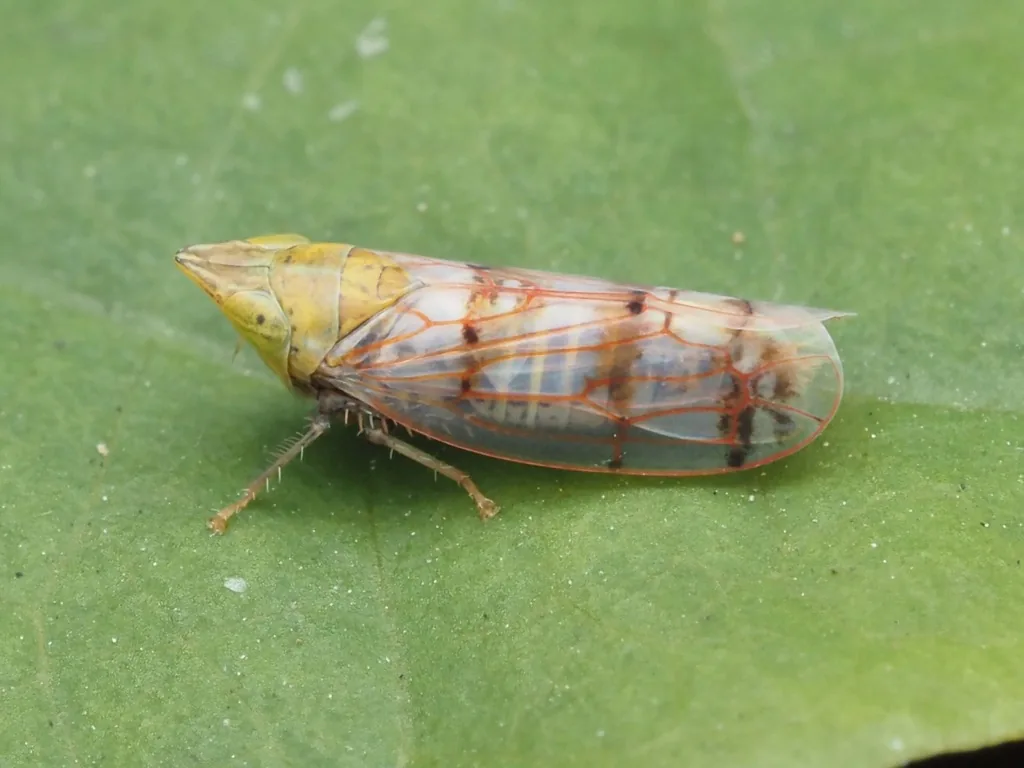
- Adult females are about 3/16 inch long and males slightly smaller, with a pointed greenish-yellow head and whitish, see-through wings crossed by three rusty to dark brown bands.[1][2]
- They are very active and jump or fly readily when disturbed; when they're abundant, their movement in a tree can sound like light rain.[1]
Where it lives
First described from the United States in 1900, it is widely believed to come from eastern Asia and probably reached North America on Japanese maple nursery stock in the late 1800s; a UK risk analysis notes some authors dispute the Asian origin because its main host in Europe is the native field maple. It is recorded from Canada and the US, China, India, Japan and Korea, has spread across much of Europe since it was found in Austria in 1961, and was first noticed in Australia in 1997 at Orange, New South Wales.[1][2][4]
Biology and life cycle
It spends the winter as eggs inserted under the bark near buds on the newest twig growth; the tips of the eggs sometimes show through the slit.[1]
Nymphs hatch in spring and feed on the undersides of leaves in the shadier parts of the tree, passing through five stages.[1]
Sources give different numbers of generations. NC State says adults are out from June through October in North Carolina, so there are probably at least two generations a year there, and that a single generation has been reported farther north; the UK risk analysis says most regions have one generation and Italy has two.[1][4]
Besides Japanese maples, NC State lists boxelder and Norway, red and silver maples; the UK risk analysis lists eleven maple species, including field maple and sycamore maple in Europe, and notes adults caught on sticky traps in sour cherry and pin oak.[1][4]
Because the eggs are hidden under the bark of young twigs, they are hard to detect and travel easily on dormant nursery stock, which the UK analysis considers its main route to new countries.[4][1]
Damage and signs
- NC State says it doesn't seem to produce any signs or symptoms on its host plants, NSW DPI says it has not been found causing significant damage in Australia, and the UK risk analysis found no impacts reported in Europe, Australia or the USA. It is not recorded as a vector of plant diseases, though related leafhoppers are, and no specific studies have been done.[1][2][4]
Health risk
It feeds on maple sap, and no cited source describes any risk to people or pets.[1][4]
Control
Prevention
No source reports damage that would call for treatment, and the UK analysis rates its impacts as very small. NC State says that should the need arise, most contact insecticides labeled for landscape use should control it, since it is unlikely to be resistant. Yellow sticky traps catch adults if you want to confirm they're there.[4][1]
Common questions
- What are the little banded insects jumping off my Japanese maple?
- Probably Japanese maple leafhoppers, which have a pointed greenish-yellow head and rust-banded wings and jump readily when disturbed.[1][2]
- Are Japanese maple leafhoppers hurting my tree?
- No damage has been reported. NC State notes they don't seem to cause any signs or symptoms on their host plants, and a UK risk analysis found no impacts anywhere in their range.[1][4]
Sources
- NC State Extension, “Japanese Maple Leafhopper.” content.ces.ncsu.edu/japanese-maple-leafhopper (accessed 2026-11-13)
- New South Wales Department of Primary Industries, “Japananus hyalinus (Osborn), Japanese maple leafhopper (leafhopper identification key).” idtools.dpi.nsw.gov.au/keys/cicadell/species/japananus.htm (accessed 2026-11-13)
- Global Biodiversity Information Facility (GBIF), “Japananus hyalinus (Osborn, 1900) (GBIF Backbone Taxonomy).” api.gbif.org/v1/species/2029899 (accessed 2026-11-13)
- UK Department for Environment, Food and Rural Affairs (Defra) Plant Health Portal, “Rapid Pest Risk Analysis (PRA) for Japananus hyalinus (Fera; Tuffen et al., September 2014).” planthealthportal.defra.gov.uk/pests-and-diseases/uk-plant-health-risk-register/downloadExternalPra.cfm?id=4075 (accessed 2026-11-13)