On this page
How to identify it
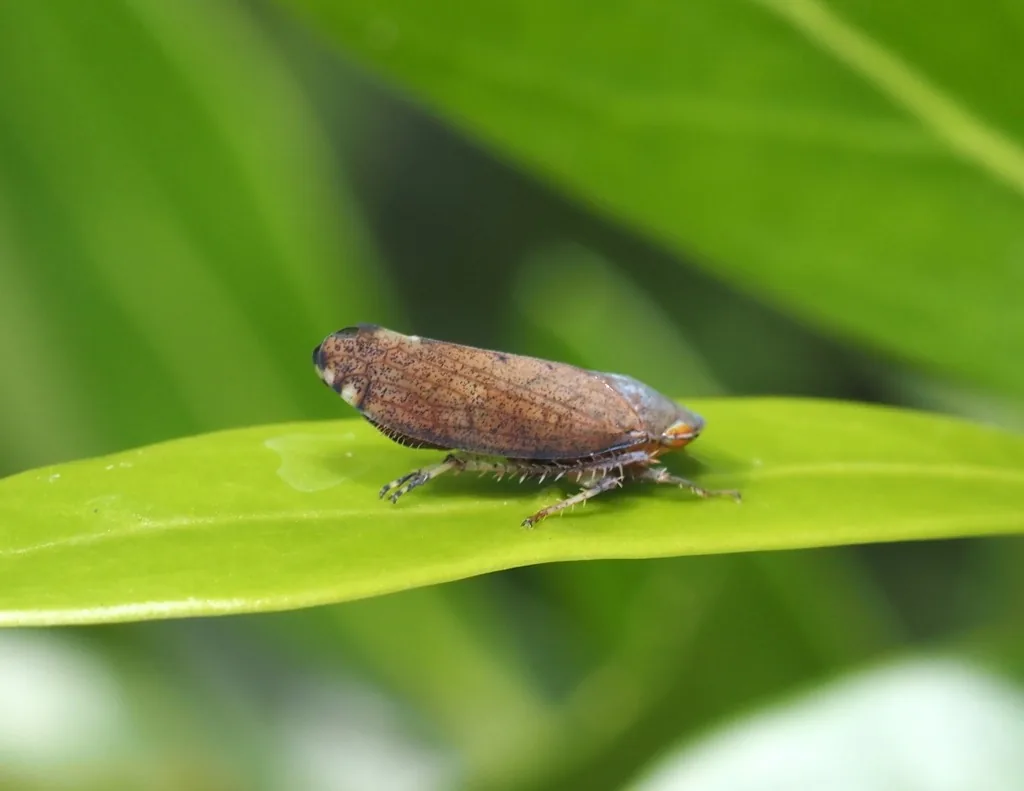
- Adults are dark brown, and their shape and color mimic the buds of their host plants.[1]
- Sizes are given two ways: the Pacific Northwest handbook says the leafhoppers of cherry orchards are slender insects about 0.125 inch or less, while British Columbia's X-disease factsheet puts the leafhopper vectors at about 3 - 5mm. Adults hop or fly away when disturbed, and nymphs and adults can run forward, backward or sideways.[2][4]
- It is less active than the mountain leafhopper and does not travel as far looking for hosts.[1]
Look-alikes
| Look-alike | How to tell them apart |
|---|---|
| Mountain leafhopper | Colladonus montanus is another X-disease carrier in cherry orchards. UC IPM describes it as more active than the cherry leafhopper and more likely to travel in search of hosts.[1][2] |
| Other orchard leafhoppers | Several leafhopper species turn up in cherry orchards, ranging in color from green to brown; the cherry leafhopper is the dark brown one shaped like a bud.[2][1] |
Where it lives
UC IPM treats it as a pest of California cherry orchards, the Pacific Northwest handbook lists it among the leafhoppers of cherries there, and British Columbia found it in its orchard surveys. GBIF holds 1,042 U.S. records since 1990 from 41 states and the District of Columbia, led by California (313), Texas (93), Oregon (79) and Washington (72). It has also been studied in apple orchards in northwestern Italy.[1][2][4][6][5]
Biology and life cycle
It spends the winter as nymphs on ornamental hosts such as privet, boxwood, myrtle, hawthorn, pyracantha, ceanothus, cotoneaster, crabapple and apple, and as eggs on ornamental hosts and deciduous fruit trees.[1]
Adults are active in three periods: mid-April through May, July, and September through October.[1]
Researchers in Italy describe it as highly polyphagous, feeding on many kinds of plants.[5]
Leafhopper numbers in cherry orchards tend to peak after harvest, which is also when the X-disease phytoplasma is most concentrated in infected trees.[2]
Oregon State explains how a leafhopper becomes a carrier: after it feeds on an infected plant, the X-disease phytoplasma multiplies inside the insect and moves from its stomach to its salivary glands, which takes three to five weeks. From then on it can pass the pathogen to a new plant with every feeding.[3]
Damage and signs
- Leafhoppers suck juices from the leaves of cherries, ornamental plants and weeds.[2]
- Its main importance is as a carrier of X-disease (cherry buckskin), and UC IPM says it can be responsible for severe outbreaks.[1]
- Trees infected with X-disease may produce small, misshapen, bitter fruit. There is no cure, and infected trees should be removed so the disease does not spread.[2]
- In laboratory trials in Italy it also carried and transmitted the phytoplasma that causes apple proliferation to apple seedlings, although the researchers judged the risk in the field to be low because so few of these leafhoppers were found in orchards.[5]
- It is one of seven leafhopper species known to carry X-disease in Washington State, and British Columbia's Ministry of Agriculture and Food found it in orchard surveys in the Okanagan, Similkameen and Creston valleys from 2021 to 2023. Oregon State lists it among several native leafhoppers that transmit the phytoplasma.[4][3]
Health risk
The sources describe it only as a plant pest and disease carrier; none mentions any risk to people or pets.[1][2]
Control
Prevention
Yellow sticky cards hung during the growing season show which leafhoppers are present and where they come from, but UC IPM says they should not be used to decide when to treat. Oregon State adds that many leafhoppers cannot be identified in the field, so it does not recommend monitoring for particular species.[1][3]
Sanitation
Control weeds and other alternative hosts in and around the orchard, such as clovers, mallow, dandelion, curly dock, bitter cherry and chokecherry.[2]
Where X-disease is a concern, UC IPM advises treating and removing ornamental leafhopper hosts in or near the orchard, and removing infected cherry trees soon after an insecticide treatment while residue is still present.[1]
Oregon State calls tree removal the best way to manage X-disease, because leafhoppers fly in from outside the orchard all year and cannot be wiped out. Remove symptomatic trees quickly, remove alternative hosts such as peach, chokecherry and bitter cherry within a 500-foot radius, remove cherry root suckers, keep the drive rows mowed and control broadleaf weeds.[3]
Traps and physical control
Because X-disease can also spread through grafted roots, Oregon State advises treating the stump of a removed tree with a labeled herbicide such as glyphosate, following the label's cut-stump instructions.[3]
Pesticides
Where X-disease is present, UC IPM recommends in-season insecticide treatments starting right after harvest and repeated at 4- to 6-week intervals, depending on how long the product lasts. For home use, the PNW handbook lists azadirachtin (neem oil), horticultural mineral oil, insecticidal soap, kaolin, pyrethrins and imidacloprid.[1][2]
For organic orchards, Oregon State says Surround (kaolin clay) and reflective ground cloth (Extenday) could prevent or reduce leafhopper feeding, and advises focusing leafhopper control on the early season and after harvest, rotating between pesticide groups. Kaolin is also on the Pacific Northwest handbook's home-use list.[3][2]
Common questions
- Why do cherry growers worry about the cherry leafhopper?
- Because it can carry the phytoplasma that causes X-disease, or cherry buckskin. Infected trees bear small, misshapen, bitter fruit, and there is no cure.[1][2]
- Where does the cherry leafhopper spend the winter?
- As nymphs on ornamental shrubs and trees such as privet, boxwood, myrtle, hawthorn, pyracantha and crabapple, and as eggs on ornamentals and deciduous fruit trees.[1]
- Can I use yellow sticky traps to time sprays?
- No. They tell you which leafhoppers are around and where they come from, but UC IPM says not to base treatment decisions on them.[1]
- How do I know if my cherry tree has X-disease?
- Look at the fruit as it ripens: Oregon State says infected trees bear small, pointed or pale fruit, or fruit with dull, blotchy skin and a bitter or tasteless flavor, mixed in among normal fruit. The Pacific Northwest handbook adds that there is no cure and infected trees should be removed.[3][2]
Sources
- University of California Statewide IPM Program, “Cherry Leafhopper, UC IPM Pest Management Guidelines: Cherry.” ipm.ucanr.edu/agriculture/cherry/cherry-leafhopper (accessed 2026-11-12)
- Pacific Northwest Pest Management Handbooks (Oregon State University, Washington State University and University of Idaho Extension), “Cherry-Leafhopper, Pacific Northwest Insect Management Handbook.” pnwhandbooks.org/insect/tree-fruit/cherry/cherry-leafhopper (accessed 2026-11-12)
- Oregon State University Extension Service, “Getting Ahead of X-Disease (EM 9362).” extension.oregonstate.edu/sites/default/files/catalog/auto/EM9362.pdf (accessed 2026-11-12)
- Government of British Columbia, Ministry of Agriculture and Food, “X-Disease (Western X) of Stone Fruits (factsheet).” www2.gov.bc.ca/assets/gov/farming-natural-resources-and-industry/agriculture-and-seafood/animal-and-crops/plant-health/disease-factsheets/tree-fruits/x_disease_western_x.pdf (accessed 2026-11-12)
- American Phytopathological Society (Plant Disease), “Tedeschi R, Alma A. Fieberiella florii (Homoptera: Auchenorrhyncha) as a vector of 'Candidatus Phytoplasma mali'. Plant Disease 90(3):284-290 (2006) (abstract).” doi.org/10.1094/PD-90-0284 (accessed 2026-11-12)
- Global Biodiversity Information Facility (GBIF), “Fieberiella florii: U.S. occurrence records since 1990 by state (GBIF occurrence search).” api.gbif.org/v1/occurrence/search?taxonKey=2043586&country=US&hasGeospatialIssue=false&occurrenceStatus=PRESENT&year=1990%2C2026&facet=stateProvince&facetLimit=400&limit=0 (accessed 2026-11-12)
- iNaturalist, “Fieberiella florii taxon page (order and family).” www.inaturalist.org/taxa/126622 (accessed 2026-11-09)