On this page
How to identify it
- Adults are small, about 0.14 to 0.16 inch long, active and whitish-green.[4]
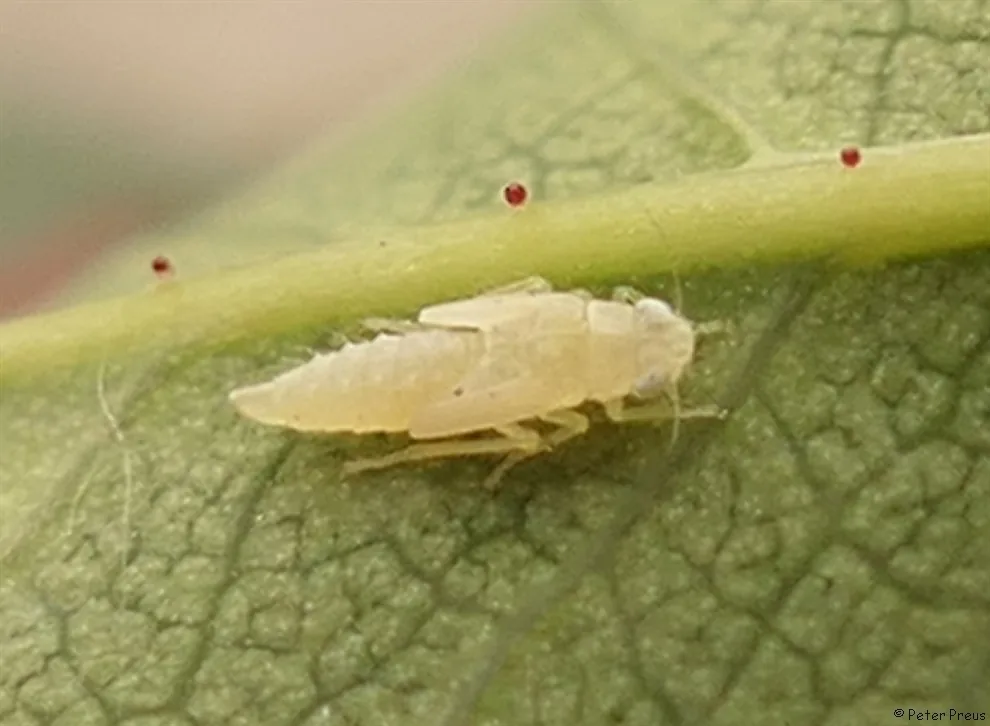
- Young nymphs are white with red eyes; the red is gone by the fourth instar. UMass says a nymph can pass through its 4 instars on a single leaf if it isn't crowded.[1][4]
- Nymphs carry small black spots on the thorax and wing pads, which separate them from the similar white apple leafhopper.[2]
- Adults look so much like the white apple leafhopper that they can't be told apart in the field; Penn State says not unless dissected.[1][2]
- How they move is described differently: the Pacific Northwest handbook says rose leafhoppers run forward, backward or sideways when disturbed, while UMass says the nymphs move only forward, not sideways. White cast skins on leaf undersides are another sign.[4][1]
Look-alikes
| Look-alike | How to tell them apart |
|---|---|
| White apple leafhopper | Nearly identical as adults and causes the same leaf injury on apple; rose leafhopper nymphs have the black spots.[1][2] |
| Spider mites | Spider mite stippling looks similar, but leafhopper spots are larger and more widely spaced.[4][6] |
Where it lives
A non-native leafhopper from Europe, now a pest of rose-family plants throughout the United States and southern Canada. Extension and state sources from the Pacific Northwest, Connecticut and Pennsylvania all describe it.[1][4][5][2]
Biology and life cycle
In fall, before frost, females insert eggs into wild or cultivated rose, blackberry and raspberry canes, and the eggs overwinter there. Egg sites show as dark, raised or purplish spots; UMass reports up to 577 eggs per inch observed on infested plants.[1][4][5]
Eggs hatch in spring, and the first generation develops on rose. First-generation adults move to apple and other trees by about early June; Penn State says nymphs appear on apple in early July and adults again in early August.[1][2]
Summer generations lay eggs in the undersides of leaves of apple, cherry, dogwood, elm, hawthorn, maple, oak and poplar. A study in South Wales found that nymphs show little preference among species, but egg-laying adults switch host plants completely between generations.[1][4][5][7]
The number of generations differs by place: Penn State gives three a year, the Pacific Northwest handbook three in eastern Washington, UMass at least three possible, while the Welsh study found two.[2][4][1][7]
Damage and signs
- Feeding leaves pale or yellow stippling on leaves, and badly injured leaves, on apple especially, may drop early.[1][4][6]
- Fall egg-laying wounds the canes. UMass says feeding on roses can let in stem-canker fungi that kill canes and that roses are sometimes killed; the Pacific Northwest handbook and the Connecticut station also note that egg wounds give fungi (and, the Connecticut station adds, bacteria) a way in.[1][4][5]
- Others rate the injury lower: the Pacific Northwest handbook calls the damage mainly aesthetic, and Mississippi State says leafhoppers on roses are usually minor pests that seldom cause serious injury.[4][6]
- On apple fruit, leafhopper excrement and honeydew leave small dark specks; moderate drought favors outbreaks.[2]
Health risk
A plant feeder; none of the sources describes any risk to people or pets.[1][2][4]
Control
Prevention
In fall and late winter, check rose canes for egg spots; in spring look for nymphs and cast skins under the leaves. The Pacific Northwest handbook advises tolerating cosmetic damage unless the infestation looks worse than usual.[1][4]
Sanitation
Removing wild roses, the fall egg-laying sites, near apple trees may reduce local numbers.[1][2]
Traps and physical control
If rose canes carry many egg spots, prune out and destroy them before eggs hatch in spring, where that won't disfigure the plant.[1]
Biological control
An egg-parasitoid wasp, Anagrus armatus, has at times cut numbers enough that no treatment was needed. Lacewings, damsel bugs, assassin bugs and spiders also eat leafhoppers, so avoid broad-spectrum insecticides that kill them.[1][4]
Pesticides
Penn State notes that insecticides used for aphids also control leafhoppers, timed for young nymphs. UMass advises spraying after bloom, and at times when pollinators are less active, to protect them.[2][1]
Common questions
- What are the tiny pale hoppers under my rose leaves?
- In spring, often rose leafhopper nymphs: white with red eyes when young, feeding on the leaf undersides.[1][4]
- Why are my rose leaves speckled white?
- Pale stippling with cast skins under the leaves is typical of leafhoppers. Spider mite stippling is finer and more crowded.[4][6]
- Can rose leafhoppers kill roses?
- UMass says they occasionally do, through heavy feeding and the canker fungi that can follow, but the Pacific Northwest handbook and Mississippi State describe the damage on roses as mostly cosmetic or minor.[1][4][6]
Sources
- UMass Extension Landscape, Nursery and Urban Forestry Program (Landscape Insect & Mite Guide), “Edwardsiana rosae (Rose Leafhopper).” www.umass.edu/agriculture-food-environment/landscape/publications-resources/insect-mite-guide/edwardsiana-rosae-l (accessed 2026-11-11)
- Penn State Extension, “Tree Fruit Insect Pest - Rose Leafhopper (updated Oct. 12, 2026).” extension.psu.edu/tree-fruit-insect-pest-rose-leafhopper (accessed 2026-11-11)
- iNaturalist, “Edwardsiana rosae taxon page (order and family).” www.inaturalist.org/taxa/127622 (accessed 2026-11-11)
- Pacific Northwest Pest Management Handbooks (Oregon State, Washington State and University of Idaho Extension), “Rose (Rosa)-Rose leafhopper, Pacific Northwest Insect Management Handbook.” pnwhandbooks.org/insect/hort/landscape/hosts-pests-landscape-plants/rose-rosa-rose-leafhopper (accessed 2026-11-11)
- Connecticut Agricultural Experiment Station, “Leafhopper Pests of Connecticut Nurseries and Landscapes (H. Smith).” portal.ct.gov/-/media/caes/documents/publications/fact_sheets/entomology/leafhopperpestsofconnecticutnurseriesandlandscapespdf.pdf (accessed 2026-11-11)
- Mississippi State University Extension Service, “Insect Pests of Roses (Publication 2472).” extension.msstate.edu/sites/default/files/publications/P2472_web.pdf (accessed 2026-11-11)
- Oecologia, via PubMed, “Claridge MF, Wilson MR (1978), Seasonal changes and alternation of food plant preference in some mesophyll-feeding leafhoppers, Oecologia 37(2):247-255.” pubmed.ncbi.nlm.nih.gov/28309654/ (accessed 2026-11-11). Cited from the PubMed abstract.