On this page
How to identify it
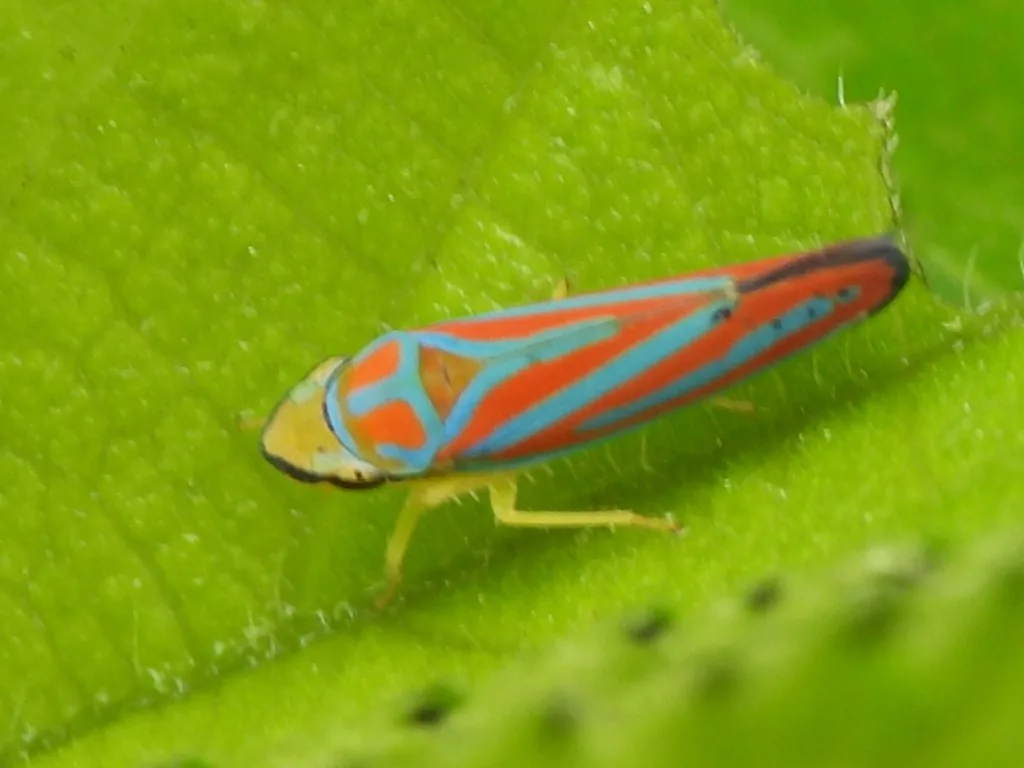
- It is about 1/4 to 5/16 inch long, with bright red and blue or green stripes on the wings and thorax and a yellow head, legs and underside.[2][1]
- It jumps or flies off quickly when approached, so its damage is often noticed first.[1][2]
- Nymphs are wingless, creamy white and about 8 mm long when fully grown; their cast skins may stick to the undersides of leaves where they fed.[1][2]
- Like other leafhoppers it has rows of small spines on the hind shins. Females of several leafhoppers carry a white patch or line of waxy granules on the wings, used in egg laying, which is not part of the body color.[3]
Look-alikes
| Look-alike | How to tell them apart |
|---|---|
| Leafhoppers | One of many leafhoppers; a close relative, G. fennahi, feeds only on rhododendron.[1] |
Where it lives
It frequents woodlands, meadows and landscapes. NC State describes it in North Carolina, UMass in Massachusetts and Pennsylvania, MDC includes it among Missouri's leafhoppers, and it has been collected in Oklahoma vineyards. GBIF holds about 17,000 U.S. records since 1990, the most from Illinois and Massachusetts.[2][1][3][4][5]
Biology and life cycle
Adults emerge in spring and, after feeding and mating, lay eggs. NC State says eggs go into leaf veins, shoots and stems; UMass says into the leaf tissue (mesophyll), where they may show through the swollen tissue under magnification.[2][1]
NC State says eggs hatch about 10 days later and adults appear about a month after that, sometimes sooner in hot weather.[2]
UMass reports two generations a year, with redbanded leafhoppers found in Pennsylvania in late April and again in mid-July, and adults present from mid-June through October or until the first killing frost; NC State says there is probably more than one generation a year in North Carolina.[1][2]
UMass suggests monitoring from July through the first killing frost.[1]
It feeds on sap and expels the excess as tiny droplets.[2][3]
Damage and signs
- Egg laying causes oval swellings under leaves that may leave 4 mm scars or holes, and nymph feeding distorts new rhododendron growth. UMass describes the injury as mostly aesthetic.[1]
- Hosts include rhododendron, azalea, mountain laurel, rose, privet, crapemyrtle, Scotch broom and fruit bushes, and UMass says at least 50 other plants have been reported as hosts.[1][2]
- Extension sources differ on its disease role: NC State says it can transmit Pierce's disease (leaf scorch) to grape, oak, elm, sycamore and other trees and shrubs, while UMass says it may be capable of transmitting the bacterium, Xylella fastidiosa.[2][1]
Health risk
None of the sources describe any bite, sting or other risk to people or pets.[1][2][3]
Control
Prevention
Keep plants vigorous to reduce the impact of feeding; because the insect is small and quick to escape, other cultural and mechanical options are limited.[1]
Keep them out
Fine netting can protect small plantings or nursery plants during active periods.[1]
Pesticides
Plants may be reinfested soon after short-residual sprays such as insecticidal soap, neem or oils, but any product labeled for home landscape leafhoppers should work. NC State suggests a pyrethroid for its longer residual, noting that pyrethroids are very toxic to fish.[2]
UMass lists systemic options applied as soil drenches or injections, and advises spraying after bloom to protect pollinators.[1]
Does it spread leaf scorch?
In a 1997 study of leafhoppers from an American elm nursery with bacterial leaf scorch, this species and the related versute sharpshooter regularly tested positive for Xylella fastidiosa, so the authors called both potential vectors.[6]
In Oklahoma vineyards and tree nurseries, it was among the leafhoppers collected for transmission tests, but the study reports transmission to plants only for the versute sharpshooter.[4]
In North Carolina vineyards, the main carriers of Pierce's disease identified were other species, including the versute sharpshooter.[7]
Common questions
- What is the red and blue striped bug on my rhododendron?
- Most likely a redbanded (candy-striped) leafhopper, a 1/4 to 5/16 inch sharpshooter with a yellow head and legs.[1][2]
- Is the candy-striped leafhopper harmful?
- Mostly to the look of plants: egg laying scars leaves and nymph feeding distorts new growth. It has tested positive for leaf scorch bacteria, and NC State says it can transmit them.[1][2][6]
- Should I spray candy-striped leafhoppers?
- Often not; the injury is mainly cosmetic. If needed, netting protects small plants, and NC State says any insecticide labeled for landscape leafhoppers should work, although quick-fading sprays allow reinfestation.[1][2]
Sources
- UMass Extension Landscape, Nursery and Urban Forestry Program (Landscape Insect & Mite Guide), “Graphocephala coccinea (Redbanded Leafhopper / Sharpshooter).” www.umass.edu/agriculture-food-environment/landscape/publications-resources/insect-mite-guide/graphocephala-coccinea (accessed 2026-11-11)
- NC State Extension, “Redbanded Leafhopper on Ornamental Plants (PDIC Factsheet).” content.ces.ncsu.edu/the-red-banded-leafhopper-on-ornamental-plants (accessed 2026-11-11)
- Missouri Department of Conservation, “Leafhoppers (Field Guide).” mdc.mo.gov/discover-nature/field-guide/leafhoppers (accessed 2026-11-11)
- Journal of Economic Entomology, via PubMed, “Seasonal abundance and natural inoculativity of insect vectors of Xylella fastidiosa in Oklahoma tree nurseries and vineyards (Overall et al. 2015).” pubmed.ncbi.nlm.nih.gov/26331482/ (accessed 2026-11-11)
- Global Biodiversity Information Facility (GBIF), “Graphocephala coccinea: U.S. occurrence records since 1990 by state (GBIF occurrence search).” api.gbif.org/v1/occurrence/search?taxonKey=9693162&country=US&hasGeospatialIssue=false&occurrenceStatus=PRESENT&year=1990%2C2026&facet=stateProvince&facetLimit=400&limit=0 (accessed 2026-11-11)
- Letters in Applied Microbiology, via PubMed, “Detection of Xylella fastidiosa in potential insect vectors by immunomagnetic separation and nested polymerase chain reaction (Pooler et al. 1997).” pubmed.ncbi.nlm.nih.gov/9281861/ (accessed 2026-11-11)
- Phytopathology, via PubMed, “Pierce's disease of grapevines: identification of the primary vectors in North Carolina (Myers et al. 2007).” pubmed.ncbi.nlm.nih.gov/18943514/ (accessed 2026-11-11)
- iNaturalist, “Graphocephala coccinea taxon page (order and family).” www.inaturalist.org/taxa/56925 (accessed 2026-10-06)