On this page
How to identify it
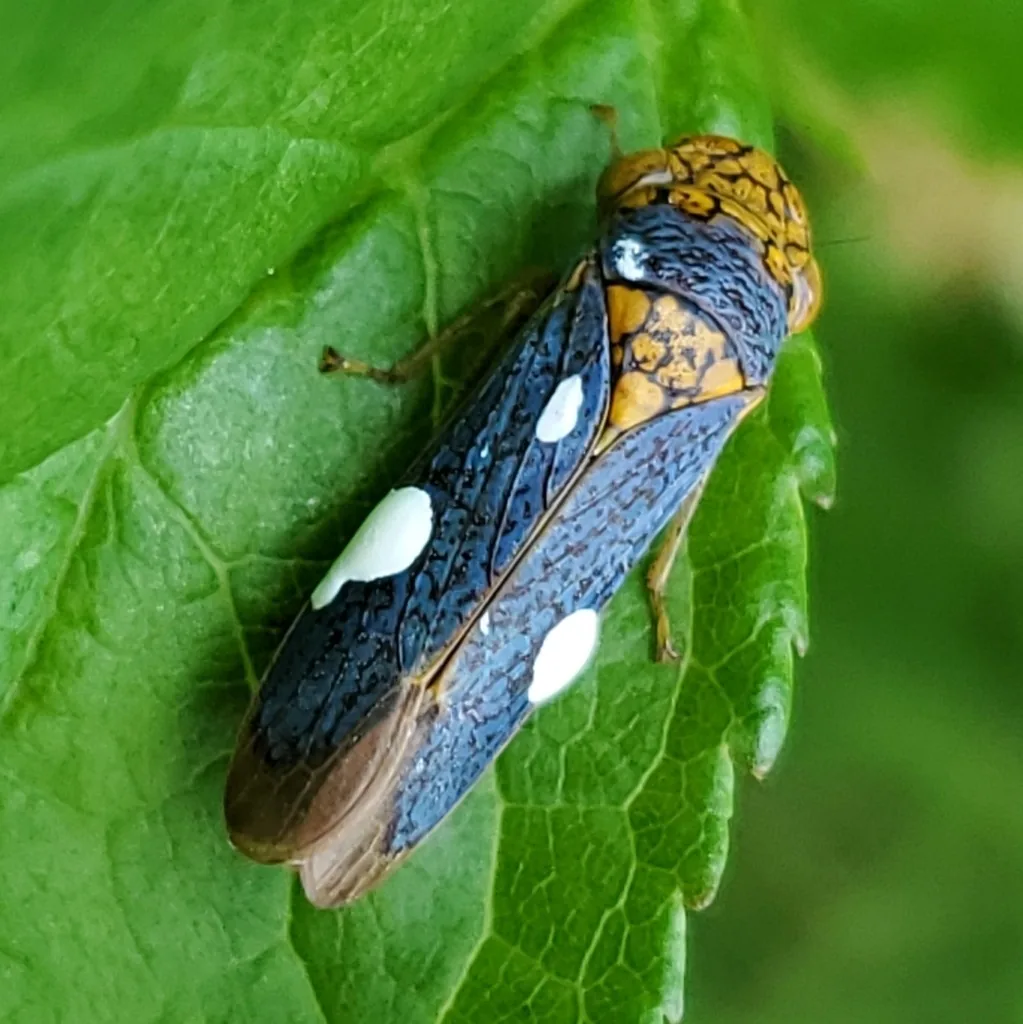
- Adults are about 1/2 inch (12 mm) long, with an orange head, eyes, legs and abdomen; the forewings and the plate behind the head (pronotum) are speckled light blue and black.[1]
- Oklahoma State suggests the common name comes from its wide head.[1]
- Females sometimes carry white patches, called brochosomes, on the sides of the forewings; they smear the proteins in them onto their eggs to keep the eggs from drying out.[1][2]
- A study at the Illinois Natural History Survey found that nymphs, males and young females coat their bodies with tiny round brochosome particles, while females with developing eggs switch to making rod-shaped ones, 3.5 to 11.0 micrometers long, which they use to powder the spots where they lay eggs.[6]
Look-alikes
| Look-alike | How to tell them apart |
|---|---|
| Versute sharpshooter | The versute sharpshooter is much smaller, about 3/16 inch, with green forewings that end in black, tooth-like marks and a light blue stripe running along each wing to the head.[1] |
| Candy-striped leafhopper | The candy-striped (red-banded) leafhopper is about 3/8 inch, with alternating red and blue stripes on its wings and thorax and a yellow head.[1] |
| Oncometopia nigricans | A 2016 revision of the Oncometopia orbona species group (9 species) found that O. nigricans looks much like the broad-headed sharpshooter from the outside but differs strongly in both male and female genitalia; rare in-between forms are known from northern Florida and southern Georgia.[7] |
Where it lives
It is widespread in the eastern United States, from Texas and Missouri through the Southeast and north to Maryland and Pennsylvania, and it ranges south through Mexico into Central and South America. It is not known to occur in California, where inspectors intercepted it four times in shipments from eastern states.[1][2]
Biology and life cycle
It feeds on a very wide range of plants: CDFA cites records from 47 species in 25 families of grasses, shrubs and trees, and it also feeds on conifers, sedges and many broad-leaved plants.[2]
In Oklahoma it prefers sunflower, hollyhock, okra, lambsquarters, ash, oak, silktree, peach and crapemyrtle.[1]
Like other sharpshooters, it feeds on xylem, the water-conducting tissue where Xylella fastidiosa lives.[1]
Oklahoma State expects it to be active in vineyards from late May through late August, peaking in late July, with apparently one generation a year there; CDFA cites two to three generations a year.[1][2]
Adults fly, and CDFA rates both its reproduction and its ability to spread as high.[2]
Damage and signs
- Feeding draws fluid from the plant and causes mechanical injury that helps plant pathogens spread.[2]
- Its main importance is as a vector of Xylella fastidiosa, which causes Pierce's disease of grapes; once a vine is infected there is no cure, and it eventually dies.[2][1]
- In Oklahoma vineyards it turns up less often than the versute sharpshooter, but Oklahoma State counts all of the state's vineyard sharpshooters as potential carriers.[1]
- In a 2004-2005 North Carolina study, 27% of trapped broad-headed sharpshooters tested positive for Xylella fastidiosa, and transmission tests showed the species can infect grapevines. The authors expect it to matter in winegrowing regions across the Southeast, since it is documented throughout the southern states.[4]
- Xylella fastidiosa also causes diseases of peach, plum, elm, oak and pecan. In an Oklahoma survey of vineyards and tree nurseries, the broad-headed sharpshooter was one of the three insect vectors caught most often, along with the versute sharpshooter and the spittlebug Clastoptera xanthocephala.[5]
Health risk
It feeds on plant sap; Oklahoma State and CDFA mention no risk to people.[1][2]
Control
Prevention
Insects aren't the only route: Oklahoma State notes that Pierce's disease can arrive on shared cuttings and spread between vines on pruning shears.[1]
Sanitation
Manage weeds in and around the vineyard. Sharpshooters feed on many plants that can harbor Xylella fastidiosa, and Oklahoma State calls weed management an important way to reduce disease spread.[1]
Traps and physical control
Monitor with yellow sticky cards about 3 by 5 inches, sticky on both sides, clipped to the upper vine support wire around the edge and along diagonals through the vineyard; 12 to 16 cards cover most vineyards of 2 acres or less. Check them at least twice a week, replace them every two weeks, and identify catches with a 15X hand lens.[1]
Pesticides
For vineyards, Oklahoma State pairs a contact pyrethroid (IRAC group 3A) for quick knockdown with a systemic neonicotinoid (group 4A) for longer protection. Use pyrethroids sparingly because they also kill lady beetles, lacewings and parasitic wasps, and don't apply neonicotinoids preventively, since pest pressure varies from year to year.[1]
Where sources disagree
Generations: Oklahoma State reports apparently one generation a year in Oklahoma; CDFA cites two to three a year.[1][2]
How often vectors carry the bacterium: in the North Carolina study, 27% of trapped broad-headed sharpshooters tested positive; in the Oklahoma survey, 2.4% of all screened vector insects (all species together) tested positive. The two studies measured different groups, so the numbers are not directly comparable.[4][5]
Common questions
- Can broad-headed sharpshooters spread Pierce's disease to my grapes?
- They can carry Xylella fastidiosa, the bacterium behind Pierce's disease. In Oklahoma vineyards, though, the versute sharpshooter is more common and is the species Oklahoma State says to focus monitoring on.[2][1]
- What are the white spots on the wings of some sharpshooters?
- On females, white patches on the sides of the forewings are brochosomes, protein-rich material the female smears onto her eggs to keep them from drying out.[1][2]
- Is the broad-headed sharpshooter found in California?
- It isn't known to occur there. California gives it an A pest rating, has intercepted it in shipments from eastern states, and expects it could establish widely if introduced.[2]
- Has it been shown to spread Pierce's disease in the Southeast?
- Yes. A North Carolina study reported the first evidence that the broad-headed sharpshooter and the versute sharpshooter can transmit Xylella fastidiosa to grapevines in the Southeast, and the bacterial strains from trapped insects were genetically similar to the Pierce's disease strain known from California.[4]
Sources
- Oklahoma State University, Oklahoma Cooperative Extension Service, “Insect Vectors of Pierce's Disease in Oklahoma Vineyards, EPP-7091 (E. J. Rebek and L. M. Overall).” pods.okstate.edu/fact-sheets/EPP-7091pod.pdf (accessed 2026-11-12)
- California Department of Food and Agriculture, “California Pest Rating Profile: Oncometopia orbona (Fabricius), broad-headed sharpshooter (Pest Rating A).” blogs.cdfa.ca.gov/Section3162/wp-content/uploads/2024/10/Oncometopia-orbona-broad-headed-sharpshooter.pdf (accessed 2026-11-12)
- iNaturalist, “Oncometopia orbona taxon page (order and family).” www.inaturalist.org/taxa/133102 (accessed 2026-11-12)
- Phytopathology 2007;97(11):1440-50, via PubMed, “Pierce's Disease of Grapevines: Identification of the Primary Vectors in North Carolina.” pubmed.ncbi.nlm.nih.gov/18943514/ (accessed 2026-11-12). Cited from the PubMed abstract.
- Journal of Economic Entomology 2015;108(6):2536-45, via PubMed, “Seasonal Abundance and Natural Inoculativity of Insect Vectors of Xylella fastidiosa in Oklahoma Tree Nurseries and Vineyards.” pubmed.ncbi.nlm.nih.gov/26331482/ (accessed 2026-11-12). Cited from the PubMed abstract.
- Tissue and Cell 2000;32(1):28-39, via PubMed, “Secretion of brochosomes during the ontogenesis of a leafhopper, Oncometopia orbona (F.).” pubmed.ncbi.nlm.nih.gov/10798315/ (accessed 2026-11-12). Cited from the PubMed abstract.
- Zootaxa 2016;4168(1):109-133, via PubMed, “The Oncometopia orbona species group (Hemiptera, Cicadellidae, Proconiini).” pubmed.ncbi.nlm.nih.gov/27701350/ (accessed 2026-11-12). Cited from the PubMed abstract.