On this page
How to identify it
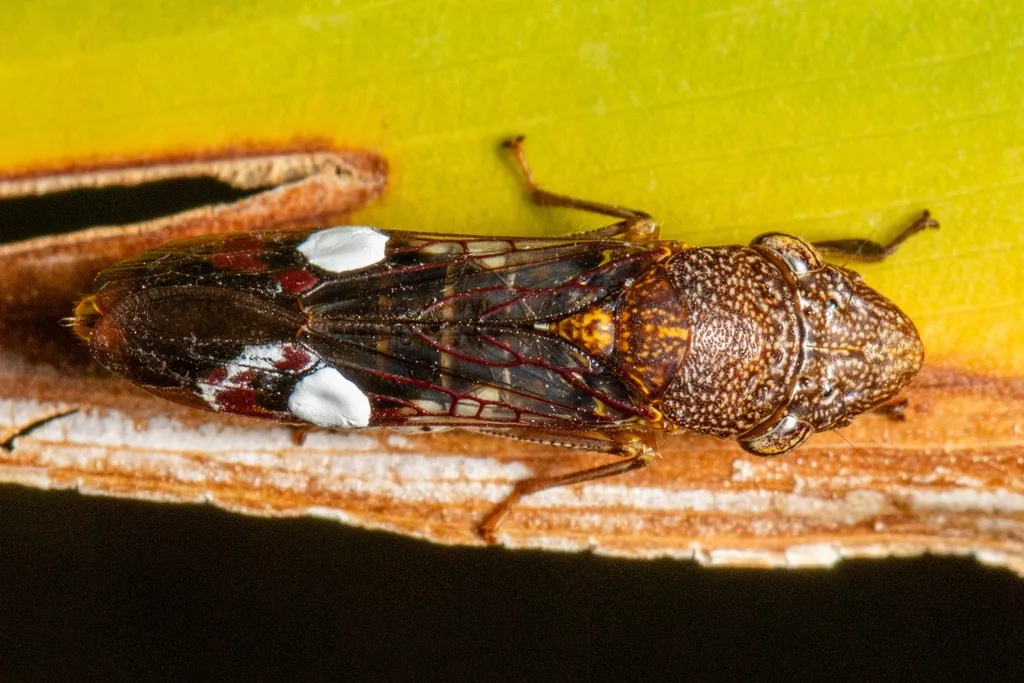
- Adults are large leafhoppers about 1/2 inch long, dark brown to black from above and from the side, with a whitish or yellow abdomen. The wings are clear with red veins but look dark brown over the body. UF/IFAS gives about 12 mm, with large smoky-brown wings marked with red, ivory and black markings under the abdomen, and a yellow-orange face and legs.[1][2][3]
- The head is brown to black and covered with many ivory to yellowish spots; CDFA describes small yellow dots on the head and thorax.[1][2]
- Shortly before laying eggs, females carry chalky white spots on their wings, which they use to cover the egg mass. Males never have these spots. UF/IFAS explains that the white material is brochosomes, tiny water-repellent particles made in the insect's excretory tubules; after mating, females switch to rod-shaped brochosomes to coat their egg masses.[1][3]
- Nymphs look like small adults in profile but are wingless, a uniform olive gray, with prominent bulging eyes. UF/IFAS describes nymphs as wingless and gray, shaped like the adults.[1][3]
- Eggs are laid side by side under the skin of the lower leaf surface. Eggs killed by parasitic wasps show pinpoint holes at one end.[1]
Look-alikes
| Look-alike | How to tell them apart |
|---|---|
| Smoke-tree sharpshooter | This close relative, native to the desert region of Southern California, has wavy light-colored lines on its head instead of spots.[1] |
| Blue-green sharpshooter | UF/IFAS says the glassy-winged sharpshooter is a very good flier, able to spread plant diseases farther than other vector leafhoppers such as the blue-green sharpshooter.[3] |
Where it lives
Native to the southeastern United States and northeastern Mexico. In California, UC IPM says it is established throughout most of southern California and in parts of the San Joaquin Valley, abundant in much of Kern County and locally in parts of Tulare and Fresno Counties; infestations in several northern counties were eradicated. California's quarantine manual lists Alabama, Arkansas, Florida, Louisiana, Mississippi, Nevada, North Carolina, South Carolina and Texas as infested states, and notes it also occurs in Mexico. UF/IFAS cites a 1959 description of it as a strictly southern species, abundant from the latitude of Augusta, Georgia, to Leesburg, Florida, west to Val Verde and Edwards counties in Texas, and says it is now also present to some extent in south Florida.[2][4][1][5][3]
Biology and life cycle
There are typically two generations a year in Southern California and the San Joaquin Valley. Adults overwinter on citrus and other evergreen plants and begin laying eggs in February, with most egg-laying in late March and April. In its native range, UF/IFAS says, populations peak in summer and begin to decline in late August; as winter approaches, adults move into forest areas and partly hibernate until spring, and mating takes place in spring and summer.[1][2][3]
Nymphs hatch in 10 to 14 days and pass through five stages on young, succulent stems. First-generation adults appear from May through July, and they lay the second generation's eggs from June to October; those nymphs become the adults that overwinter.[2]
It feeds on xylem sap, which is poor in nutrients, so it drinks large amounts and excretes a lot of liquid. CDFA counts more than 360 plant genera as hosts, and UC IPM lists acacia, avocado, eucalyptus, citrus, crape myrtle, heavenly bamboo, grape, photinia and pittosporum among the common ones. UF/IFAS says it feeds mostly on last year's growth and actively growing tips, drinks 100 to 300 times its dry body weight in xylem fluid per day, and times feeding to the plant's peak nutrient content; a filter chamber in its gut recycles the fluid, leaving excreta that is 99.9% water, inorganic ions and ammonia. Preferred hosts include crape myrtle, citrus and holly, and females may favor holly, sunflower and citrus for egg laying.[2][1][3]
It lives in farm crops, urban landscapes, native woodlands and streamside vegetation.[1][2]
Damage and signs
- Heavy populations excrete so much liquid that leaves and fruit look whitewashed when it dries, and the residue lands on cars and other surfaces under infested trees. UC IPM calls this a cosmetic nuisance rather than real damage.[1][2]
- When it feeds on an infected plant it picks up X. fastidiosa, which multiplies in its mouthparts and is passed to the next plant it feeds on. Adults stay infective for life; nymphs lose the bacteria when they molt. UF/IFAS says the bacterium attaches to surfaces inside the insect's mouthparts. In Florida natural infectivity of the sharpshooter is very low, but in one study UF/IFAS cites, 83% of oleander plants each exposed to a single infective sharpshooter became infected under ideal conditions.[1][2][3]
- Pierce's disease scorches grape leaves and can kill whole vines in one to five years. In August 1999 at Temecula, in Riverside County, over 300 acres of vines infested with the sharpshooter were infected and ultimately destroyed.[2]
- Other strains of the bacterium cause almond, mulberry and cherry plum leaf scorch and sweet gum dieback in California, and elsewhere phony peach disease, plum leaf scald and leaf scorch of sycamore, elm, maple and oak. None of these diseases can be cured. UF/IFAS names it one of the main vectors of the bacterium, including for phony peach disease of peach and Pierce's disease of grape.[2][3]
Health risk
It feeds only on plant xylem sap; none of these sources reports a risk to people or pets.[1][2]
Control
Prevention
California regulates host plant shipments. In enforcing counties, host nursery stock shipped from infested areas must travel under a blue tag and be held for inspection at its destination, and nursery stock from infested states enters California under a quarantine warning hold notice. Don't carry host plants out of infested areas yourself.[5][6][1]
For growers, UF/IFAS lists removing other host plants such as weeds and fruit trees from the area, and notes that wine grapes are susceptible to Pierce's disease while muscadine grapes are resistant and may someday provide resistant rootstocks.[3]
Biological control
Tiny wasps that develop inside sharpshooter eggs were introduced and are now established wherever the sharpshooter lives in California. They parasitize 10 to 50% of eggs early in the year and can kill upwards of 90% by late summer or early fall, so avoid broad-spectrum insecticides that kill them and other predators. UF/IFAS names the introduced egg parasite Gonatocerus triguttatus, a tiny wasp from Texas and northern Mexico, and notes research on Hirsutella, a fungus known to infect sharpshooters in the southeastern United States.[1][3]
Pesticides
UC IPM says insecticides are typically not recommended around homes in most of California, because natural enemies keep numbers low. To deal with white residue, insecticidal soaps or oils kill only the soft nymphs, need thorough coverage and must be repeated every 7 to 10 days.[1]
When to call a professional
If you find one in California where it isn't known to be established, call the CDFA pest hotline at 1-800-491-1899 or your county agricultural commissioner's office.[1]
Where it could spread
A weather-driven model by Gutierrez and colleagues predicted that the sharpshooter would stay largely restricted to warm southern California, with egg parasitoids cutting its abundance by more than 90%, but that warming of 2 to 3°C would increase it in the Central Valley.[4]
Rossi and Rasplus found climate around the Mediterranean basin suitable for it and projected suitable areas shifting north in both North America and Europe in coming decades.[7]
Where sources disagree
Arrival in California: UC IPM and CDFA say it most likely arrived in the late 1980s as egg masses on plant foliage, and CDFA says it was first reported in the state in 1994; Gutierrez and colleagues date its range extension into California to 1989.[1][2][4]
Egg mass size: UC IPM gives 8 to 12 eggs per mass, CDFA about 10 to 12. UF/IFAS gives groups of 3 to 28 eggs.[1][2][3]
Host range: UF/IFAS cites a 1959 count of more than 100 plant species; CDFA now counts more than 360 plant genera.[3][2]
Name change and research notes
Its scientific name changed from Homalodisca coagulata to H. vitripennis in 2006, after taxonomists traced missing collections and type specimens; older publications use the old name.[3]
UF/IFAS cites a 2001 study in which foliar-applied acetamiprid and soil-applied imidacloprid and thiamethoxam blocked transmission of oleander leaf scorch, and says conventional insecticides have removed the sharpshooter from vineyards and orchards, though effective management remains somewhat elusive.[3]
Common questions
- Why are my car and patio covered with white spots under a tree?
- Large sharpshooter populations excrete liquid that dries white on leaves, fruit and cars. It is a cosmetic nuisance more than plant damage.[1][2]
- Where do I look for them?
- Check about 6 inches to a foot back from the tips of new shoots. Their brown color blends with the twigs, and they hide by moving to the far side of the twig when disturbed.[1]
- Is it a pest in Florida and the Southeast?
- Usually not a serious one, UF/IFAS says. It is native there, and natural infectivity with Xylella fastidiosa in Florida is very low; it became a serious threat after being introduced to southern California.[3]
Sources
- University of California Statewide IPM Program, “Pest Notes: Glassy-winged Sharpshooter (Publication 7492).” ipm.ucanr.edu/PMG/PESTNOTES/pn7492.html (accessed 2026-11-14)
- California Department of Food and Agriculture, Pierce's Disease Control Program, “Glassy-winged Sharpshooter and Pierce's Disease in California: Background and History (January 2018).” www.cdfa.ca.gov/PDCP/Documents/Background.pdf (accessed 2026-11-14)
- University of Florida/IFAS Extension (Featured Creatures), “Glassy-Winged Sharpshooter, Homalodisca vitripennis (=coagulata) (Germar), EENY-274/IN552.” ask.ifas.ufl.edu/publication/IN552 (accessed 2026-11-14)
- Environmental Entomology, via PubMed, “Geographic distribution and relative abundance of the invasive glassy-winged sharpshooter: effects of temperature and egg parasitoids (Gutierrez et al. 2011).” pubmed.ncbi.nlm.nih.gov/22251675/ (accessed 2026-11-14)
- California Department of Food and Agriculture, Plant Health and Pest Prevention Services, “County Restrictions on Glassy-winged Sharpshooter (Plant Quarantine Manual, section 510).” pi.cdfa.ca.gov/pqm/manual/htm/510.htm (accessed 2026-11-14)
- California Department of Food and Agriculture, “Pierce's Disease Control Program.” www.cdfa.ca.gov/pdcp/ (accessed 2026-11-14)
- Science of the Total Environment, via PubMed, “Climate change and the potential distribution of the glassy-winged sharpshooter (Homalodisca vitripennis), an insect vector of Xylella fastidiosa (Rossi and Rasplus 2023).” pubmed.ncbi.nlm.nih.gov/36423847/ (accessed 2026-11-14)
- iNaturalist, “Homalodisca vitripennis taxon page (order and family).” www.inaturalist.org/taxa/199381 (accessed 2026-11-14)