On this page
How to identify it
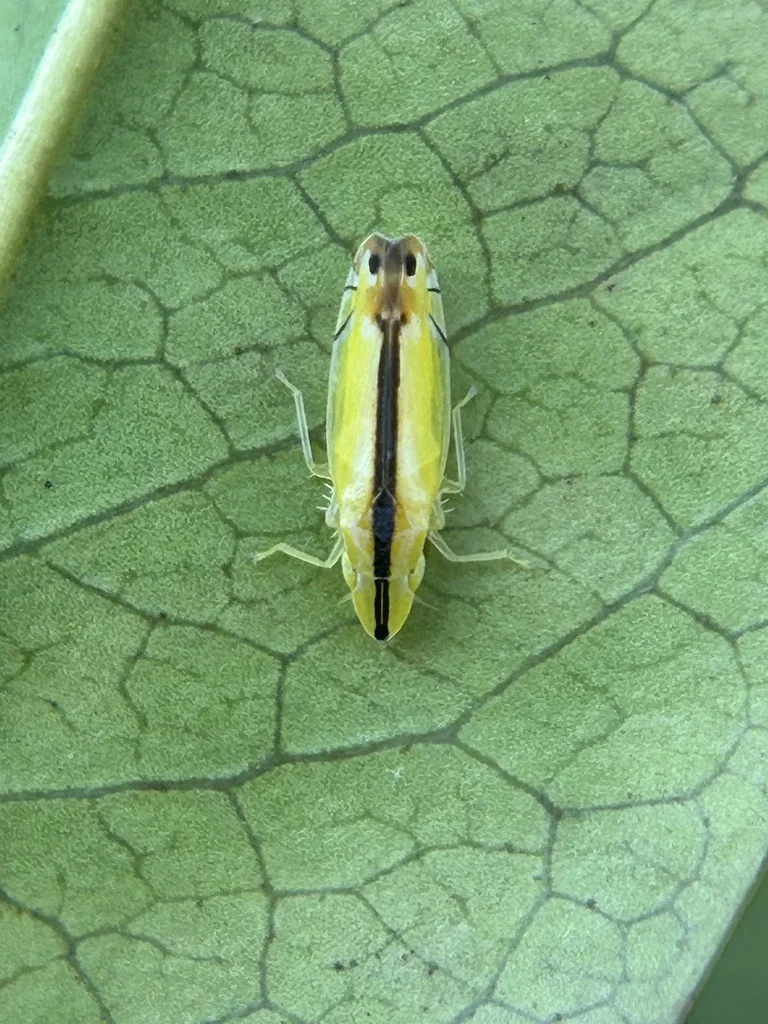
- Adults are about 3/16 inch (4.2 to 5.5 mm) long and yellow, with a dark stripe down the middle of the body (CTAHR says it has red markings) and two dark spots at the rear end.[1][3]
- Its true eyes are the same yellow as its body; the Bishop Museum points out that the eyespots are on its hind end, not its head.[3][4]
- Nymphs are smaller, wingless and translucent yellow, with two dark spots at the rear; the skins they shed keep the spots and stay on the leaves for some time.[1]
Where it lives
CTAHR says it was described from southern China, which it calls the most probable native home, and was first found on Oahu in 1987; the Bishop Museum lists it on all main Hawaiian islands except Niihau and Kahoolawe. TISI says it reached California in 1996 in cut-flower shipments from Hawaii, has been seen in Texas since 2013, and has established in southern California and most of the Southeastern United States.[1][2][4][3]
Biology and life cycle
Eggs are laid in plant tissue and are very difficult to detect.[1]
In University of Hawaii rearing work, adults became reproductively mature 10 to 14 days after emerging and each female laid one or two eggs a day; eggs took about four weeks to hatch, and the nymphs, which go through four stages, took seven to eight weeks to reach adulthood.[2][1]
TISI says its exact life history is unknown but several generations occur through the year, and in Hawaii's winter one generation can take up to three months.[3]
A University of Hawaii biocontrol project counted more than 300 host species in 83 families: 68 percent economically important crops, 22 percent endemic Hawaiian plants (including 14 rare and endangered species) and 10 percent weeds. CTAHR's tea guide names avocado, guava, chili peppers, sweetpotato, ti, octopus plant, uluhe fern and mamaki among them.[2][1]
Damage and signs
- CTAHR says that in some plants its saliva causes leaf yellowing, brown or black patches on the leaves, leaf distortion and stunting; TISI describes yellowing between the leaf veins that can lead to total chlorosis.[1][3]
- In a USDA-ARS study, injured plants of the native Hawaiian Hibiscus arnottianus showed a 40 percent drop in photosynthesis and a 42 percent drop in transpiration, while tea (Camellia sinensis), one of its hosts in Asia, showed no drop.[5]
- The Bishop Museum says much of the dead uluhe fern seen along roadsides is the result of its feeding.[4]
- On tea in Hawaii, CTAHR says nymphs and adults are often found on the plants but their importance to the crop is not yet known.[1]
Health risk
It feeds on plant sap. CTAHR, the Bishop Museum, TISI and USDA-ARS describe plant damage only and don't mention any risk to people or pets.[1][4][3][5]
Control
Prevention
CTAHR says the eggs, laid inside plant tissue, are very difficult to detect, and that the spotted cast skins left on leaves are useful for telling whether the leafhopper is present.[1]
Biological control
In Hawaii, tiny wasps in the family Mymaridae parasitize its eggs: two adventive species and an endemic Polynema were trapped on Kauai and the Big Island, and their numbers rose with the leafhopper's through the season. TISI says egg parasitism was more successful at lower elevations.[6][3]
Where the sources disagree
Name: CTAHR and the USGS record use Sophonia rufofascia; TISI and the USDA-ARS study use Sophonia orientalis, the name GBIF accepts.[1][6][3][5][7]
Host count: CTAHR gives more than 300 species; TISI gives more than 235 plants.[2][1][3]
Development time: CTAHR's rearing work gives about four weeks for the egg and seven to eight weeks for the nymphs; TISI describes a three- to four-month development cycle in Hawaii.[2][3]
Common questions
- Why does the two-spotted leafhopper look like it's walking backward?
- Its true eyes are the same yellow as its body and two dark spots sit at the tail end; the Bishop Museum notes those eyespots are on its hind end, not its head.[3][4]
- Is the two-spotted leafhopper killing uluhe ferns?
- The Bishop Museum says much of the dead uluhe seen along roadsides is the result of its feeding, and CTAHR lists uluhe fern among its hosts.[4][1]
Sources
- University of Hawaii College of Tropical Agriculture and Human Resources, “Guide to Insect and Mite Pests of Tea (Camellia sinensis) in Hawai'i, IP-28 (R. T. Hamasaki, R. Shimabuku and S. T. Nakamoto, January 2008), twospotted leafhopper entry.” www3.ctahr.hawaii.edu/oc/freepubs/pdf/ip-28.pdf (accessed 2026-11-13)
- University of Hawaii College of Tropical Agriculture and Human Resources, “Biological Control of the Two-spotted Leafhopper (T-STAR project report, July 1998 to March 1999; J. Duan and R. Messing).” www.ctahr.hawaii.edu/t-star/leafhopper.htm (accessed 2026-11-13)
- Texas Invasive Species Institute, “Two-spotted leafhopper, Sophonia orientalis.” tsusinvasives.org/home/database/sophonia-orientalis (accessed 2026-11-13)
- Bishop Museum, Hawaii Biological Survey, “Good Guys & Bad Guys, card 98: Two-Spotted Leafhopper.” hbs.bishopmuseum.org/good-bad/sophonia.html (accessed 2026-11-13)
- USDA Agricultural Research Service, “Short-term physiological response of a native Hawaiian plant, Hibiscus arnottianus, to injury by the exotic leafhopper, Sophonia orientalis (A. Avanesyan, K. Snook, P. A. Follett and W. Lamp; Environmental Entomology 48(2):363-369, 2019; abstract on the USDA-ARS publication record).” www.ars.usda.gov/research/publications/publication/?seqNo115=354948 (accessed 2026-11-13)
- U.S. Geological Survey Publications Warehouse, “Distribution and abundance of mymarid parasitoids (Hymenoptera: Mymaridae) of Sophonia rufofascia in Hawaii (Biological Control, 2002; P. Yang, D. Foote, A. Alyokhin, L. Lenz and R. Messing).” pubs.usgs.gov/publication/70024769 (accessed 2026-11-13)
- Global Biodiversity Information Facility (GBIF), “Sophonia orientalis (Matsumura, 1912) (GBIF Backbone Taxonomy).” api.gbif.org/v1/species/2028238 (accessed 2026-11-13). GBIF lists Sophonia rufofascia (Kuoh & Kuoh), the name used by UH CTAHR and the USGS record, as a synonym of Sophonia orientalis.
- iNaturalist, “Sophonia orientalis taxon page (order and family).” www.inaturalist.org/taxa/448241 (accessed 2026-10-06)