On this page
How to identify it
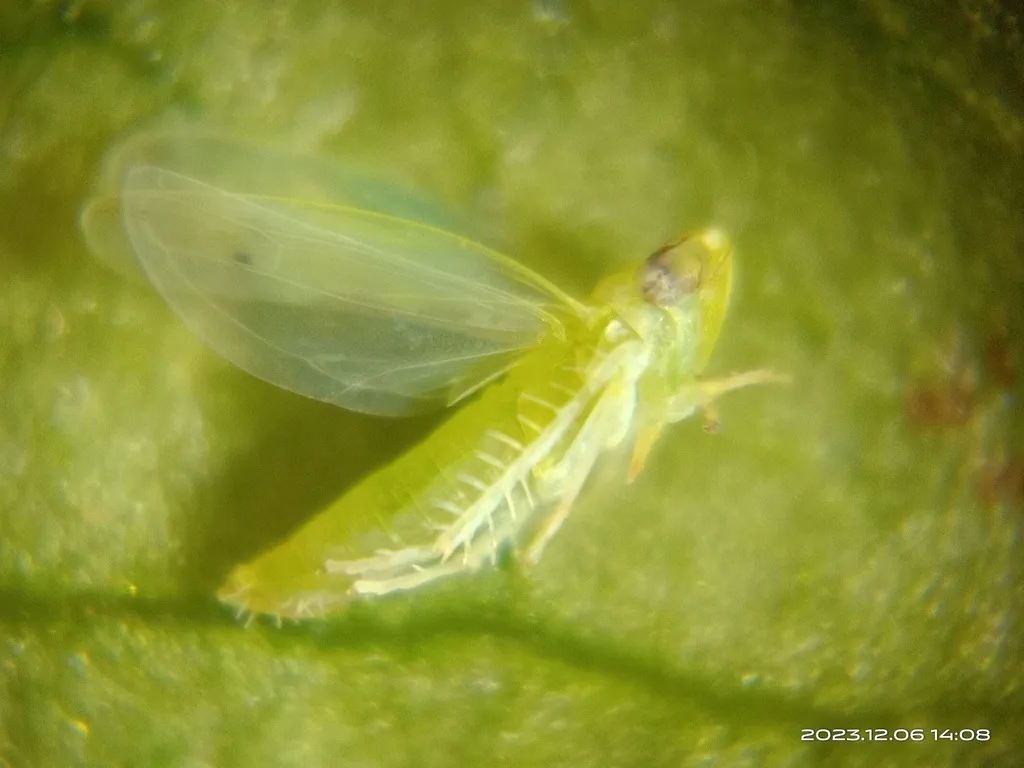
- Adults are small, pale green leafhoppers. Penn State and Texas A&M put them at 2 to 3 mm, about the size of a potato leafhopper, while the Texas Department of Agriculture's quarantine order says 3 to 4 mm.[1][3][6]
- Look for a dark spot near the tip of each forewing, and often two on the head. The spots can be faint or missing, especially on newly emerged adults and on nymphs, so Texas A&M says a sure ID needs dissection of a male or a DNA test.[1][3][12]
- Nymphs are pale green, wedge-shaped and wingless. They stay on leaf undersides, move quickly and tend to walk sideways.[1][3]
Look-alikes
| Look-alike | How to tell them apart |
|---|---|
| Potato leafhopper | About the same size and color. Check for the dark wing spots, and keep in mind that Clemson scouts have found plenty of leafhoppers without spots that turned out not to be the invader. Have suspects confirmed by Extension.[1][2] |
Where it lives
Its native range runs from Iran to Japan and Indonesia, and it became a serious cotton pest in West Africa in 2022 and 2023. Penn State counted 101 infested counties in Florida, Georgia, South Carolina and Alabama by August 2025, with more finds in Texas, Louisiana, Mississippi, North Carolina and Tennessee. By April 2026 the University of Georgia put it in more than 100 counties across seven southeastern states.[3][1][4]
Biology and life cycle
The sources give slightly different arrival dates. Penn State says the first mainland find was in December 2024 on cotton in Miami-Dade County, Florida; the Texas Department of Agriculture says November 2024 on okra in the same county; California's agriculture department says Florida's survey traps first caught it in late fall 2024. The first Western Hemisphere record was in Puerto Rico in 2023.[1][7][9]
Penn State and Texas A&M say up to 11 generations a year are possible, and Penn State gives 15 to 46 days from egg to adult, depending on temperature and humidity. The Texas quarantine order gives a higher figure, up to 20 to 30 generations in warm climates, with a 7- to 14-day life cycle in Texas summers.[1][3][6]
Females insert eggs into leaf veins and midribs. Reported counts per female vary: 20 to 25 (Penn State), 15 to 21 (Georgia), 14 to 60 (Texas A&M). Texas A&M says adults can live up to five weeks; Penn State says two to three weeks.[1][4][3]
It feeds on plants in the mallow, bean, aster and nightshade families. Penn State lists cotton, okra, eggplant, cucumber, watermelon, potato, sunflower, grape and tropical hibiscus among the hosts it can complete development on. Tennessee State counts at least 27 plant species, and Georgia singles out rose of Sharon and tropical hibiscus as especially susceptible.[3][1][5][4]
Storms carry adults long distances, and shipments of ornamentals and vegetable transplants spread it too. Texas A&M says infested hibiscus appear to have been shipped from South Florida for sale across much of the southern US.[1][3]
Damage and signs
- Leaves yellow along the margins first, then brown and die in patches; they may curl and distort, and plants lose vigor.[1][4]
- The damage, called hopperburn, usually starts at field edges, and Texas A&M warns it can be mistaken at first for Verticillium wilt or potassium deficiency. Tennessee State notes symptoms can keep developing after the insects are killed, because of toxins in their saliva.[3][5]
- It isn't confirmed to carry any plant disease; the harm comes from feeding itself.[3][4][9]
Health risk
It is a plant-feeding insect. None of the Extension or agency sources cited here mentions any risk to people or pets.[1][4][9]
Control
Prevention
Buy plants from reputable nurseries, check new plants (including leaf undersides) before bringing them home, and keep them apart from other host plants for a while. Georgia suggests 7 to 10 days; Tennessee State says at least a week.[1][4][5]
Yellow sticky cards help detect adults, and checking leaf undersides turns up eggs, nymphs and adults.[1]
Biological control
Green lacewings and minute pirate bugs may help suppress it, and Georgia adds lady beetles and predatory plant bugs as generalist predators.[1][4]
Pesticides
If insecticides are used, Tennessee State advises rotating products from different IRAC groups with each application to slow resistance.[5]
When to call a professional
Report suspected finds so the ID can be confirmed: contact your county Extension office, or in Pennsylvania the state Department of Agriculture at badbug@pa.gov. Texas asks anyone who bought hibiscus or other cotton-family plants to inspect them and call 1-800-TELL-TDA if they suspect an infestation.[1][2][7]
Spread and quarantines
The USDA Agricultural Research Service made the first DNA-verified US record from a cotton field in Macon County, Alabama, in August 2025. The sample matched Asian specimens at better than 99%.[12]
In August 2025 Texas found it on hibiscus in retail stores in cities from McAllen to El Paso. Texas A&M also reported a probable, not yet confirmed, find in cotton in Fort Bend County.[7][3]
Texas put an emergency quarantine in place on October 3, 2025, and replaced it with a new one on February 5, 2026 that stays until rescinded. It covers Cameron, Grimes, Fort Bend and Wharton counties and bars host plants from ten infested states unless they are certified and treated.[6][8]
California has no known infestation, but its agriculture department rates the insect highly likely to establish there, and a sample was intercepted on hibiscus from Alabama in October 2025. An emergency quarantine on mallow-family plants such as hibiscus, cotton, okra and hollyhock from infested areas took effect March 12, 2026 and runs to September 9, 2026.[9][10][11]
In August 2026 Clemson found it again in South Carolina, on okra and as a single adult in a zucchini field in Charleston, close to the date of the state's first detections in 2025.[2]
Common questions
- What damage does the two-spotted cotton leafhopper cause?
- Yellowing along leaf margins, then browning and dead patches, curled and distorted leaves, and weaker plants.[1]
- How do I tell it from other small green leafhoppers?
- Look for a dark spot on each forewing tip, which may be faint or missing, and have the ID confirmed by Extension. Many green leafhoppers without spots are other species.[1][3][2]
- Is the two-spotted cotton leafhopper in California?
- Not according to the California Department of Food and Agriculture, which says it isn't known in the state and has an emergency quarantine on host plants from infested areas.[9][11]
- I bought a hibiscus recently. What should I check?
- Look at the leaves, especially the undersides, for small green leafhoppers and for yellowed or curled margins. Keep the plant away from other hosts for a week or more and report suspects to Extension or your state agriculture department.[7][4][5][1]
Sources
- Penn State Extension, “Invasive Insect: Two-Spotted Cotton Leafhopper.” extension.psu.edu/invasive-insect-two-spotted-cotton-leafhopper (accessed 2026-11-13)
- Clemson Cooperative Extension, Home & Garden Information Center, “South Carolina Field Update (August 10, 2026): Two-Spotted Cotton Leafhopper Found.” hgic.clemson.edu/south-carolina-field-update-august-10-2026-two-spotted-cotton-leafhopper-found/ (accessed 2026-11-13)
- Texas A&M AgriLife Extension Service, “Update on Cotton Jassid: A New Pest of Concern in Texas Cotton.” agrilifeextension.tamu.edu/update-on-cotton-jassid/ (accessed 2026-11-13)
- University of Georgia, Department of Entomology, “Biology and Management of Invasive Two-Spot Cotton Leafhopper in Ornamentals (Attia and Joseph, 2026).” site.caes.uga.edu/entomologyresearch/2026/04/biology-and-management-of-invasive-two-spot-cotton-leafhopper-in-ornamentals/ (accessed 2026-11-13)
- Tennessee State University Cooperative Extension, “Two-Spot Cotton Leafhopper (Cotton Jassid) (ANR-ENT-01-2026).” tnstate.edu/agriculture/nrc/documents/Two%20spotted%20cotton%20leafhopper%20Factsheet.pdf (accessed 2026-11-13)
- Texas Department of Agriculture, “Cotton Jassid Emergency Quarantine (February 2026).” texasagriculture.gov/Portals/0/images/ACP/Cotton/Emergency%20Quarantine%20Cotton%20Jassid.pdf (accessed 2026-11-13)
- Texas Department of Agriculture, “Commissioner Miller activates emergency response to protect Texas cotton and ornamental industries from new invasive pest.” texasagriculture.gov/News-Events/Article/10528/COMMISSIONER-MILLER-ACTIVATES-EMERGENCY-RESPONSE-TO-PROTECT-TEXAS-COTTON-AND-OR (accessed 2026-11-13)
- Texas Department of Agriculture, “Commissioner Miller takes emergency action to protect Texas agriculture from invasive leafhopper pest.” texasagriculture.gov/News-Events/Article/10789/Commissioner-Miller-Takes-Emergency-Action-to-Protect-Texas-Agriculture-from-In (accessed 2026-11-13)
- California Department of Food and Agriculture, “Cotton Jassid Pest Information (pest profile).” www.cdfa.ca.gov/plant/PDEP/target_pest_disease_profiles/cotton_jassid_profile.html (accessed 2026-11-13)
- California Department of Food and Agriculture, “Section 3290, Cotton Jassid (Two-Spotted Leafhopper) Exterior Quarantine (emergency regulation text).” www.cdfa.ca.gov/plant/docs/2026/3290_text.pdf (accessed 2026-11-13)
- California Department of Food and Agriculture, “Notice of approval of emergency regulatory action, Section 3290 (Office of Administrative Law, 2026).” www.cdfa.ca.gov/plant/docs/2026/3290_aoe_2026313.pdf (accessed 2026-11-13)
- USDA Agricultural Research Service, “First molecular verification of the two-spot cotton leafhopper Amrasca biguttula in the United States (Zhao and Balkcom, 2026).” www.ars.usda.gov/research/publications/publication/?seqNo115=429059 (accessed 2026-11-13)
- Global Biodiversity Information Facility (GBIF), “Amrasca biguttula (Ishida, 1913) (GBIF Backbone Taxonomy).” api.gbif.org/v1/species/2042790 (accessed 2026-11-13)