On this page
How to identify it
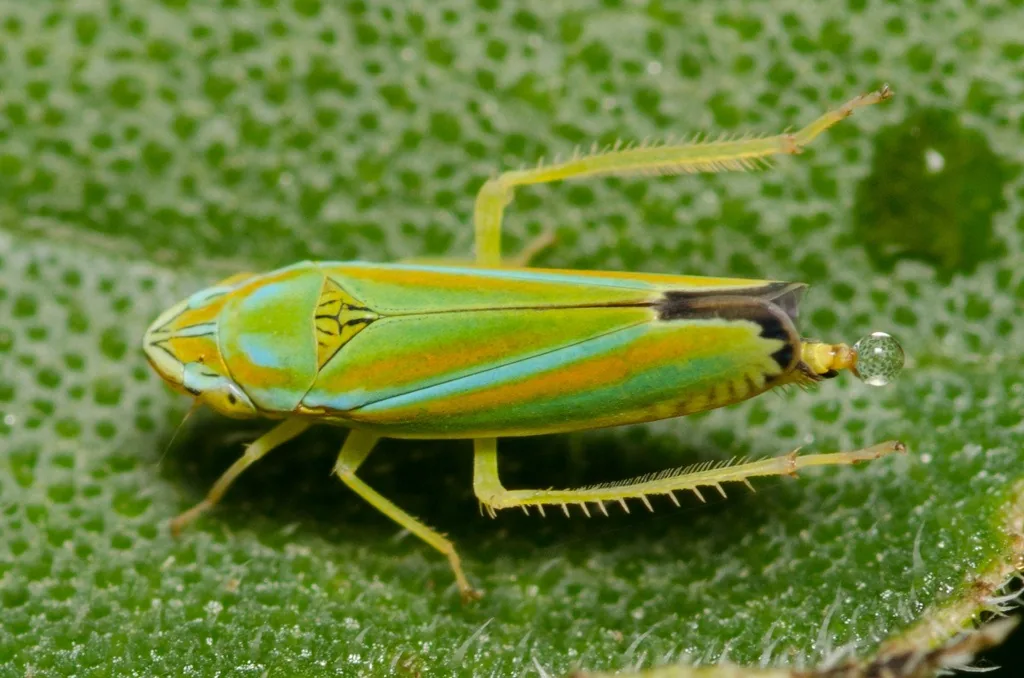
- Adults are about 3/16 inch (5 mm) long, with green forewings marked by several black, tooth-like spots at the wing tips.[1]
- A light blue stripe runs diagonally along each forewing and continues to the front of the head; in some individuals it is edged with orange on both sides.[1]
- The top of the head is light brown to orange, with a light blue stripe down the middle.[1]
- Its small size means a hand lens of at least 15X helps when sorting insects on sticky cards.[1]
Look-alikes
| Look-alike | How to tell them apart |
|---|---|
| Redbanded leafhopper | The redbanded (candy-striped) leafhopper is larger, about 3/8 inch, with alternating red and blue stripes, a yellow head with a black stripe, and bright yellow legs and abdomen.[1] |
| Broad-headed sharpshooter | The broad-headed sharpshooter is about 1/2 inch long, with an orange head, eyes, legs and abdomen and light blue and black speckles on the wings and pronotum.[1] |
Where it lives
Oklahoma State describes it as common in the southern United States, from Texas north to Illinois, and the North Carolina study notes it has been documented throughout the southern states. Records reach farther northeast than that: it was trapped in oak canopies in central New Jersey, and GBIF holds about 14,000 U.S. records since 1990, most of them from Virginia, North Carolina and Maryland. It is the most prevalent sharpshooter in Oklahoma vineyards and one of the three species that dominated catches of xylem feeders in central Texas vineyards.[1][2][3][4][5]
Biology and life cycle
Adults spend the winter in woody habitats and move onto herbaceous perennial plants in March.[1]
Females lay eggs on the undersides of leaves of ragweed, sunflower, okra and other plants.[1]
It feeds on blackberry, grape, honeysuckle, privet, cherry and other deciduous trees, sucking fluid from the water-conducting tissue (xylem) where the Pierce's disease bacterium lives.[1]
In Oklahoma vineyards it is active from early June through late August, with a clear peak from late June through mid-July.[1]
Insects able to transmit the bacterium do not show up until mid to late June.[1]
There appears to be one generation a year in Oklahoma.[1]
Season varies by region. In central Texas, catches were highest between May or June and August, and on New Jersey oaks it peaked in mid-July.[6][3]
In central Texas it was always more likely to be caught on vegetation next to vineyards than inside them.[6]
Damage and signs
- The harm is disease, not feeding. Pierce's disease of grapes has no cure, and infected vines eventually die; Oklahoma State says it has been detected in Oklahoma vineyards since 2009.[1]
- In research trials, versute sharpshooters collected in and near Oklahoma vineyards transmitted the bacterium to susceptible plants.[1]
- In North Carolina vineyards in 2004 and 2005, 28% of trapped versute sharpshooters carried Xylella fastidiosa, and transmission tests showed it can pass the bacterium to grapevines. This was the first report of it transmitting the bacterium to grapes in the Southeast.[2]
- In central Texas, it was one of the three species that dominated sticky-trap catches of xylem feeders in vineyards, and the share of insects carrying the bacterium rose over the growing season.[5][6]
- The same bacterium causes bacterial leaf scorch in pin and red oaks. In a New Jersey survey of insects in the canopies of those oaks, the versute sharpshooter made up 6.2% of the catch; six leafhopper species tested positive for the bacterium, though the study abstract does not name them.[3]
Health risk
It feeds on plant fluids. Oklahoma State and the North Carolina, Texas and New Jersey studies treat it only as a carrier of plant disease; none of them mentions bites or any effect on people or pets.[1][2][6][3]
Control
Prevention
Oklahoma State tells growers to focus monitoring on this species, because it is the most common sharpshooter in the state's vineyards and has been shown to transmit the bacterium. Watch for it from early June through late August.[1]
Vectors are not the only route: cuttings shared between growers can bring infected vines into a new vineyard, and once the disease is present, pruning shears can carry it from vine to vine.[1]
Watch the vineyard edges as well as the vines: in Texas it was caught more often in vegetation next to vineyards than inside them.[6]
Sanitation
Because sharpshooters feed on many plants that can carry the bacterium, managing weeds in and near the vineyard reduces transmission.[1]
Traps and physical control
Use yellow sticky cards about 3 by 5 inches with adhesive on both sides, clipped to the upper vine support cable around the edge and along diagonals through the middle. Twelve to 16 cards are enough for most vineyards of 2 acres or less; check them at least twice a week and replace them every two weeks.[1]
Pesticides
No treatment threshold exists for the versute sharpshooter, so Oklahoma State advises spraying as soon as it appears in the vineyard, since one infective insect can spread the bacterium. Pyrethroids (IRAC group 3A) knock it down fast but kill lady beetles, lacewings and parasitic wasps and wear off quickly; systemic neonicotinoids (group 4A) last longer but should not be applied as a routine precaution.[1]
How much of the population carries the bacterium?
Infection rates vary between studies. In North Carolina vineyards in 2004 and 2005, 28% of the versute sharpshooters tested carried Xylella fastidiosa; in a New Jersey oak survey, 13.89% of all the treehoppers, leafhoppers and spittlebugs tested were positive.[2][3]
Oklahoma State notes that insects able to spread the bacterium do not appear until mid to late June, and in central Texas the share of contaminated insects rose through the season, suggesting they pick up the bacterium from infected vines.[1][5]
Oklahoma State's advice is to treat as soon as the insect is seen, because one infective individual can spread the bacterium through a vineyard.[1]
Where the sources disagree
Peak season: Oklahoma State gives a distinct peak from late June through mid-July in Oklahoma vineyards; in central Texas, catches were usually highest between May or June and August; on New Jersey oaks it peaked in mid-July.[1][6][3]
Range: Oklahoma State calls it common in the southern U.S., from Texas north to Illinois, and the North Carolina study says it is documented throughout the southern states; GBIF's U.S. records since 1990 come mostly from Virginia, North Carolina and Maryland, and it was trapped in central New Jersey.[1][2][4][3]
Common questions
- When should Oklahoma growers start watching for versute sharpshooters?
- From early June. They are active in vineyards from early June through late August and peak from late June through mid-July, and individuals able to spread the bacterium appear in mid to late June.[1]
- How many sticky cards does a small vineyard need?
- Oklahoma State suggests 12 to 16 double-sided yellow cards for most vineyards of 2 acres or less, checked at least twice a week.[1]
- Is the versute sharpshooter only a problem in Oklahoma?
- No. In North Carolina tests it transmitted the Pierce's disease bacterium to grapevines, it is one of the dominant xylem-feeding insects in central Texas vineyards, and it has been trapped as far northeast as New Jersey.[2][6][5][3]
Sources
- Oklahoma State University, Oklahoma Cooperative Extension Service, “Insect Vectors of Pierce's Disease in Oklahoma Vineyards, EPP-7091 (E. J. Rebek and L. M. Overall).” pods.okstate.edu/fact-sheets/EPP-7091pod.pdf (accessed 2026-11-13)
- Phytopathology, via PubMed, “Pierce's disease of grapevines: identification of the primary vectors in North Carolina (Myers et al. 2007).” pubmed.ncbi.nlm.nih.gov/18943514/ (accessed 2026-11-13)
- Environmental Entomology, via PubMed, “Cicadomorpha insects associated with bacterial leaf scorch infected oak in central New Jersey (Zhang et al. 2011).” pubmed.ncbi.nlm.nih.gov/22251725/ (accessed 2026-11-13)
- Global Biodiversity Information Facility (GBIF), “Graphocephala versuta: U.S. occurrence records since 1990 by state (GBIF occurrence search).” api.gbif.org/v1/occurrence/search?taxonKey=2041644&country=US&hasGeospatialIssue=false&occurrenceStatus=PRESENT&year=1990%2C2026&facet=stateProvince&facetLimit=400&limit=0 (accessed 2026-11-13)
- Journal of Economic Entomology, via PubMed, “Seasonal increase of Xylella fastidiosa in Hemiptera collected from central Texas vineyards (Mitchell et al. 2009).” pubmed.ncbi.nlm.nih.gov/19886437/ (accessed 2026-11-13)
- Environmental Entomology, via PubMed, “Seasonal abundance and spatio-temporal distribution of dominant xylem fluid-feeding Hemiptera in vineyards of central Texas and surrounding habitats (Lauziere, Sheather and Mitchell 2008).” pubmed.ncbi.nlm.nih.gov/18801258/ (accessed 2026-11-13)
- Global Biodiversity Information Facility (GBIF), “Graphocephala versuta (Say, 1830) (GBIF Backbone Taxonomy).” api.gbif.org/v1/species/2041644 (accessed 2026-11-13)
- iNaturalist, “Graphocephala versuta taxon page (order and family).” www.inaturalist.org/taxa/133280 (accessed 2026-11-08)