On this page
How to identify it
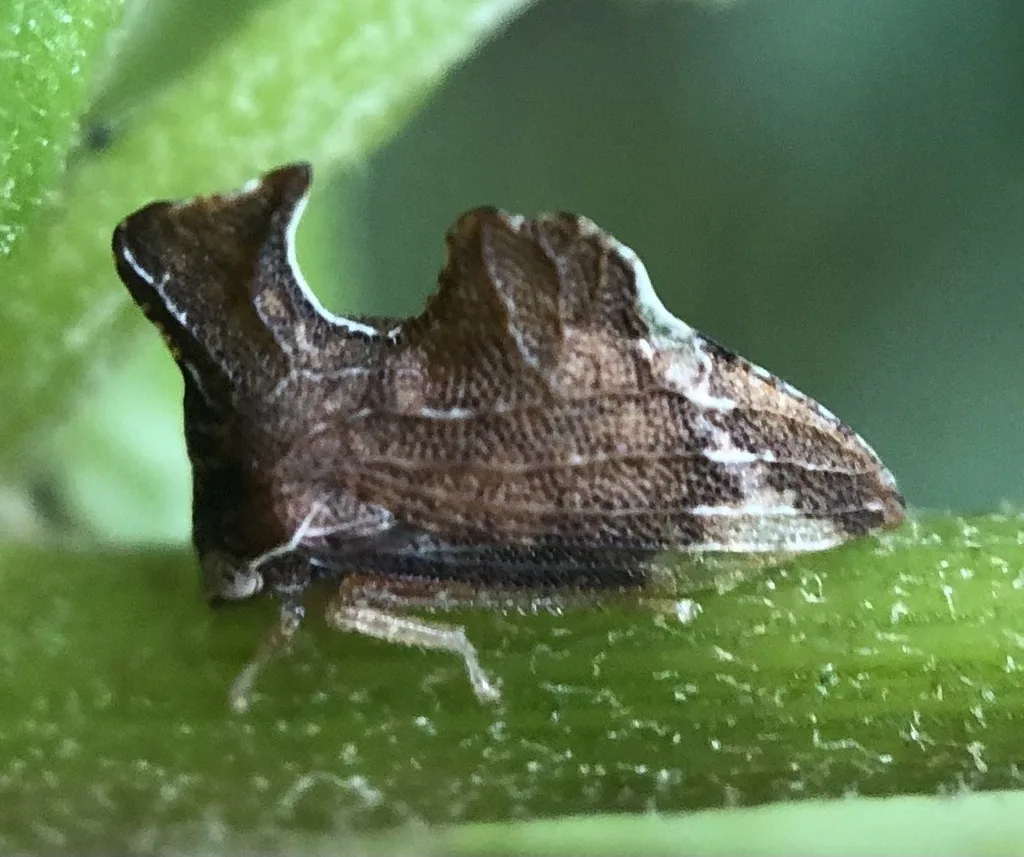
- Adults are small and brown with a saddle-shaped keel on the back. Females are almost 1/4 inch long with elaborate projections on the thorax; males are slightly smaller with less pronounced projections, so different that the sexes were once described as separate species.[1]
- Color varies a great deal, from pale individuals to dark ones with pale lines.[1]
- Nymphs are smaller, with several many-pronged spines on top, and their projections grow with each molt.[1]
- Look for a female sitting on her egg mass embedded in a leaf midrib, sometimes inside a folded leaf, and for ants attending the colony for honeydew.[1]
Look-alikes
| Look-alike | How to tell them apart |
|---|---|
| Buffalo treehopper | The keeled treehopper is brown with a saddle-shaped keel and elaborate thoracic projections, and it lives mainly on goldenrod, asters and other composites.[1] |
| Oak treehopper | Keeled treehoppers are occasionally found on oak and dogwood, but their usual hosts are composites, and the females guard egg masses set into leaf midribs.[1] |
| Sharpshooters and other Xylella vectors | In an Oklahoma survey of Pierce's disease vectors, keeled treehoppers were collected from vineyards and tested alongside sharpshooters; NC State says the species does not transmit plant diseases.[2][1] |
Where it lives
Documented by NC State in North Carolina, where it has been collected as late as December 19, in Delaware (as E. bactriana) and in Oklahoma vineyards. GBIF holds about 6,500 U.S. records since 1990 from 40 state-level areas, the most from Maryland (689), Virginia (571) and Pennsylvania (553).[1][3][2][4]
Biology and life cycle
Hosts are mainly composites: aster, baccharis, beggartick, boneset, dahlia, fireweed, fleabane, goldenrod, horseweed, joe-pye weed, ragweed, sunflower and yacon. It has also been found on dogwood, oak, Solanum and yarrow.[1]
Adults overwinter in leaf litter and emerge in early spring, around March. Females embed eggs in the midrib of tender goldenrod leaves and many other plants; the leaf may fold at the egg mass to form a shelter in which the nymphs develop.[1]
Mothers guard their egg masses, a small show of maternal, presocial behavior. Ants often attend the treehoppers, protecting them from predators in exchange for the honeydew they excrete.[1]
In North Carolina there are at least four generations a year.[1]
Like other sap-feeding hoppers, it depends on two obligate bacterial symbionts (Sulcia and a Nasuia-lineage bacterium) that supply essential amino acids missing from its plant-sap diet; its genome study was the first for any treehopper.[5]
Egg guarding pays off. In a University of Delaware study on Canada thistle (published under the older name Entylia bactriana, now treated as a synonym of E. carinata), adults overwintered and were in the field by early May. Almost 47 percent of 353 females left their first egg mass before it hatched; abandoned egg masses hatched less well, and their nymphs were less likely to be found and tended by ants.[3][6]
The same study calls it an obligate ant mutualist: its nymphs depend on ant protection to reach adulthood.[3]
Damage and signs
Health risk
NC State describes only a sap-feeding plant insect, and neither it nor the Delaware and Oklahoma studies mentions bites, stings or any effect on people or pets.[1][3][2]
Control
Prevention
No pesticide recommendation seems necessary; NC State treats the keeled treehopper as a curiosity rather than a pest.[1]
Where the sources disagree
Spring emergence: NC State says adults leave the leaf litter in early spring, around March; in the Delaware study they were in the field in early May and began laying eggs in mid-May.[1][3]
Generations: NC State reports at least four generations a year in North Carolina; the Delaware study describes a spring and a summer generation, with the summer generation's offspring overwintering.[1][3]
Common questions
- What is the odd brown bug with a hump on my goldenrod?
- A keeled treehopper. Its saddle-shaped keel and thoracic projections are distinctive, and the female often sits over an egg mass in the leaf midrib with ants nearby.[1]
- Why are ants crawling over it?
- The ants feed on the honeydew the treehoppers excrete and in return guard them from predators; nymphs from egg masses their mothers abandon are less likely to be found by ants.[1][3]
- Does it spread disease to my plants?
- No. NC State says keeled treehoppers do not transmit plant diseases. An Oklahoma vineyard study collected them along with sharpshooters to test as possible Xylella fastidiosa vectors; the insect it reported as transmitting the bacterium was the versute sharpshooter.[1][2]
- Should I spray them?
- No. NC State says no pesticide recommendation seems necessary for this curiosity.[1]
Sources
- NC State Extension, “Keeled Treehopper (PDIC Factsheets).” content.ces.ncsu.edu/ientylia-carinatai-the-keeled-treehopper (accessed 2026-11-13)
- J Econ Entomol 2015;108(6):2536-2545, via PubMed, “Seasonal Abundance and Natural Inoculativity of Insect Vectors of Xylella fastidiosa in Oklahoma Tree Nurseries and Vineyards.” pubmed.ncbi.nlm.nih.gov/26331482/ (accessed 2026-11-13)
- Cambridge Entomological Club, Psyche: A Journal of Entomology, “The effect of clutch size and ant attendance on egg guarding by Entylia bactriana (Homoptera: Membracidae) (Olmstead & Wood, Psyche 97:111-120, 1990).” groups.csail.mit.edu/mac/projects/psyche/97/97-111.html (accessed 2026-11-13)
- Global Biodiversity Information Facility (GBIF), “Entylia carinata: U.S. occurrence records since 1990 by state (GBIF occurrence search).” api.gbif.org/v1/occurrence/search?taxonKey=2021152&country=US&hasGeospatialIssue=false&occurrenceStatus=PRESENT&year=1990%2C2026&facet=stateProvince&facetLimit=400&limit=0 (accessed 2026-11-13). State counts are records reported, not abundance. 6,474 records on 2026-11-13.
- Genome Biol Evol 2017;9(6):1803-1815, via PubMed, “Comparative Genomics of the Dual-Obligate Symbionts from the Treehopper, Entylia carinata (Hemiptera: Membracidae), Provide Insight into the Origins and Evolution of an Ancient Symbiosis.” pubmed.ncbi.nlm.nih.gov/28854637/ (accessed 2026-11-13)
- Global Biodiversity Information Facility (GBIF) / Catalogue of Life, “Entylia bactriana Germar, 1835: synonym of Entylia carinata (Forster, 1771) (Catalogue of Life, via GBIF).” api.gbif.org/v1/species/296800758 (accessed 2026-11-13)
- Global Biodiversity Information Facility (GBIF), “Entylia carinata Forster (GBIF Backbone Taxonomy).” api.gbif.org/v1/species/2021152 (accessed 2026-11-13)
- iNaturalist, “Entylia carinata taxon page (order and family).” www.inaturalist.org/taxa/83177 (accessed 2026-11-10)