On this page
How to identify it
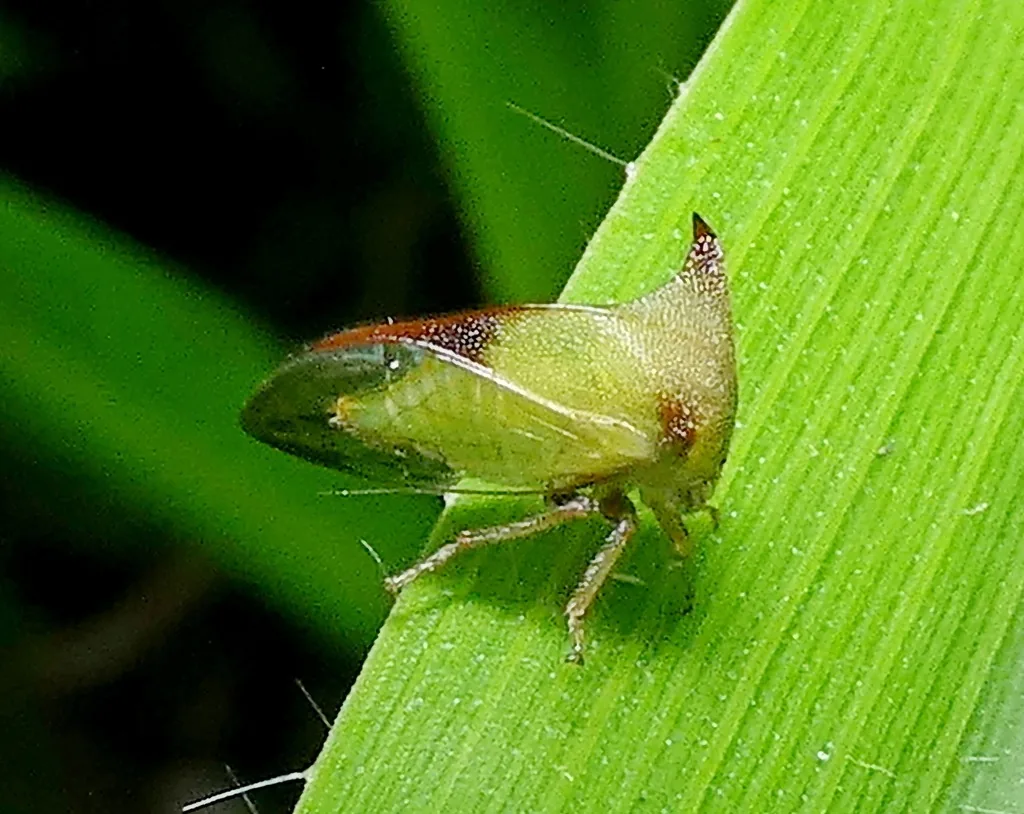
- Adults are green or brown with a yellowish underside, triangular from above and humpbacked from the side. UC IPM puts them at 2/5 inch long or less; Penn State says 3/8 inch.[1][3][2]
- An enlarged hood behind the head covers the front half of the body, setting treehoppers apart from true bugs.[1]
- Nymphs are reddish brown with many spines on the back, often in groups on stems, and both stages jump readily.[1]
Look-alikes
| Look-alike | How to tell them apart |
|---|---|
| Leafhoppers and cicadas | They share rows of spines on the hind legs, but only treehoppers have the large hood over the body.[1] |
Where it lives
It comes from North America and feeds on many herbaceous and woody plants. UC IPM lists ash, elm, fruit trees, hawthorn, locust, poplar and herbaceous plants such as tomatoes and peppers; Penn State names apple, pear, cherry, prune and quince as egg-laying hosts. It is now established in many Northern Hemisphere countries and was first recorded in China in 2017.[1][3][2][4]
Biology and life cycle
Eggs spend the winter in slits that females cut in the upper side of twigs. Penn State says females lay from July to October, cutting a row of slits and placing six to twelve eggs in each.[1][2]
Eggs hatch in spring, in May or June in Pennsylvania, and the nymphs drop to feed on grasses, weeds and other herbaceous plants nearby.[1][2]
Adults appear in summer and fall and lay the overwintering eggs; there's one generation a year.[1]
Damage and signs
- Sap feeding usually does no noticeable harm, but honeydew can grow black sooty mold when they're numerous.[1]
- The egg slits heal and slowly enlarge, leaving the bark rough and scabby. Heavy scarring can stunt and weaken the limbs of young trees; orchards that are weedy or next to weedy fields are hit most often.[1][2]
- UC IPM adds that twigs injured by egg-laying may die back and regrow crooked, while mature woody plants tolerate a lot of egg-laying damage.[3]
- In Italian apple orchards, researchers sometimes found the apple proliferation phytoplasma in buffalo treehoppers, but at far lower levels than in the psyllids known to spread that disease.[5]
Health risk
No cited source describes any risk to people or pets; it feeds on plant sap.[1][2]
Control
Prevention
UC IPM says control is generally not needed to protect plant health. Penn State advises insecticides only when young trees suffer economic damage that winter pruning can't handle, and notes that sprays are hard to time because egg-laying lasts for months.[1][2]
Sanitation
Removing herbaceous weeds lowers nymph survival and future egg-laying damage, since the nymphs feed on weeds and grasses after hatching.[1][3][2]
Traps and physical control
On small plants, a forceful spray of water knocks them off.[1]
Check young trees for egg scars in fall or winter and prune out badly scarred branches.[2]
Pesticides
If twig damage was heavy the season before, dormant-season horticultural oil that thoroughly covers the twig tips can kill overwintering eggs. During the growing season, oil or insecticidal soap sprayed onto exposed nymphs and adults can reduce their numbers.[1][3]
Spread beyond North America
The buffalo treehopper originated in the United States and is now established in many countries in the Northern Hemisphere. A 2025 genetic study found that most populations in China came from Europe, through at least two introductions.[4]
The same study's climate model found the most suitable areas today in western North America and Europe, and predicted that suitable areas will expand under every future climate scenario it tested.[4]
Common questions
- What is the little green horned bug on my tree?
- Probably a buffalo treehopper; its hooded, triangular shape is distinctive.[1]
- Do treehoppers damage trees?
- Feeding rarely matters, but egg slits can roughen, stunt and weaken young twigs. Mature trees tolerate it well.[1][3][2]
- Should I prune scarred twigs?
- On young trees, yes for badly scarred branches. Penn State suggests checking for scars in fall or winter, pruning out the worst, and keeping weeds down.[2]
Sources
- University of California Statewide IPM Program, “Buffalo Treehopper (Pests in Gardens and Landscapes).” ipm.ucanr.edu/PMG/GARDEN/VEGES/PESTS/buftrehop.html (accessed 2026-11-13)
- Penn State Extension, “Tree Fruit Insect Pest - Buffalo Treehopper (updated February 25, 2026).” extension.psu.edu/tree-fruit-insect-pest-buffalo-treehopper/ (accessed 2026-11-13)
- University of California Statewide IPM Program, “Treehoppers (Pest Notes, Home and Landscape).” ipm.ucanr.edu/PMG/GARDEN/PLANTS/INVERT/treehopper.html (accessed 2026-11-13)
- Ecology and Evolution (via PubMed), “Source of introduction to China and global suitable habitat prediction for the invasive insect Stictocephala bisonia (Cai W et al., Ecology and Evolution, 2025) (abstract).” pubmed.ncbi.nlm.nih.gov/41426646/ (accessed 2026-11-13)
- Insects (via PubMed), “Surveying potential vectors of apple proliferation phytoplasma: faunistic analysis and infection status of selected Auchenorrhyncha species (Fischnaller S et al., Insects, 2020) (abstract).” pubmed.ncbi.nlm.nih.gov/33375284/ (accessed 2026-11-13)
- Global Biodiversity Information Facility (GBIF), “Stictocephala bisonia Kopp & Yonke, 1977 (GBIF Backbone Taxonomy).” api.gbif.org/v1/species/5154481 (accessed 2026-11-13)