On this page
How to identify it
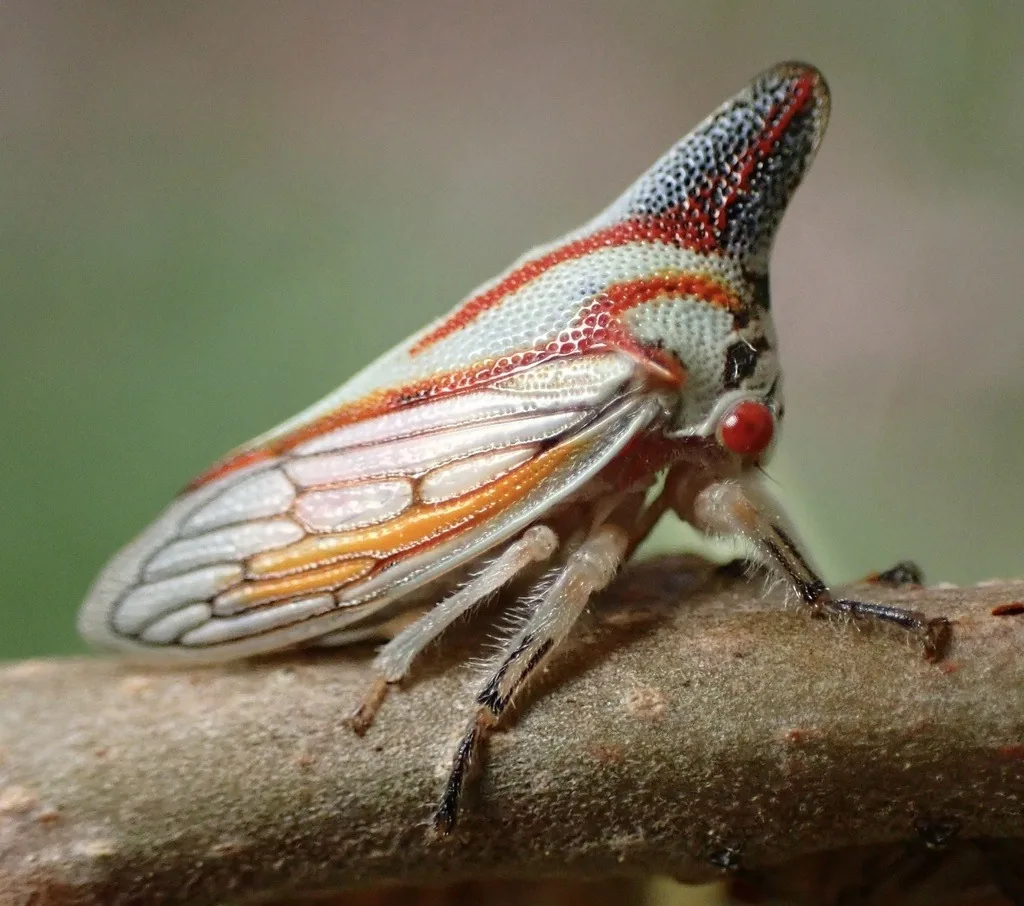
- Like other treehoppers, it has an enlarged pronotum (the shield behind the head) that extends back over the abdomen. Some oak treehoppers have a conspicuous horn projecting forward over the head.[2][1]
- Color changes with age: young adults may be white with red and black markings, while older adults are dull brown or dull green.[1]
- Nymphs have two tiny spikes on the back and are usually boldly marked in white, black and red. They feed together in a cluster around the slit the female cut in the bark.[1]
- MDC gives treehoppers in general as ½ inch long or less, with some species reaching ¾ inch.[2]
Where it lives
NC State describes it feeding on oaks throughout the eastern United States. GBIF has 4,003 U.S. records since 1990 from 35 state-level areas, led by Virginia (762), North Carolina (591), Maryland (445) and Florida (295), with 222 from California and smaller numbers from Washington (55), Oregon (54) and Arizona (17), plus records from Canada (211), Mexico (13) and Honduras (2).[1][3][4]
Biology and life cycle
Females spend the winter in leaf litter and lay their eggs in bark slits the next spring. Courtship and mating happen in the morning or evening; a female mates more than once, but only the last male's sperm fertilizes her 40 or so eggs.[1]
When the eggs hatch, the nymphs gather and feed at the slit while the mother broods over them and bumps away predators.[1]
NC State says the overwintering females lay their eggs the following spring, and that second-generation eggs are laid in August and hatch and develop into the overwintering forms.[1]
Oaks are the usual hosts, but oak treehoppers have also been collected from river birch in Ohio and chestnut in California.[1]
Damage and signs
Health risk
Oak treehoppers drink plant sap. NC State and MDC don't mention any risk to people or pets.[1][2]
Control
Prevention
MDC says treehoppers rarely cause real trouble for their food plants and provide food for multitudes of birds and insect-eating insects, and NC State says oak treehoppers usually cause little damage to shade trees.[2][1]
Pesticides
If they do get out of hand, NC State says most contact pesticides, such as pyrethroids, should give more than adequate control, and says to avoid using pyrethroids around pools, ponds and streams because they are toxic to fish. NC State also says to examine a current product label before applying any chemical.[1]
Where the sources disagree
Overwintering: MDC says treehopper eggs, inserted into twigs, overwinter and hatch in spring; NC State says the oak treehopper overwinters as females in leaf litter.[2][1]
Range: NC State says it feeds on oaks throughout the eastern United States; GBIF also has U.S. records from California (222), Washington (55), Oregon (54) and Arizona (17).[1][3]
Name: NC State writes Platycotis vittata; GBIF's accepted name is Platycotis vittatus.[1][5]
Common questions
- What are the striped, horned bugs clustered on my oak twigs?
- Probably oak treehoppers. Young adults are white with red and black markings, nymphs are boldly marked in white, black and red, and they feed in groups on oak.[1]
- Do oak treehoppers hurt the tree?
- Rarely. NC State says oak treehoppers usually cause little damage to shade trees, and MDC says treehoppers' egg laying can damage small twigs.[1][2]
- Why is one bug sitting next to the group?
- Female oak treehoppers guard their nymphs and bump away predators.[1]
Sources
- NC State Extension, “Oak Treehopper (PDIC Factsheet).” content.ces.ncsu.edu/oak-treehopper-1 (accessed 2026-11-13)
- Missouri Department of Conservation, “Treehoppers (Field Guide).” mdc.mo.gov/discover-nature/field-guide/treehoppers (accessed 2026-11-13)
- Global Biodiversity Information Facility (GBIF), “Platycotis vittata: U.S. occurrence records since 1990 by state (GBIF occurrence search).” api.gbif.org/v1/occurrence/search?taxonKey=2024482&country=US&hasGeospatialIssue=false&occurrenceStatus=PRESENT&year=1990%2C2026&facet=stateProvince&facetLimit=400&limit=0 (accessed 2026-11-13)
- Global Biodiversity Information Facility (GBIF), “Platycotis vittata: occurrence records since 1990 by country (GBIF occurrence search).” api.gbif.org/v1/occurrence/search?taxonKey=2024482&hasGeospatialIssue=false&occurrenceStatus=PRESENT&year=1990%2C2026&facet=country&limit=0 (accessed 2026-11-13)
- Global Biodiversity Information Facility (GBIF), “Platycotis vittatus Fabricius (GBIF Backbone Taxonomy).” api.gbif.org/v1/species/2024482 (accessed 2026-11-13). GBIF spells the species name vittatus; NC State writes vittata
- iNaturalist, “Platycotis vittata taxon page (order and family).” www.inaturalist.org/taxa/48679 (accessed 2026-10-06)