On this page
How to identify it
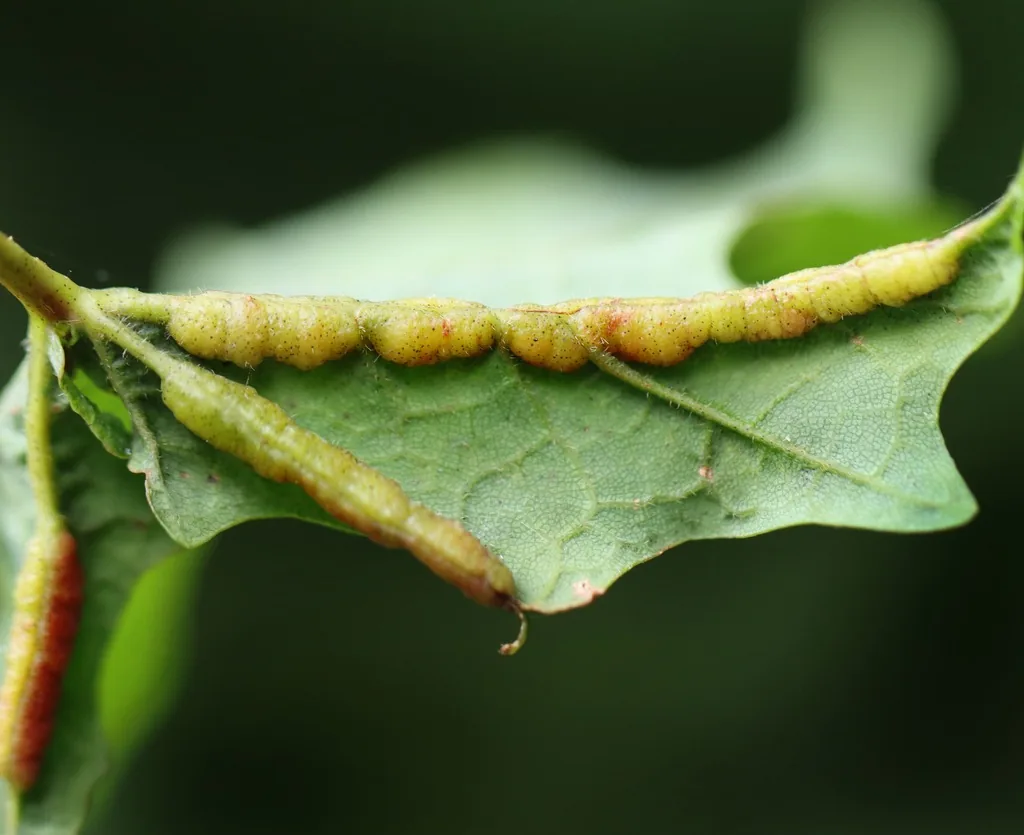
- Galls are irregular swellings along the leaf veins on the underside of the leaf, light green to red, with discoloration or slight distortion on the upper surface.[1][2]
- Leaves galled while still growing can curl or become misshapen.[1][2]
- Ohio State describes thickened pouches along the major veins that can completely crumple early leaves, so they may be mistaken for herbicide damage. The adults are tiny gnat-like midges with black wings and heads and a body that looks reddish from the eggs inside.[4]
Look-alikes
| Look-alike | How to tell them apart |
|---|---|
| Maple eyespot gall midge | Its galls are round, ringed spots in the leaf blade rather than swellings along the veins.[2] |
| Maple bladdergall mite | Bladder galls are separate globular bumps about 2.5 to 3 mm across on the upper leaf surface, not swollen veins underneath.[2] |
Where it lives
Extension services in North Carolina, Pennsylvania, Ohio and Missouri describe it. Sources list different hosts: NC State says the most frequent are sugar maple, red maple and boxelder; Missouri names sugar and red maple; Ohio State says it attacks only sugar maple; Penn State lists red, silver, sugar and striped maple for vein galls caused by Dasineura midges.[1][5][4][2]
Biology and life cycle
There is one generation a year. Females lay eggs on new, developing leaves in spring; Ohio State says each may lay up to 100 eggs among the hairs on the lower leaf surface. The larvae gather along the veins to feed, and the leaf tissue swells around them.[1][4][5]
Sources disagree on when the larvae leave. NC State says they mature within about two months, the gall splits, and they drop to the ground in early summer; Ohio State says they feed inside the galls until October, and Missouri says a slit opens in the fall as the leaves drop and dry.[1][4][5]
Larvae overwinter in the leaf litter and soil under the tree. NC State says they pupate the next spring; Ohio State says they spin small white cocoons from late January to early March, and the adults emerge in April and early May. NC State says the adults don't feed and live no more than three days.[1][4][5]
Damage and signs
- The galls are largely cosmetic. NC State says severe leaf curl can reduce a tree's ability to make food but is not lethal; Ohio State says maple leaf galls seldom if ever cause permanent injury, though leaves may drop early, and that after a mild winter damage can be heavy but trees often put out new leaves.[1][4][5]
Health risk
It feeds on maple leaves, and no cited source describes any risk to people or pets.[1][4]
Control
Sanitation
Raking up leaf litter and debris around the base of the tree removes overwintering cocoons, and hand-picking galled leaves also helps on small trees.[1]
Pesticides
Sources differ on spraying. Ohio State says that because the galls are cosmetic, control is generally not recommended. For high-value trees galled year after year, NC State says systemic insecticides applied as a soil drench or sprayed on new leaves have worked; Missouri suggests treating the ground litter in late fall or early spring, or the new foliage in spring before the veins swell. Follow the label of any product used.[4][1][5]
Common questions
- Why are the veins on my maple leaves swollen and red?
- Most likely gouty vein galls, made by the larvae of a tiny gall midge feeding along the veins in spring.[1][2]
- Will gouty vein galls harm my maple?
- Rarely. Extension services describe them as mostly cosmetic; even heavy leaf curl isn't lethal, and affected trees often grow new leaves.[1][4]
Sources
- NC State Extension, “Gouty Vein Gall Midge (Diptera: Cecidomyiidae).” content.ces.ncsu.edu/gouty-vein-gall-midge-diptera-cecidomyiidae (accessed 2026-11-13)
- Penn State Extension, “Leaf Galls on Maple.” extension.psu.edu/leaf-galls-on-maple (accessed 2026-11-13)
- Global Biodiversity Information Facility (GBIF), “Dasineura communis (Felt, 1911) (GBIF Backbone Taxonomy).” api.gbif.org/v1/species/1594929 (accessed 2026-11-13)
- Ohio State University Extension (Ohioline), “Galls of Maple Trees in Ohio (ENT-60).” ohioline.osu.edu/factsheet/ENT-60 (accessed 2026-11-13)
- University of Missouri Extension, “Insect and Mite Galls on Missouri Trees (G7272).” extension.missouri.edu/media/wysiwyg/Extensiondata/Pub/pdf/agguides/pests/g07272.pdf (accessed 2026-11-13)