On this page
How to identify it
- Adults are dark brown or black, about 1.5 to 2 inches long, with orange-red antenna tips that include a flattened, leaf-like segment, enlarged spiny hind legs, and wings with orange or yellow veins.[1]
- Males have much wider hind legs than females and use them as weapons, squeezing rivals during fights; females' hind legs are relatively inconspicuous and used only for walking.[2][3]
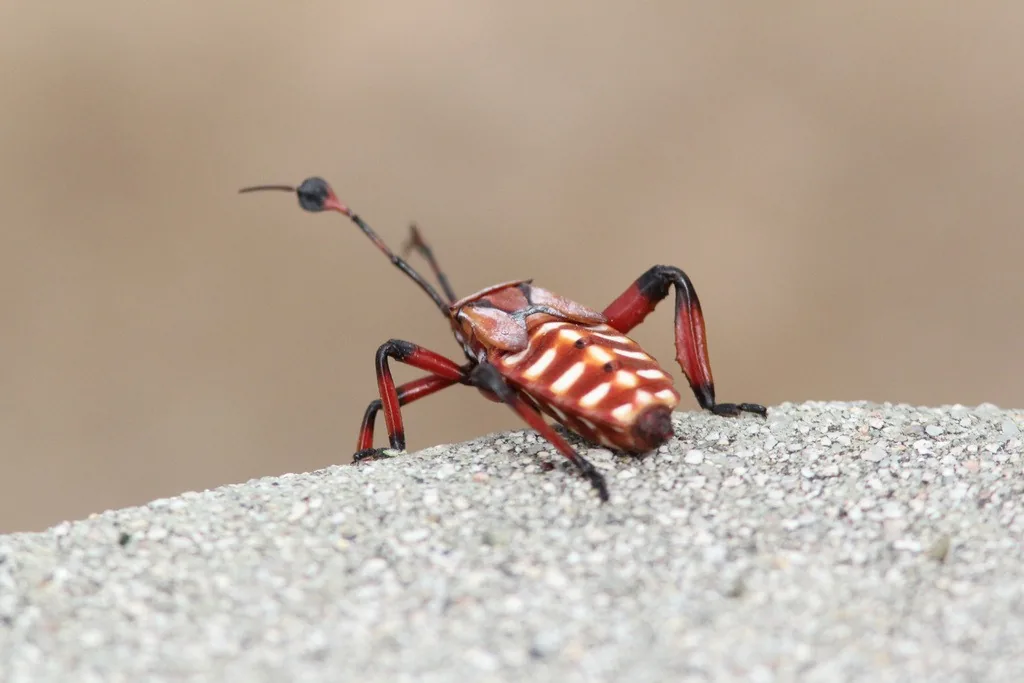
- Nymphs are patterned in vivid red, yellow, white and black, change pattern through five molts, and often gather in clusters, which may make them look like a larger animal to predators. By May they are about an inch long, with an enlarged segment near the tip of each antenna.[1]
- Texas A&M's insect image collection records a cluster of over a hundred large nymphs, 35 mm long, on a hopbush plant in Nogales, Arizona.[4]
Look-alikes
| Look-alike | How to tell them apart |
|---|---|
| Kissing bugs | University of Arizona entomologists say most insects the public sent them as suspected kissing bugs turned out to be leaffooted bugs, and they list the giant mesquite bug among Arizona's common leaffooted bugs. Leaffooted bugs have a four-segmented beak, often more than half the body length, while kissing bugs and other assassin bugs have a three-segmented beak.[5] |
Where it lives
Common in desert Southwest landscapes, particularly on mesquite. Researchers note that mesquite bugs were until recently mainly tropical and subtropical insects of Mexico and Central America and have since occupied the southwestern United States where mesquite grows. GBIF holds about 1,310 records: 1,101 from the United States, 1,088 of them from Arizona, and 186 from Mexico, the most from Baja California Sur (62), Sonora (57) and Chihuahua (33).[1][6][9]
Biology and life cycle
Adults are slow, clumsy fliers usually seen in small groups, and adults and nymphs may give off a foul-smelling defensive secretion when threatened.[1]
Nymphs and adults have beaks for sipping juices from mesquite leaves and leaf stalks.[1]
Bugs normally feed in the tops of mesquites but move toward the base as temperatures rise, and in hot years people may suddenly see large numbers on the lower trunk or the ground.[1]
Large males with big hind legs win access to mates, and females are more likely to mate with males carrying large weapons; in experiments, leg injuries from fighting did not change females' choices.[3]
After breeding in late summer, when night temperatures dropped below 21 degrees C, adults sat motionless at the edges of trees in one Arizona study, and pallid bats ate so many that 88% of the insect parts dropped under their night roosts came from adult mesquite bugs.[6]
Eggs are laid in chains under stems, leaves or loose bark on mesquite. In southern Arizona they begin hatching about mid-April, as mesquites bloom, and the first nymphs are small and blue.[1]
Damage and signs
- Adults and nymphs feed on mesquite but cause no significant damage to the tree; they can also turn up on other garden and landscape plants.[1]
Health risk
It feeds on plant sap, and no cited source describes any risk to people or pets.[1][5]
Control
Prevention
The University of Arizona says not to worry about the bugs or the trees, since the two have evolved together and neither suffers significant injury, and suggests simply enjoying them. In one Arizona study, pallid bats ate large numbers of the adults.[1][6]
Where the sources disagree
Name: GBIF's backbone lists Thasus neocalifornicus as the accepted name and Pachylis neocalifornicus as a synonym. The 2025 mate-choice study uses Pachylis, while the University of Arizona, Texas A&M and the 2018 and 2022 papers use Thasus.[7][8][3][1][4][6][2]
Season: the University of Arizona newsletter says the bugs are on mesquite from May to August, and that adults are active from June to September.[1]
Egg laying: the same newsletter says eggs are laid in late fall and the adults die soon after, and also that adults mate and lay eggs in late summer and then die; the pallid bat study observed breeding in late summer.[1][6]
Adult wings and food: the newsletter describes adult wings as having prominent orange or yellow veins on a dark background in one passage and as olive-drab with creamy diagonal stripes in another, and says adults feed on leaves in one passage and prefer to cluster on seed pods in another.[1]
Female hind legs: the University of Arizona says females' hind legs are enlarged but not nearly as robust as males', while a 2022 study found hind-leg length did not differ between the sexes, though males' legs were wider and stronger.[1][2]
Plants: the University of Arizona describes the bugs on mesquite, while a Texas A&M image record shows a cluster of over a hundred nymphs on a hopbush plant.[1][4]
Common questions
- What are the red, yellow and white bugs clustered on my mesquite?
- Clusters of red, yellow, white and black bugs on mesquite in late spring and summer are likely giant mesquite bug nymphs, which change pattern through five molts.[1]
- Is it a kissing bug?
- No. University of Arizona entomologists list it among the plant-feeding leaffooted bugs. Leaffooted bugs have a four-segmented beak, while blood-feeding kissing bugs have a three-segmented one.[5]
- Why do some have huge back legs?
- Those are males. They use their enlarged hind legs as weapons, squeezing rival males in fights over mates.[2][3]
Sources
- Zoology 150:125988, 2022 (Graham, Kaiser & Palaoro), via PubMed, “Biomechanics influence sexual dimorphism in the giant mesquite bug, Thasus neocalifornicus.” pubmed.ncbi.nlm.nih.gov/34973543/ (accessed 2026-11-13)
- Behavioral Ecology 36(4), 2025 (Cirino et al.), via PubMed, “Fighting-related injuries do not affect mate choice in the giant mesquite bug, Pachylis neocalifornicus.” pubmed.ncbi.nlm.nih.gov/40519853/ (accessed 2026-11-13)
- Texas A&M AgriLife Extension, Extension Landscape Pest (ELP) program, “Thasus neocalifornicus, giant mesquite bug (insect image record).” elp.tamu.edu/ipm/bugs/family-coreidae-leaf-footed-bugs/hemiptera-heteroptera-coreidae-thasus-neocalifornicus-giant-mesquite-bug-i/ (accessed 2026-11-13)
- University of Arizona Cooperative Extension (Department of Entomology), “Leaffooted Bugs Want Your Veggies, Not Your Blood.” extension.arizona.edu/sites/extension.arizona.edu/files/attachment/leaffooted-bugs.pdf (accessed 2026-11-13)
- PeerJ 6:e6065, 2018 (Czaplewski, Menard & Peachey), via PubMed, “Mesquite bugs, other insects, and a bat in the diet of pallid bats in southeastern Arizona.” pubmed.ncbi.nlm.nih.gov/30533321/ (accessed 2026-11-13)
- Global Biodiversity Information Facility (GBIF), “Thasus neocalifornicus Brailovsky & Barrera, 1994 (GBIF Backbone Taxonomy).” api.gbif.org/v1/species/2050094 (accessed 2026-11-13)
- Global Biodiversity Information Facility (GBIF), “Pachylis neocalifornicus (Brailovsky & Barrera, 1994), synonym of Thasus neocalifornicus (GBIF Backbone Taxonomy).” api.gbif.org/v1/species/12309447 (accessed 2026-11-13)
- Global Biodiversity Information Facility (GBIF), “Thasus neocalifornicus: occurrence records by state and country (GBIF occurrence search).” api.gbif.org/v1/occurrence/search?taxonKey=2050094&hasGeospatialIssue=false&occurrenceStatus=PRESENT&facet=country&facet=stateProvince&facetLimit=50&limit=0 (accessed 2026-11-13). Exact count at access: 1,307 records (United States 1,101; Mexico 186). States: Arizona 1,088; Baja California Sur 62 (two spellings); Sonora 57; Chihuahua 33; Texas 6; New Mexico 5. Records reported, not abundance.