On this page
How to identify it
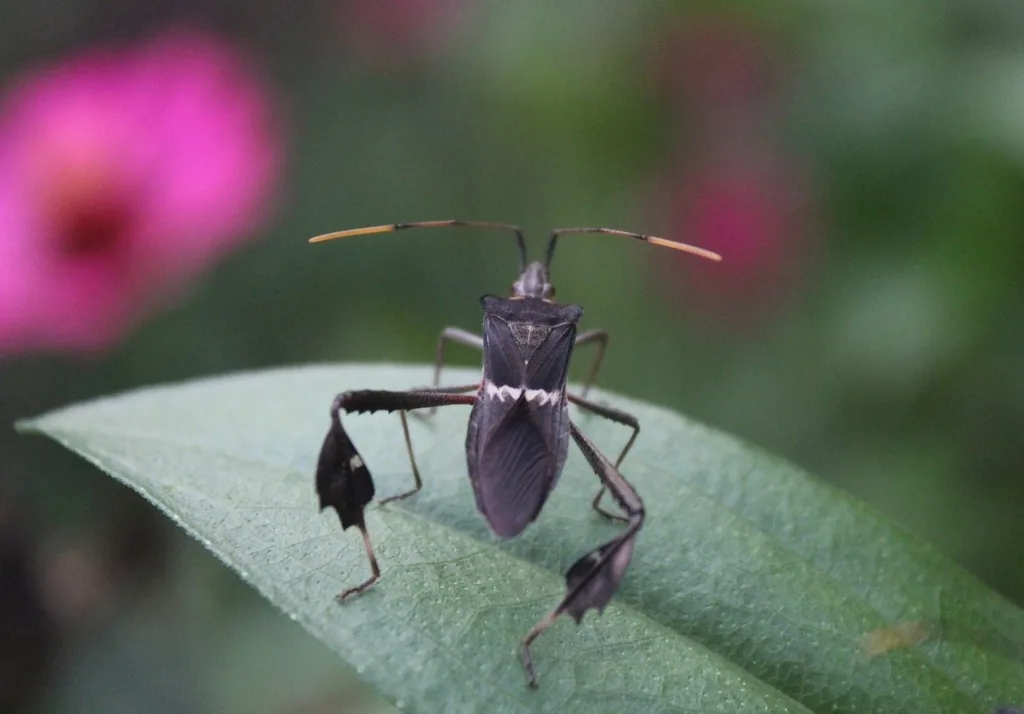
- Adults are narrow, brown bugs about 3/4 to 1 inch long, with flattened, leaf-like widenings on the lower part of the hind legs.[1][5]
- A white band or zigzag runs across the wings. UC IPM says it is prominent in Leptoglossus zonatus and L. clypealis and faint in L. occidentalis.[1][5]
- Leptoglossus zonatus, the species this page centers on, also has two yellow spots just behind the head; L. clypealis has a thorn-like point on the tip of the head.[1]
- Eggs are brown cylinders laid end to end in a string along a stem or leaf midrib, usually 10 to 15 to a strand. Young nymphs are orange to reddish brown with dark heads and legs, and the leaf-like flaps appear as they grow.[1][4]
- They fly well and make a loud buzzing sound in flight, which can startle gardeners into mistaking them for bees or wasps.[4][6]
Look-alikes
| Look-alike | How to tell them apart |
|---|---|
| Western conifer seed bug | The western conifer seed bug is itself a leaffooted bug, Leptoglossus occidentalis; it lacks the yellow spots, has only a faint zigzag and lives mainly on conifers.[1] |
| Squash bug | Squash bugs are flat, dark gray to grayish-brown cucurbit pests with orange-striped abdomen edges; leaffooted bugs are narrower and brown, with leaf-like flaps on the hind legs.[2][1] |
| Assassin bug nymphs | Young assassin bug nymphs, which are beneficial, have light-colored legs and antennae and hatch from grouped, barrel-shaped eggs rather than egg strands.[1] |
| Stink bugs | Stink bugs feed in a similar way but have a rounder or squarer, shield-like body with a large triangle in the middle of the back and five-segmented antennae; leaffooted bugs have four.[6][4] |
Where it lives
UC IPM lists three common species native to California and the western United States. Leptoglossus zonatus is widely distributed in the Western Hemisphere and has been recorded in California since around 1900, and Missouri Department of Conservation says L. clypealis also occurs in Missouri, having gradually spread east since the early 20th century.[1][7][6]
Biology and life cycle
Adults spend the winter in groups in woodpiles, outbuildings, under loose bark, in palm fronds, citrus or juniper trees, and in leftover fruit such as pomegranate culls.[1]
Sources differ on winter cold. UC IPM says cold winters kill many adults and outbreaks often follow mild winters, while a lab study in California's San Joaquin Valley rated L. zonatus chill-intolerant, with half dying after six hours at about -5.8 °C, and found temperatures that cold rarely occur there.[1][8]
In spring adults feed on thistles and other weeds, then move into gardens as fruit develops; an overwintered female can lay over 200 eggs in about two months. A 2023 California study found evidence that females mate before leaving their winter sites.[1][9]
Eggs hatch in about a week and nymphs reach adulthood in 5 to 8 weeks; California sees two to three generations through spring and summer, and in a Fresno County pomegranate hedgerow L. zonatus produced another generation mostly between September and mid-November.[1][8]
Numbers in vegetable gardens peak in late summer and fall, after one or more generations and as adults leave weeds and row crops that have dried down. Very young nymphs stay tightly clustered, and adults give off a distinctive odor when handled.[4][1]
Damage and signs
- Feeding on small tomatoes can make them drop, while feeding on mid-sized fruit leaves depressions or discolored spots as the fruit ripens. Mississippi State says the soft, sunken spots can come with an off taste even when damage is mild.[1][4]
- On ripe tomatoes the marks are slight surface blemishes that need not concern home gardeners.[1]
- On pomegranates, late feeding can darken and shrivel the seeds inside without outward damage; on almonds and pistachios it can kill or stain kernels. L. zonatus is now the dominant leaffooted bug on almonds, pistachios and pomegranates in California's Central Valley.[1][9][8]
- Garden hosts also include peppers, eggplant, okra, peas, beans and tomatillos, and in Texas sorghum fields they feed on the developing kernels, which are then more likely to be hit by fungi.[4][5]
- The mouthparts can carry a yeast, Eremothecium coryli, that discolors fruit; UC IPM says it does not stop the fruit from being harvested and eaten.[1]
- Feeding on leaves and shoots of most ornamentals and many garden plants causes no visible harm.[1]
Health risk
Leaffooted bugs feed on plants, not people. Their main nuisance is a distinctive odor when handled, so wear gloves when picking them off.[1][4]
Control
Prevention
Mississippi State suggests a trap crop of about a dozen large-flowered sunflowers to pull leaffooted bugs away from vegetables, with the bugs on the sunflowers treated before the nymphs mature.[4]
Keep them out
Row covers put on before bugs arrive prevent feeding, but they also block pollinators and beneficial insects from reaching the plants.[1]
Sanitation
Remove or inspect overwintering sites such as woodpiles and leftover fruit, and mow or remove nearby weeds that feed bugs in winter and spring.[1]
Traps and physical control
Check plants daily to several times a week, handpicking bugs or brushing them into soapy water; mornings work best, when they move less, and crush the egg strands too.[1][4]
Remove bugs early in the season, while young nymphs are still clustered; a dedicated handheld vacuum used regularly can reduce numbers. In pomegranates, knocking nymphs out of the tree onto a white ground sheet and crushing them every 1 to 2 weeks also works.[1]
Biological control
Tiny egg-parasite wasps, tachinid flies, birds, spiders and assassin bugs all attack leaffooted bugs; avoid persistent broad-spectrum sprays that harm them. Look for the tachinid's small white eggs on the bugs' bodies.[1][6]
Pesticides
Sources differ on spraying. UC IPM says insecticides are rarely needed in gardens and work best on small nymphs, with insecticidal soap, neem oil or pyrethrin controlling young nymphs only; Mississippi State calls well-timed contact sprays the key once adults are numerous, repeated every 7 to 10 days and made early in the morning.[1][4]
Pyrethroids such as permethrin are the most effective but are highly toxic to bees and beneficials, so UC IPM treats them as a last resort. Because treatment often falls at harvest, observe the label's days-to-harvest interval and wash the fruit.[1][4]
Common questions
- What are the brown bugs with flat back legs on my tomatoes?
- Those are likely leaffooted bugs, recognized by the leaf-like flaps on their hind legs; light feeding marks on ripe tomatoes are cosmetic.[1][6]
- Why are my pomegranate seeds dark and shriveled?
- Late-season leaffooted bug feeding can darken and wither pomegranate seeds even when the outside of the fruit looks fine.[1]
- Do I need to spray leaffooted bugs?
- Usually not, according to UC IPM: populations are typically tolerable in gardens, and handpicking, weed control and removing overwintering spots come first. Mississippi State does recommend repeated sprays when large numbers of adults move into a late-season vegetable garden.[1][4]
- Why are there so many in my garden in late summer?
- By late summer they have finished one or more generations, and adults fly in from weeds and crops that are drying down.[4]
Sources
- University of California Statewide IPM Program, “Pest Notes: Leaffooted Bug, Publication 74168.” ipm.ucanr.edu/home-and-landscape/leaffooted-bug/ (accessed 2026-11-11)
- University of California Statewide IPM Program, “Squash Bugs (Pest Notes, Home and Landscape).” ipm.ucanr.edu/home-and-landscape/squash-bugs/ (accessed 2026-11-11)
- iNaturalist, “Leptoglossus zonatus taxon page (order and family).” www.inaturalist.org/taxa/154551 (accessed 2026-11-11)
- Mississippi State University Extension Service, “Leaffooted Bugs, Bug's Eye View Vol. 4, No. 24 (B. Layton, 2018).” extension.msstate.edu/newsletters/bugs-eye-view/2018/leaffooted-bugs-vol-4-no-24 (accessed 2026-11-11)
- Texas A&M AgriLife Extension, South Texas Field Crop Entomology, “Leaf Footed Bugs (sorghum pest identification).” agrilife.org/sca/leaf-footed-bugs/ (accessed 2026-11-11)
- Missouri Department of Conservation, “Leaf-Footed Bugs (Coreids), Field Guide.” mdc.mo.gov/discover-nature/field-guide/leaf-footed-bugs-coreids (accessed 2026-11-11)
- Insects, via PubMed, “Joyce AL, Parolini H, Brailovsky H (2021), Distribution of two strains of Leptoglossus zonatus in the Western Hemisphere: is L. zonatus a potential invasive species in California? Insects 12(12).” pubmed.ncbi.nlm.nih.gov/34940182/ (accessed 2026-11-11). Cited from the PubMed abstract.
- Insects, via PubMed, “Tollerup KE (2019), Cold tolerance and population dynamics of Leptoglossus zonatus (Hemiptera: Coreidae), Insects.” pubmed.ncbi.nlm.nih.gov/31627302/ (accessed 2026-11-11). Cited from the PubMed abstract.
- Journal of Economic Entomology, via PubMed, “Stahl JM, Daane KM (2023), Reproductive biology of overwintering leaffooted bug Leptoglossus zonatus in California, Journal of Economic Entomology.” pubmed.ncbi.nlm.nih.gov/37229556/ (accessed 2026-11-11). Cited from the PubMed abstract.