On this page
How to identify it
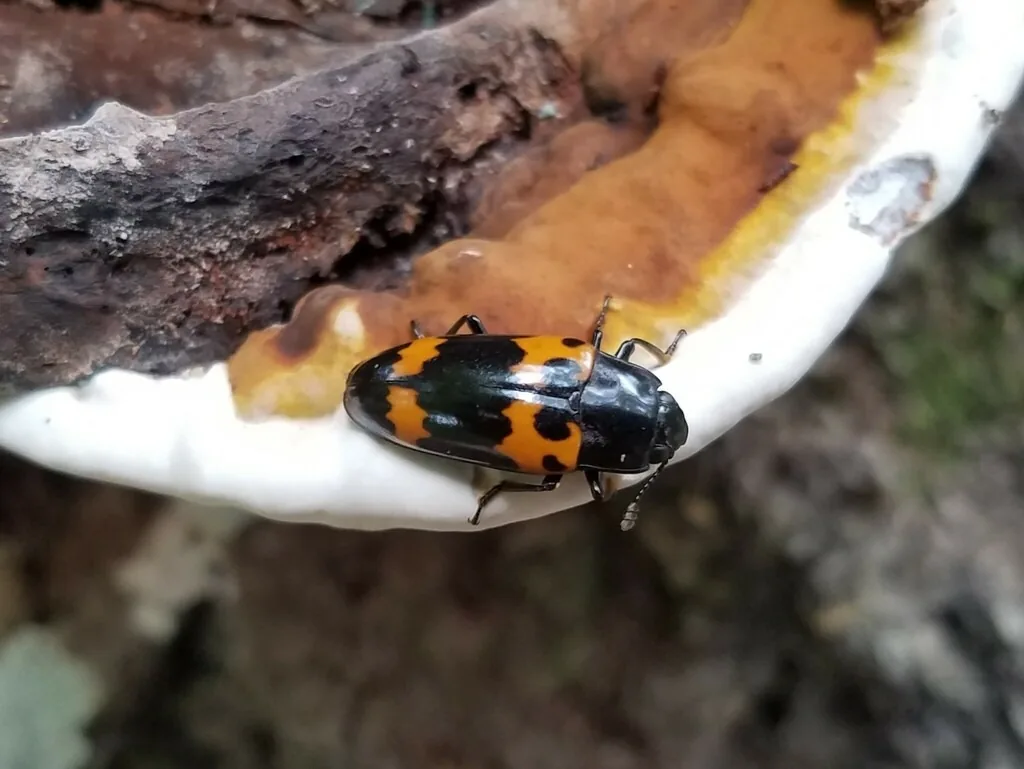
- Eastern Megalodacne species are shiny black with irregular yellowish-orange bands across the wing covers, elongate-oval and 1/2 to 7/8 inch long.[3][4]
- The common western species, Gibbifer californicus, is larger, about 2.5 to 3 cm (1 to 1 1/4 inches), with a dark head and blue or purple wing covers marked with dark pits and a black marking along the outer edge; its color fades a lot after death.[1]
- Some relatives are much smaller: Colorado's two Triplax species are found under loose bark or in fungi on rotting trees.[1]
Look-alikes
| Look-alike | How to tell them apart |
|---|---|
| Forked fungus beetle | The horned (forked) fungus beetle often shares the same Ganoderma shelf fungi, but it is only about 10 to 12 mm long, and males carry forward-pointing horns.[4] |
Where it lives
Pleasing fungus beetles occur across North America. GBIF has 1990-2026 records of the family from every U.S. state and Washington, D.C., with the most from Florida, Colorado, Arizona, Texas and Kansas, and Tritoma and Triplax species reach New Brunswick, Canada. Gibbifer californicus is a Southwest and Rocky Mountain species, recorded in Colorado, Arizona, New Mexico and Wyoming and in Mexico; in Colorado it lives in pine and aspen forests.[6][5][7][1]
Biology and life cycle
Each group sticks to certain fungi. Megalodacne and Dacne breed in hard bracket fungi such as Ganoderma, while Tritoma and Triplax live in soft polypores and other fleshy fungi; Gibbifer develops on soft conks on aspen and ponderosa pine logs.[3][5][1]
Megalodacne adults are active at night, which may be why they are seldom noticed. By day they may gather under bark or rotting wood, usually within about 25 feet of trees and stumps infected with Ganoderma.[3]
Females lay eggs on the fungus, and larvae feed inside it. Development can be quick: two weeks from egg to pupa is not uncommon in some species.[3]
In Colorado there is one generation a year. Larvae feed in late spring and early summer, then hang from the underside of logs to pupate, often in groups of several dozen; adults emerge about two weeks later and stay active into early fall.[1]
Damage and signs
- They feed on fungi. Because they breed in fungi on diseased and dead trees, NC State notes that management should aim at keeping trees healthy, not at the beetles.[3][5]
- Their host fungi are the real concern: the Ganoderma shelf fungi they use rot the roots of trees such as maple, redbud, sweetgum, honeylocust and water oak, so shelf fungi on a living tree point to wood decay worth having checked.[3][4]
Health risk
None of the extension sources describes any bite, sting or harm to people, pets or homes; the beetles live on fungi outdoors.[3][1]
Control
Prevention
No control is needed for the beetles. Keep trees healthy, and inspect larger landscape trees in fall for shelf fungi, which signal wood decay.[3][4]
Common questions
- What are the shiny black-and-orange beetles on the shelf fungus on my stump?
- Most likely pleasing fungus beetles in the genus Megalodacne, which breed in hard shelf fungi such as Ganoderma.[3][4]
- Do pleasing fungus beetles damage trees?
- No. They feed on fungi. The shelf fungus they feed on is the problem, because it means the tree has wood decay.[3][4]
- Why are there so many of them together?
- Adults gather on their host fungus or under nearby bark and rotting wood, and in Colorado full-grown larvae pupate in hanging clusters of several dozen under logs.[3][1]
Sources
- Colorado State University Extension (Colorado Insects of Interest, W. Cranshaw), “Pleasing Fungus Beetle (Colorado Insect of Interest).” wci.extension.colostate.edu/wp-content/uploads/sites/14/2017/03/PleasingFungusBeetle.pdf (accessed 2026-11-11)
- iNaturalist, “Megalodacne taxon page (order and family).” www.inaturalist.org/taxa/82102 (accessed 2026-11-11)
- NC State Extension, “Megalodacne Pleasing Fungus Beetles (PDIC factsheet, J. Baker; reviewed October 23, 2026).” content.ces.ncsu.edu/imegalodacnei-pleasing-fungus-beetles (accessed 2026-11-11)
- N.C. Cooperative Extension, “Insects and Fungal Fruiting Structures (Craven County Center, updated December 3, 2024).” craven.ces.ncsu.edu/news/insects-and-fungal-fruiting-structures/ (accessed 2026-11-11)
- ZooKeys, via PubMed Central, “Webster RP, Sweeney JD, DeMerchant I (2012), New Coleoptera records from New Brunswick, Canada: Sphindidae, Erotylidae, Monotomidae, and Cryptophagidae, ZooKeys 179:169-192 (Natural Resources Canada, Canadian Forest Service).” pmc.ncbi.nlm.nih.gov/articles/PMC3337060/ (accessed 2026-11-11). Cited from the open-access full text.
- Global Biodiversity Information Facility (GBIF), “Erotylidae: occurrence records in the U.S., 1990-2026 (GBIF occurrence search).” api.gbif.org/v1/occurrence/search?taxonKey=6981&country=US&hasGeospatialIssue=false&occurrenceStatus=PRESENT&year=1990%2C2026&facet=stateProvince&facetLimit=400&limit=0 (accessed 2026-11-11). State counts are records reported (iNaturalist research-grade, museum specimens, surveys), not abundance. GBIF's Erotylidae includes the lizard beetles (Languriinae).
- Global Biodiversity Information Facility (GBIF), “Gibbifer californicus: occurrence records, 1990-2026 (GBIF occurrence search).” api.gbif.org/v1/occurrence/search?taxonKey=1042621&hasGeospatialIssue=false&occurrenceStatus=PRESENT&year=1990%2C2026&facet=stateProvince&facet=country&facetLimit=400&limit=0 (accessed 2026-11-11). Counts are records reported, not abundance; the U.S. state split uses the same query with country=US.