On this page
How to identify it
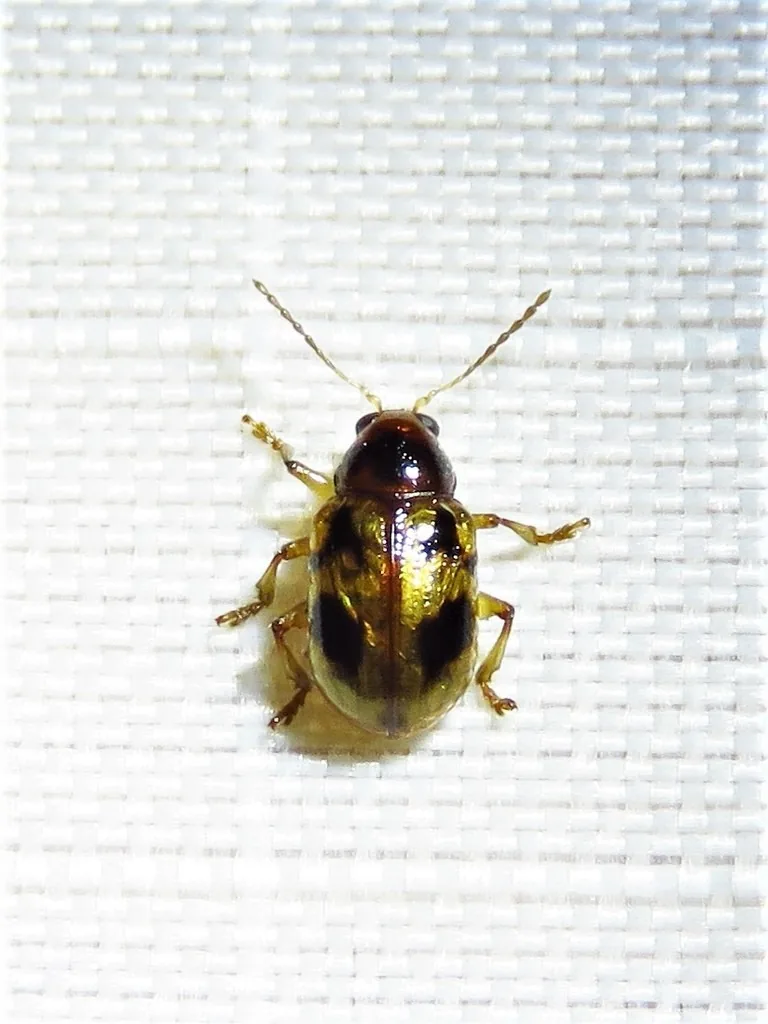
- A shiny, oval beetle about 1/8 inch long, brown to dark brown, with four dark blotches on the wing covers.[1][4]
- The larva is a slender, creamy white grub, slightly longer than the adult (up to about 1/5 inch), living in the soil or potting mix and feeding on roots.[1][4]
- The leaf damage is distinctive: small round to oval or elongated holes, generally no more than 1/16 inch across, chewed into the leaves.[1][4]
- Adults feed at night and hide by day in the foliage or in debris at the base of the plant. Knocked off a plant, they play dead for up to a minute, then scurry or fly for cover.[1][4]
Where it lives
NC State reports it on strawberry and ornamentals in North Carolina, where the beetles are active from at least April through November, and Alabama and USDA researchers note widespread reports of damage in azalea nurseries in the Southeast.[1][4]
Biology and life cycle
NC State says adults overwinter in mulch or soil crevices and become active in April and May. Older strawberry studies, as summarized by Hesselein and Boyd, say the adults feed on warm days through the winter and in mild climates emerge from early February to early March.[1][4]
In a Gulf Coast nursery study, the beetles spent the winter in leaf litter, and more overwintering adults were found there than in the foliage.[3]
Females lay eggs on older leaves near the soil surface, in the lower canopy, or in the potting mix and debris at the base of the plant. The grubs burrow into the soil to feed on roots and pupate there, and new adults appear from midsummer and feed on foliage through early fall.[1][4]
Development from egg to adult takes about 41 days at 85°F and 82 days at 70°F. Older studies reported one generation a year with a possible partial second, but USDA ARS and Alabama researchers collected four generations a year on container azaleas along the Gulf Coast. They also note that the beetle's biology in the Southeast conflicts with the taxonomic records, so the nursery pest may be a different species from the one described in older papers.[4][3][2]
The beetle can complete its entire life cycle in a container azalea without needing another host plant. Records include azalea, rhododendron, sourwood, Virginia sweetspire, strawberry and, in older literature, greenhouse roses.[4][1]
Damage and signs
- The adult beetles cause the damage, chewing numerous small holes (about 1/16 inch across) in the leaves. USDA researchers call it an emergent pest of southeastern nurseries, with severe damage around Semmes, Alabama.[4][2]
- Despite the name, the rootworms themselves do little harm; NC State calls the root damage negligible.[1]
Health risk
It is a leaf-feeding beetle of strawberry and ornamentals. NC State and the Alabama and USDA researchers don't mention any risk to people or pets.[1][4][2]
Control
Prevention
Because the beetles feed at night, check plants after dark with a flashlight before deciding to spray.[1][4]
Sanitation
Remove leaf litter and debris in winter, where the adults overwinter. USDA ARS and Alabama researchers say winter leaf-litter removal plus early-season control reduces the number of beetles later in the season.[3][1]
Traps and physical control
In nurseries, shake infested plants over a clean ground cover, or strike them over a sweep net, and look for beetles in the debris that falls.[1][4]
Pesticides
NC State says pyrethroid insecticides should give more than adequate control because they have a long residual life on the plant, and that Sevin should also give adequate control but may have to be reapplied. EPA's product search lists Sevin products with active registrations. NC State says not to apply pyrethroids around ponds, pools or streams because they are toxic to fish. Follow the label.[1][5]
In a greenhouse trial, Alabama and USDA researchers tested five insecticides against the adults on azaleas, including bifenthrin, spinosad, acephate and carbaryl. Carbaryl (Sevin) was among the most effective, and acephate and spinosad were not effective. Morning and night sprays made no detectable difference in the greenhouse, though the researchers note that outdoor weathering could reduce daytime sprays, and growers anecdotally report better results from nighttime sprays.[4][6]
Where the sources disagree
Insecticides: NC State recommends pyrethroids and says Sevin may need reapplying; in Hesselein and Boyd's greenhouse trial, Sevin was among the most effective and bifenthrin was not.[1][4]
Generations: older strawberry studies reported one generation a year with a possible partial second; the Gulf Coast azalea studies found up to four.[4][3]
Spring emergence: older studies summarized by Hesselein and Boyd give early February to early March in mild climates; NC State says adults become active in April and May.[4][1]
Spray timing: growers anecdotally report better results from nighttime sprays; the greenhouse trial found no difference between morning (9:00 A.M.) and night (9:00 P.M.) sprays.[4]
Males: Smith and Kido (1949) reported populations of females only; the nursery researchers observed males and females mating.[4]
Which species: USDA ARS says the beetle's biology in the Southeast conflicts with the taxonomic records for this species, and GBIF marks the name Paria fragariae Wilcox, 1954 as doubtful.[2][7]
Common questions
- What is making tiny round holes in my azalea leaves?
- The strawberry rootworm is one likely cause. The small brown beetles chew round or oval holes no more than about 1/16 inch across at night and hide during the day, so check the plants after dark with a flashlight.[1][4]
- Do strawberry rootworms damage roots?
- Very little. The grubs feed on roots, but NC State says they do negligible root damage; the beetles' leaf feeding is the main problem.[1]
- When should I spray for strawberry rootworm?
- Check plants at night first. USDA ARS and Alabama researchers say winter leaf-litter removal and early-season control will help reduce the adults later in the season. Growers anecdotally report better results from nighttime sprays, though a greenhouse trial found no difference between morning and night sprays. NC State notes that pyrethroids last longer on the plant than Sevin.[3][4][1]
- What do the beetles do when disturbed?
- Hesselein and Boyd say dislodged beetles at first stop moving and play dead, then within a minute scurry or fly for cover.[4]
Sources
- NC State Extension, “Strawberry Rootworm on Ornamentals, PDIC factsheet.” content.ces.ncsu.edu/strawberry-rootworm-on-ornamentals (accessed 2026-11-13)
- USDA Agricultural Research Service, “Azalea's worst nightmare: the strawberry rootworm, Paria fragariae Wilcox (publication abstract).” www.ars.usda.gov/research/publications/publication/?seqNo115=233889 (accessed 2026-11-13)
- Southern Nursery Association Research Conference, vol. 49, 2005 (Boyd & Hesselein); abstract via USDA ARS, “Biology of the strawberry rootworm, Paria fragariae, in containerized azaleas.” www.ars.usda.gov/research/publications/publication/?seqNo115=168913 (accessed 2026-11-13)
- Alabama Cooperative Extension System and USDA Agricultural Research Service (PDF hosted by USDA ARS), “Strawberry Rootworm Biology and Control (C. P. Hesselein and D. W. Boyd Jr.), SNA Research Conference Proceedings 48 (2003): 174-176.” ars.usda.gov/ARSUserFiles/60620500/BoydPDF/HesseleinandBoyd.pdf (accessed 2026-11-13)
- U.S. EPA Pesticide Product Label System, “Pesticide Product Label System: product-name search 'Sevin'.” ordspub.epa.gov/ords/pesticides/cswu/ProductSearch/partialprodsearch/v2/riname/Sevin (accessed 2026-11-13). 2697 product-name rows, 45 with product status Active (for example 61842-38 SEVIN BRAND 4F CARBARYL INSECTICIDE); saved 2026-11-13.
- USDA Agricultural Research Service, “Strawberry rootworm biology and control (publication abstract).” www.ars.usda.gov/research/publications/publication/?seqNo115=154700 (accessed 2026-11-13)
- Global Biodiversity Information Facility (GBIF), “Paria fragariae Wilcox, 1954 (GBIF Backbone Taxonomy).” api.gbif.org/v1/species/4990853 (accessed 2026-11-13). GBIF marks this species name DOUBTFUL; its subspecies P. f. fragariae and P. f. kirki are ACCEPTED
- iNaturalist, “Paria fragariae taxon page (order and family).” www.inaturalist.org/taxa/227207 (accessed 2026-11-09)