On this page
How to identify it
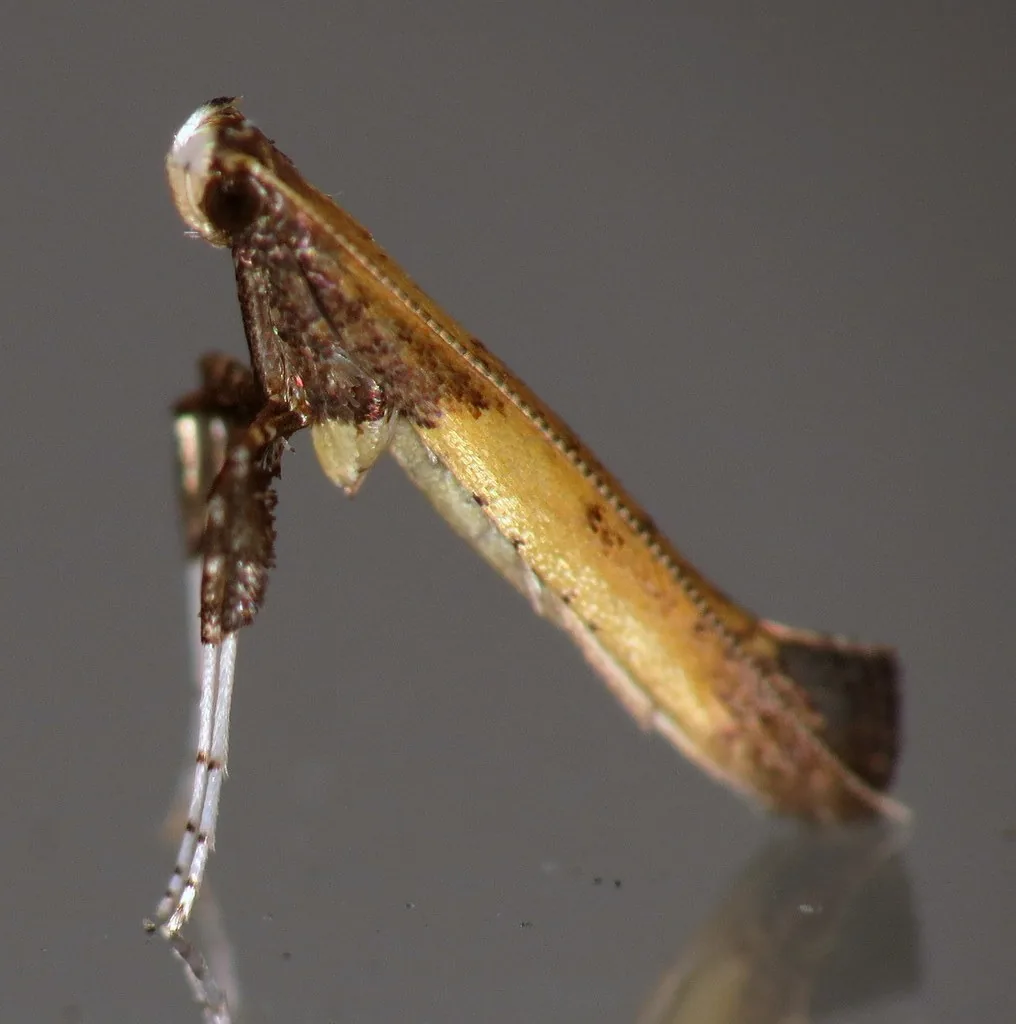
- Adults are small yellow moths with purplish markings on the wings and a wingspan of about 10 to 13 mm. Rutgers describes them as yellowish brown, about 3/8 inch with wings folded, standing tilted up at a 60-degree angle.[1][3]
- The caterpillar is yellowish and about 1/2 inch (13 mm) long when grown.[1][2][3]
- Look for brown blisters on the leaves; held up to the light, a mined leaf shows the larva inside. Later come curled leaf tips tied with silk, usually one caterpillar per leaf. Rutgers notes the damage is easy to miss until the leaf-rolling stage.[1][3]
Look-alikes
| Look-alike | How to tell them apart |
|---|---|
| Azalea lace bug and other lace bugs | Azalea lace bug feeding leaves pale mottled spots on the upper leaf surface and dark specks of excrement underneath, where the small lace-winged adults and spiny nymphs sit. It doesn't make blisters or rolled tips.[1] |
Where it lives
Native to Japan and introduced to azalea-growing regions worldwide, including southern Britain, New Zealand and eastern Australia. In North America it has been reported from Florida to Texas, Long Island, West Virginia, Ohio, California, Washington and British Columbia; NC State says it occurs in most states where azaleas are grown.[2][1]
Biology and life cycle
Eggs are laid singly under the leaf along the midrib, usually one to five per leaf, and hatch in about 4 days. Young larvae mine inside the leaf.[1][2]
At about one-third grown the larva leaves the mine, moves to the tip of a new leaf and rolls it for shelter while it feeds. It pupates in a cocoon inside a rolled leaf edge.[1][3]
Rutgers counts two or more generations a year, with a partial third in southern New Jersey. CDFA reports three generations in Oregon and other western states and three to four in southern states. In greenhouses larvae can be found at any time of year.[3][2][1]
It spends the winter as a larva or pupa in a rolled or mined leaf. Adults appear and begin laying eggs about when azaleas bloom in spring.[1][2][3]
Damage and signs
- Mined areas form brown blisters, and badly injured leaves turn yellow and drop. Plants outdoors are usually affected little, but greenhouse cuttings can be damaged considerably.[1]
- It is a pest of container and field-grown nursery azaleas and also attacks landscape plants. A heavy infestation may not kill the plant but spoils its appearance.[2]
Health risk
It feeds only on azaleas. None of the sources mention any risk to people or pets.[1][2]
Control
Prevention
Check for blotch mines early, in May and again in July. In late June and early July, shake plants to flush the moths and estimate how many are laying eggs. Rutgers puts the first-generation window at 450 to 800 growing degree-days (base 50) and the second at 1260 to 1500.[3]
Biological control
Rutgers lists few natural predators.[3]
Pesticides
Larvae shelter inside mines and rolled leaves, so they are hard to reach. Treat at the first sign of moths or new mines, while larvae are still in the mining stage; one or two applications 1 to 2 weeks apart are usually enough. Rutgers favors systemic or translaminar products and lists horticultural oil and azadirachtin as lower-impact options. Follow the label.[1][3]
Common questions
- What makes azalea leaves blister brown and roll at the tips?
- Often the azalea leafminer: young caterpillars make brown blisters inside the leaf, then older ones roll the tips with silk.[1][3][2]
- Will it kill my azaleas?
- Unlikely outdoors. NC State says it has little effect on outdoor plants, and CDFA says a heavy infestation may not kill the plant but hurts its looks. Greenhouse cuttings are more at risk.[1][2]
- Does it attack rhododendrons?
- NC State lists azaleas as its only known host. CDFA and Rutgers give the host as Rhododendron species, the genus azaleas belong to, so these sources don't settle whether it feeds on rhododendrons that aren't azaleas.[1][2][3]
Sources
- NC State Extension, “Pests of Azalea (Insect and Related Pests of Shrubs).” content.ces.ncsu.edu/pests-of-azalea (accessed 2026-11-11)
- California Department of Food and Agriculture, “Azalea Leafminer, Caloptilia azaleella (Pest Rating Proposals and Final Ratings).” blogs.cdfa.ca.gov/Section3162/?p=5657 (accessed 2026-11-11)
- Rutgers Cooperative Extension, “Azalea Leafminer (Nursery IPM).” sites.rutgers.edu/nursery-ipm/azalea-leafminer/ (accessed 2026-11-11)
- iNaturalist, “Caloptilia azaleella taxon page (order and family).” www.inaturalist.org/taxa/320764 (accessed 2026-10-06)