On this page
How to identify it
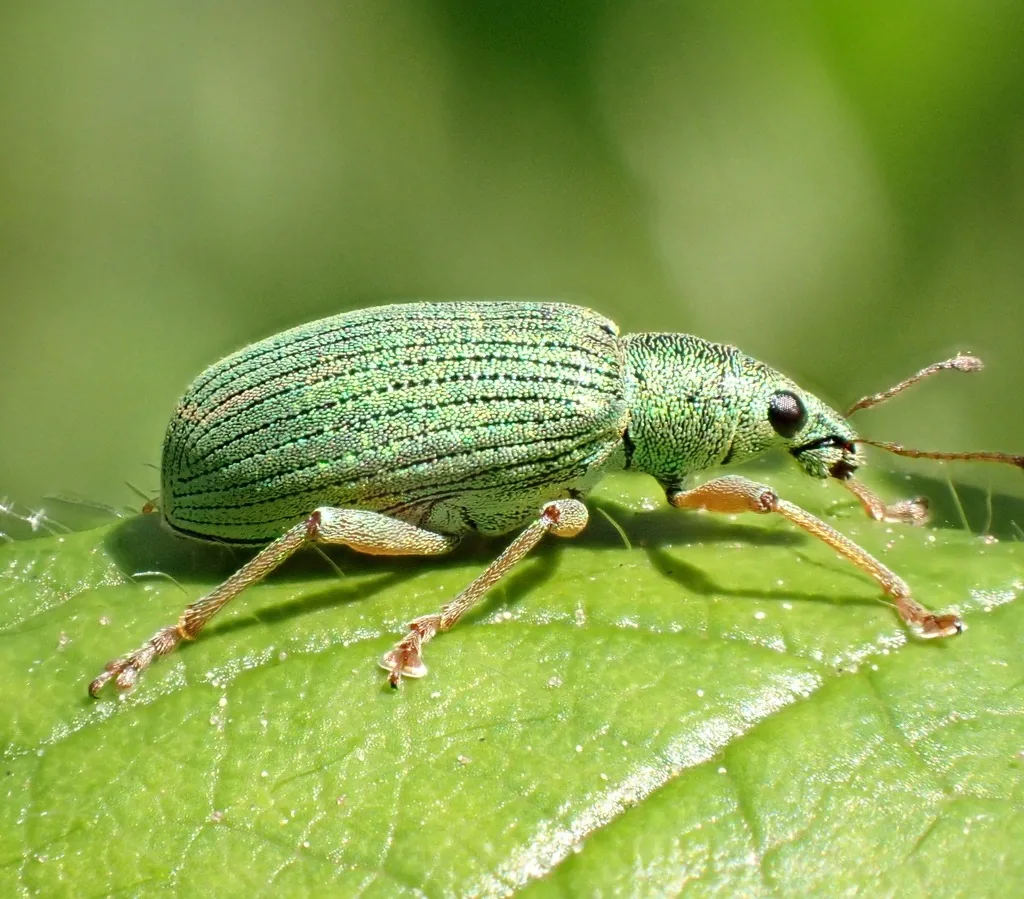
- Adults are slender, about 1/4 inch long, with a short, blunt snout and a dark body covered in bright green, sometimes yellowish, iridescent scales; where scales rub off they look green with black patches.[1][2][4]
- WSU says pale green weevil (P. impressifrons) females are slightly larger, about 5.5 mm, than males, about 4.25 mm.[4]
Look-alikes
| Look-alike | How to tell them apart |
|---|---|
| Strawberry root weevil | UMN says it's the most common home-invading weevil in Minnesota: about 1/4 inch long, black or dark brown with rows of pits, not green. WSU says its feeding on new poplar leaves can be mistaken for pale green weevil damage.[1][4] |
Where it lives
WSU says the pale green weevil is native to Germany and France, was first reported in New York in 1906 and was found in eastern Oregon hybrid poplars in 2004. UMN says P. impressifrons is common in forested northeastern and north-central Minnesota.[4][1]
Biology and life cycle
UMN says adults are active from late May or June through August. WSU says pale green weevils emerge from the ground at the base of host trees starting in late April or early May and mate right away.[2][1][4]
WSU says eggs are laid singly or in groups of up to 85 in bark crevices, holes and wounds, often on the sunny side of the tree. Larvae drop to the soil to feed on roots, overwinter as mature larvae and pupate in late April.[4][1]
Damage and signs
- Adults chew the leaves of rose, strawberry, birch, poplar, willow and apple, and UMN says the larvae feed on the roots. WSU adds pear, elm, linden, locust and yew for the pale green weevil.[1][2][4]
- Sources differ on how much it matters. UMN says it usually occurs in low numbers and the damage is cosmetic. WSU says mature trees withstand it, but large numbers emerging after a poplar harvest can devastate new plantings and young trees.[2][1][4]
Health risk
It feeds on plants, and no cited source describes any risk to people or pets. UMN calls the weevils that wander indoors from June through August a nuisance.[1][3]
Control
Keep them out
Caulk cracks and keep screens and doors snug to keep weevils out of the house.[1]
Traps and physical control
Vacuum or sweep up weevils found indoors; UMN says they're temporary and go away on their own.[1]
Pesticides
UMN says pesticides generally aren't needed indoors and products sold to the public aren't very effective against weevils.[1]
Common questions
- What are the tiny shiny green weevils in my house?
- Often Polydrusus weevils, which wander in from June through August; UMN says they're a temporary nuisance.[1][3]
- Do Polydrusus weevils damage trees?
- Usually only cosmetically, though WSU says large numbers can strip new poplar plantings and young trees.[2][4]
- Which species are they?
- UMN's Minnesota page describes Polydrusus impressifrons, and its garden ID page uses the name Polydrusus sericeus, which GBIF's backbone taxonomy treats as a synonym of Polydrusus formosus.[1][2][5]
Sources
- University of Minnesota Extension, “Home-invading weevils (Nuisance Insects).” extension.umn.edu/nuisance-insects/home-invading-weevils (accessed 2026-11-13)
- University of Minnesota Extension (What insect is this?), “Polydrusus weevil (garden pests).” apps.extension.umn.edu/garden/diagnose/insect/garden/beetles/medium/polydweevil.html (accessed 2026-11-13)
- University of Minnesota Extension (What insect is this?), “Polydrusus weevil (insects found indoors).” apps.extension.umn.edu/garden/diagnose/insect/indoor/beetles/medium/polydrususweevil.html (accessed 2026-11-13)
- Washington State University Extension (with USDA), “Pale Green Weevil (Insect Pest Management in Hybrid Poplars Series, FS273E).” wpcdn.web.wsu.edu/wp-ecommerce/uploads/sites/2/product-3956-sku-FS273E.pdf (accessed 2026-11-13)
- Global Biodiversity Information Facility (GBIF), “Polydrusus formosus (Mayer, 1779) (GBIF Backbone Taxonomy).” api.gbif.org/v1/species/4468015 (accessed 2026-11-13)
- Global Biodiversity Information Facility (GBIF), “Polydrusus impressifrons Gyllenhal, 1834 (GBIF Backbone Taxonomy).” api.gbif.org/v1/species/1176504 (accessed 2026-11-13)