On this page
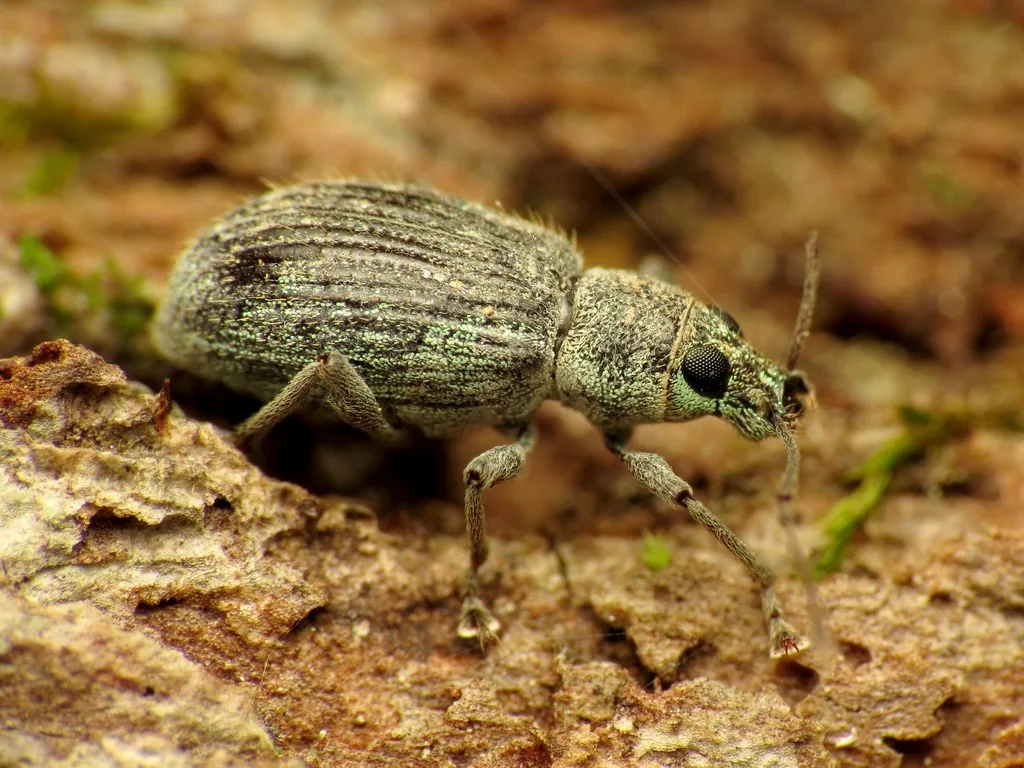
How to identify it
Where it lives
Native to Japan, it was first found in New Jersey in 1933 and now occurs through much of the eastern United States, feeding mainly on oaks. It was recorded from Canada for the first time in 2013. GBIF holds 8205 U.S. records since 1990, the most from Pennsylvania (951), Massachusetts (817), Virginia (772) and North Carolina (697).[1][2][5][6]
Biology and life cycle
Legless grubs live on the roots of hardwood trees through fall, winter and early spring, then pupate.[1]
Adults emerge in May, are most abundant in late June and early July, and lay eggs in the soil from July into fall.[1]
The larvae are small, legless grubs that live among the roots of their host trees, about 6 inches below ground; the grubs feed on roots and the adults on leaves.[2][3]
Fun fact: as far as anyone has found, they are all females. UMass says the species reproduces without males: none were found in a 1955 study, and in the lab unmated females that emerged from pupae began laying eggs in 13 to 18 days.[2]
Adults hide in leaves that caterpillars have tied together. In a field test, adding artificial leaf ties raised weevil numbers on all six tree species tested, and the weevils were naturally most common on white and black oak, which had the most natural leaf ties.[1][4]
Damage and signs
- Adults feed mainly on oaks and chestnut, chewing from the leaf edge inward, sometimes leaving only the main veins; they also feed on maples, tulip poplar and other trees.[1][2]
- Adults fed red and black oak leaves lived longer and laid more eggs than those fed white oak or sugar maple.[1]
- In a Washington University study at Tyson Research Center in Missouri, black oak seedlings that each received just 3 adult weevils had 25% less total leaf area a year later than untouched seedlings, although their stem growth, height, leaf number and survival did not differ. Older work recorded up to 35 percent defoliation in chestnut orchards, yet the U.S. Forest Service classes it as a minor defoliator.[2][3]
- UMass notes that in the southern Appalachians the weevils were more abundant and more often collected on American chestnut and its hybrids, and that high numbers were recorded on red maple, red oak and white oak in Ohio and Indiana.[2]
- Tyson Research Center calls it the most abundant free-feeding, leaf-chewing insect on oak trees in the Missouri Ozarks, and because it attacks seedlings it may affect how those forests regenerate.[3]
Health risk
None to people: UMass Extension says the weevils do not bite or sting and do not damage buildings. Indoors they are a nuisance only.[2][1]
Control
Prevention
On trees, start checking susceptible hosts in May, when adults begin emerging, and watch most closely in late June and early July at their seasonal peak. UMass suggests that reducing leaf-tying and leaf-rolling caterpillars on an individual ornamental or shade tree may also reduce weevils, but not in native forests, where those caterpillars belong.[2]
Traps and physical control
Indoors, remove the weevils by sweeping or vacuuming.[2]
Pesticides
On a small, heavily infested specimen tree, most landscape insecticides should give adequate control.[1]
Common questions
- What are the small gray weevils in my house?
- In oak country they may be Asiatic oak weevils, which sometimes enter houses for the winter.[1]
- Do Asiatic oak weevils hurt oaks?
- Adults chew leaf edges, sometimes eating all but the main veins.[1]
- Will Asiatic oak weevils bite me or damage my house?
- No. UMass Extension says they do not bite or sting and do not damage buildings; sweep or vacuum them up.[2]
- Where did it come from?
- It is native to Japan. NC State and UMass date the first U.S. find to 1933 in New Jersey.[1][2]
- Are there male Asiatic oak weevils?
- None have been found. UMass says the species reproduces without males, and unmated females raised in the lab began laying eggs in 13 to 18 days.[2]
- Do the weevils kill oak seedlings?
- Not in the one test we found. At Tyson Research Center, black oak seedlings given 3 weevils each lost 25% of their leaf area but grew and survived as well as untouched seedlings the next year.[3]
Sources
- NC State Extension, “Asiatic Oak Weevil (PDIC Factsheet).” content.ces.ncsu.edu/asiatic-oak-weevil (accessed 2026-11-12)
- UMass Extension Landscape, Nursery and Urban Forestry Program (Landscape Insect & Mite Guide), “Cyrtepistomus castaneus (Asiatic Oak Weevil).” www.umass.edu/agriculture-food-environment/landscape/publications-resources/insect-mite-guide/cyrtepistomus-castaneus-0 (accessed 2026-11-12)
- Washington University in St. Louis, Tyson Research Center, “Impacts of the Asiatic oak weevil (Cyrtepistomus castaneus) on the growth and survivorship of black oak (Quercus velutina) seedlings (R. Marquis, L. B. Catano).” tyson.wustl.edu/allprojects/2017/10/4/impacts-of-the-asiatic-oak-weevil-icyrtepistomus-castaneusi-on-the-growth-and-survivorship-of-black-oak-iquercus-velutinai-seedlings (accessed 2026-11-12)
- Ecology (2014), via PubMed, “Native leaf-tying caterpillars influence host plant use by the invasive Asiatic oak weevil through ecosystem engineering.” pubmed.ncbi.nlm.nih.gov/25039212/ (accessed 2026-11-12). Cited from the PubMed abstract.
- ZooKeys (2013), via PubMed, “New Curculionoidea (Coleoptera) records for Canada.” pubmed.ncbi.nlm.nih.gov/23794927/ (accessed 2026-11-12). Cited from the PubMed abstract.
- Global Biodiversity Information Facility (GBIF), “Cyrtepistomus castaneus: U.S. occurrence records since 1990 by state (GBIF occurrence search).” api.gbif.org/v1/occurrence/search?taxonKey=4291745&country=US&hasGeospatialIssue=false&occurrenceStatus=PRESENT&year=1990%2C2026&facet=stateProvince&facetLimit=400&limit=0 (accessed 2026-11-12)
- iNaturalist, “Cyrtepistomus castaneus taxon page (order and family).” www.inaturalist.org/taxa/218048 (accessed 2026-11-12)