The short answer
- Exclusion works best: replace loose screens, and caulk gaps around door and window frames, soffits and siding before the bugs gather.[1]
- Screen soffit and peak vents as well as windows and doors.[3]
- Vacuum bugs that get inside rather than crushing or spraying them; a shop vacuum with a little soapy water kills them and keeps odor out of your household vacuum.[3]
- They come in looking for winter shelter; beyond being annoying, they are not a threat.[1]
- Timing matters more than products. Kentucky Extension says to seal in late spring or summer, before lady beetles start flying to buildings; Minnesota Extension sets the end of August for boxelder bug repairs and the end of September for lady beetles.[9][13][10]
- Once they're in the walls or attic, insecticides inside aren't advised. Penn State says to seal the cracks they crawl out of indoors instead, around baseboards, trim, ceiling lights and exhaust fans.[6][16]
- Foggers and bug bombs don't solve it. A fogger kills the insects in the open but doesn't stop more from coming out of wall voids.[14][16][5]
Common invaders with full profiles
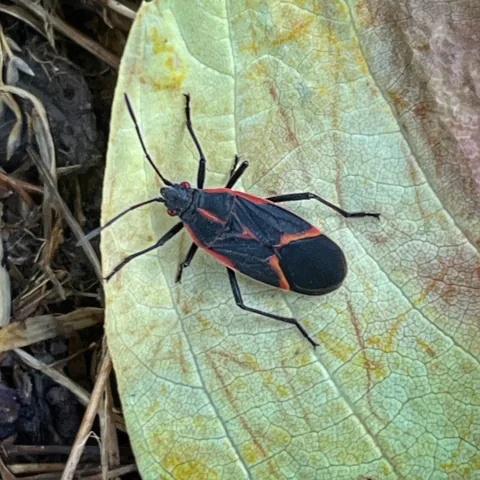 Boxelder Bug
Boisea trivittata
Boxelder bugs feed mainly on the seeds of female boxelder trees and become a nuisance in fall, when large numbers gather on and around homes looking for a place to spend the winter. Indoors they can stain fabrics and smell when crushed, but they don't damage the structure and don't breed inside.
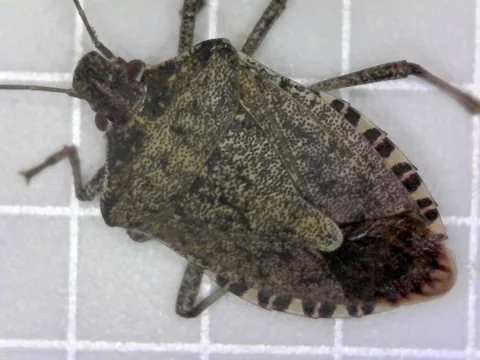 Brown Marmorated Stink Bug
Halyomorpha halys
The brown marmorated stink bug is an invasive insect from east Asia that damages fruit and vegetable crops and invades homes in fall looking for overwintering sites. Minnesota Extension says it feeds on about 200 plant species and, unlike the native stink bugs there, prefers to spend the winter in homes. Clemson notes that the bugs gather on outside walls before they move in.
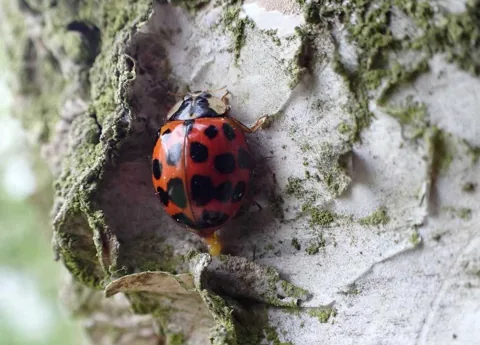 Multicolored Asian Lady Beetle
Harmonia axyridis
The multicolored Asian lady beetle is a beneficial aphid predator outdoors but becomes a nuisance when it flies to buildings in fall to overwinter and ends up indoors. Clemson and Colorado State extension both describe it as a valuable aphid predator on crops, trees and shrubs.
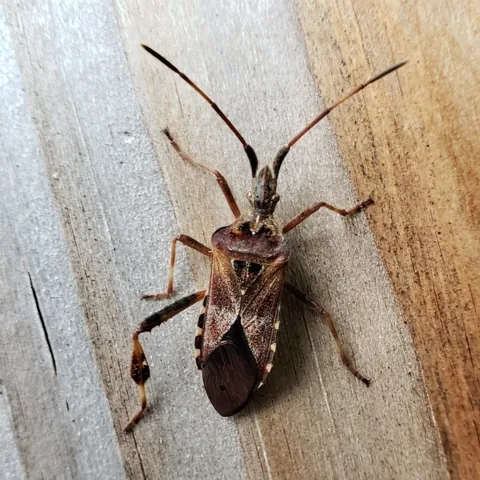 Western Conifer Seed Bug
Leptoglossus occidentalis
The western conifer seed bug is a leaf-footed bug that feeds on the seeds and cones of pines and other conifers. In fall, adults look for sheltered places to spend the winter, and many end up inside houses, where they are a nuisance but harmless.
 Kudzu Bug
Megacopta cribraria
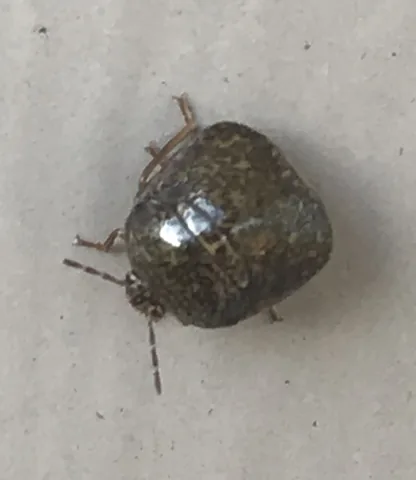
The kudzu bug is an invasive Asian insect, related to stink bugs, that feeds on kudzu, wisteria and soybeans. In late summer and fall it gathers in large numbers on houses, especially light-colored ones, hunting for places to spend the winter. It is a nuisance rather than a danger: its secretions smell bad and stain fabric, walls and skin. Seal gaps before fall, vacuum bugs that get in instead of crushing them, and spray outdoors only where bugs land.
 Elm Leaf Beetle
Xanthogaleruca luteola
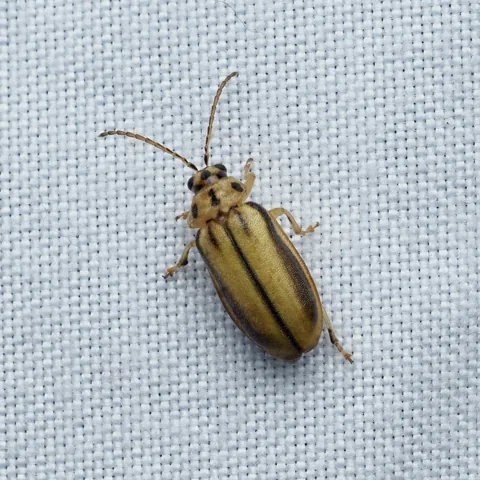
The elm leaf beetle is a small striped beetle that chews elm leaves and can strip large elms bare. In fall the adults look for winter shelter and often end up inside homes, where they are a nuisance but don't bite, feed or breed. Indoors, seal entry points and vacuum them up; on the tree, natural enemies keep it in check in most years, and badly hit trees can be protected with bark bands or systemic insecticides.
 Elm Seed Bug
Arocatus melanocephalus
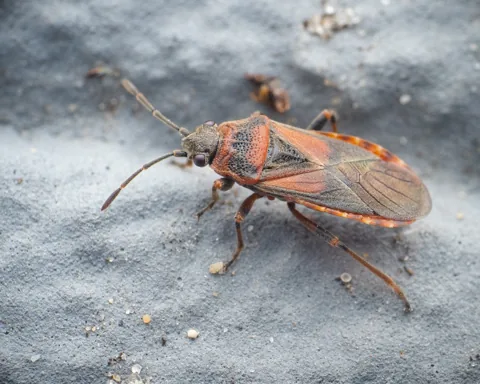
The elm seed bug is a small rusty-red and black true bug from Europe that feeds on elm seeds and moves into homes and buildings in great numbers. It doesn't bite, breed indoors or damage the house, but it leaves fecal spots and smells like bitter almonds when crushed. Unlike the boxelder bug, it peaks indoors in summer. The best fixes are sealing cracks outside and vacuuming the bugs inside.
 Cluster Fly
Pollenia species (e.g., P. rudis)
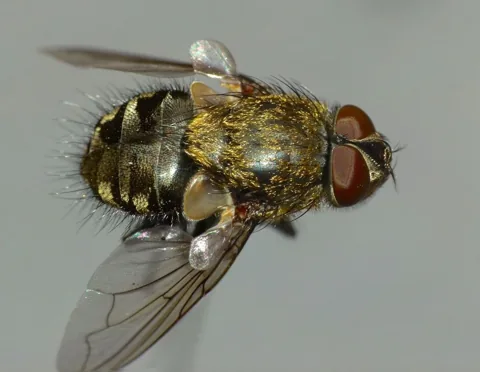
Cluster flies gather on the sunny sides of buildings in fall to find places to overwinter and then appear indoors, often in large numbers, on warm days through winter and spring. They do not breed indoors.
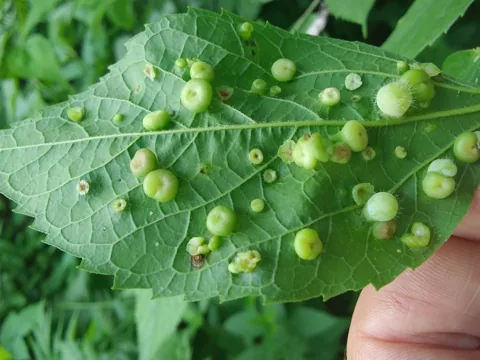 Hackberry Psyllids
Pachypsylla species (e.g., P. celtidismamma, the hackberry nipple gall maker)
Hackberry psyllids are tiny insects that spend the summer inside galls on hackberry leaves. In fall the adults leave the galls looking for winter shelter, gather on windows and screens, and are small enough to squeeze through most window screening.
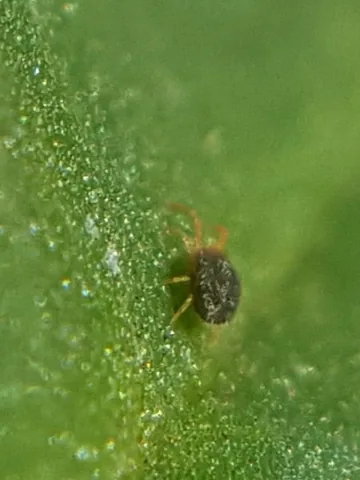 Clover Mite
Bryobia praetiosa
Clover mites are tiny plant feeders that invade homes in early spring and sometimes fall; they don't bite people or pets, don't breed indoors and soon die inside.
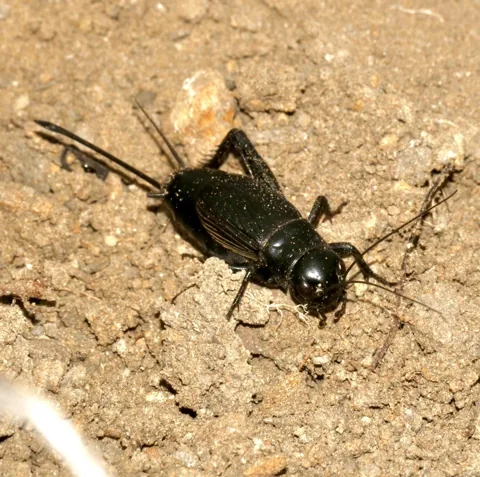 Field Crickets
Gryllus species (e.g., G. pennsylvanicus)
Field crickets are several species in the genus Gryllus that live outdoors in fields, pastures, roadsides and yards. They come into homes most often in late summer and fall, when cooler nights and outdoor lights draw them toward buildings.
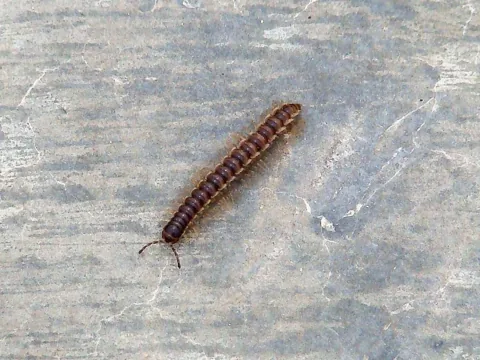 Greenhouse Millipede
Oxidus gracilis
Millipedes live in cool, damp places under leaves, mulch and stones; occasionally they migrate into buildings in large numbers but do no damage and soon die indoors. Clemson says the garden millipede (Oxidus gracilis) is the species that most often invades homes in large numbers.
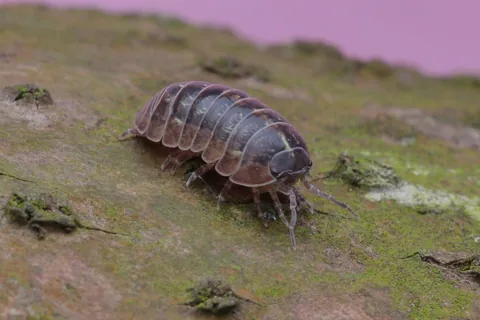 Common Pillbug
Armadillidium vulgare
Sowbugs and pillbugs are land-living crustaceans, more closely related to shrimp and crayfish than to insects, that feed mostly on decaying plant matter. They are harmless indoors, and finding many inside usually points to dampness, a large population outdoors or a gap at a door or window.
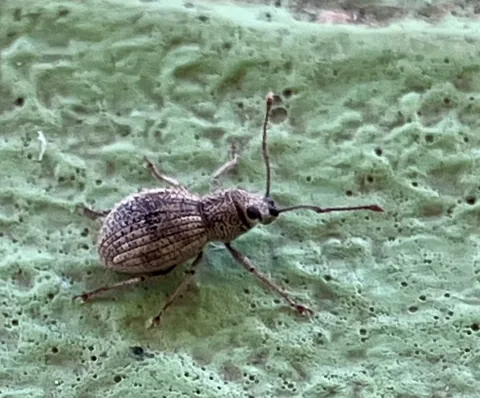 Imported Longhorned Weevil
Calomycterus setarius
The imported longhorned weevil is a small, gray-brown snout beetle from Japan that wanders into homes by mistake in July and August. It is harmless: it doesn't bite or sting, and it doesn't damage the house, furnishings, people or pets. Vacuum or sweep up the ones inside and seal the cracks they crawl through; indoor sprays aren't needed. A fun fact: only females have ever been found, and they lay eggs without mating, so a single weevil can start a new population. They also cannot fly, so they walk in.
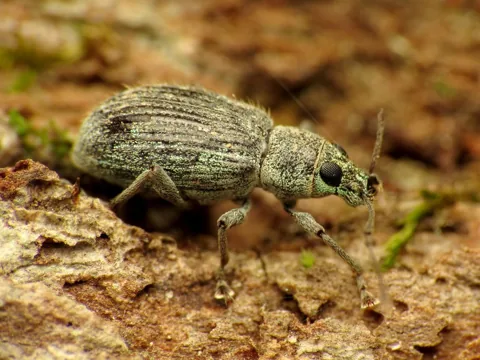 Asiatic Oak Weevil
Cyrtepistomus castaneus
The Asiatic oak weevil is a small, greenish-gray, broad-nosed weevil from Japan that chews the edges of oak and chestnut leaves in summer and sometimes invades houses looking for a place to spend the winter. Indoors it is only a nuisance: it does not bite or sting and does not damage the house, so sweep or vacuum it up.
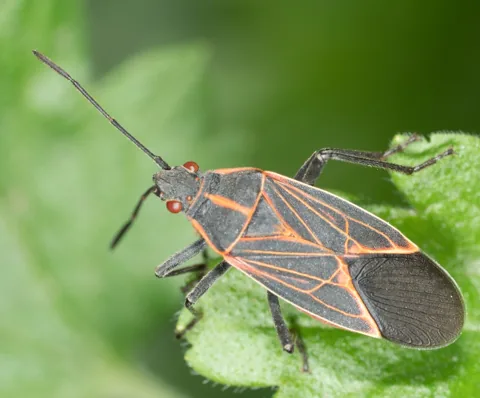 Western boxelder bug
Boisea rubrolineata
The western boxelder bug is a black-and-red true bug that feeds mostly on the leaves, flowers and seedpods of female box elder trees. It does little harm to plants. The trouble starts when clusters form on outside walls and then move into the house in fall and spring. Colorado State, writing about boxelder bugs in general, says they are a nuisance in and around homes from fall through early spring.
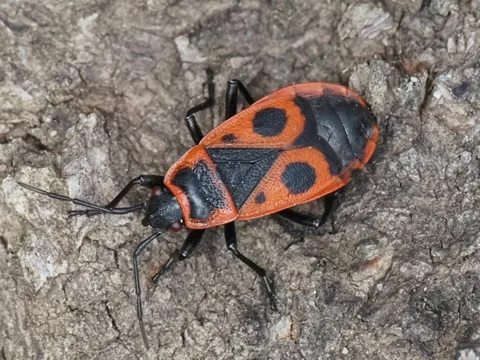 Red firebug (European firebug)
Pyrrhocoris apterus
The red firebug, also called the European firebug, is a red-and-black true bug from Europe and Asia that feeds mainly on seeds of mallows, lindens and their relatives. First found in North America in Salt Lake City in 2008, it is now established across Utah and southern Idaho. It does little harm to plants, but large groups gather on homes and can move indoors in late fall.
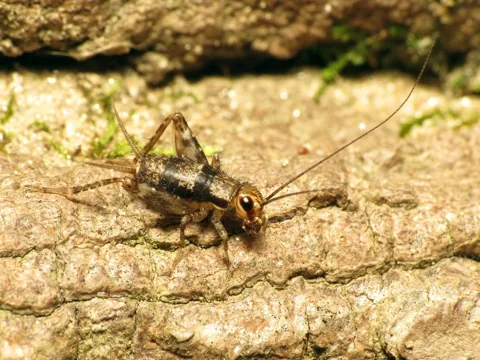 Ground crickets
Nemobiinae (Allonemobius, Eunemobius, Neonemobius and others)
Every autumn someone asks why the pavement under the store lights is covered in baby crickets. They are not babies. Ground crickets, sometimes called pygmy field crickets, are a separate group from the big black field crickets, and the ones under the lights are full-grown adults with wings, less than half an inch long. They scavenge plants and other insects, are generally not pests of crops, gardens or landscapes, and are among the last insects still singing in late fall.
Which invader is it?
Most of these insects behave the same way: they look for a sheltered place to spend the winter, gather on warm, sunny walls, and slip through cracks. The right plan depends on which one you have, so start here, then use the guide links below this list.[4][5]
- Shield-shaped, mottled brown bugs with light bands on the antennae: brown marmorated stink bugs. Illinois Extension notes they also feed on fruit, vegetables and crops outdoors, so they're more than a nuisance.[4][6]
- Yellow to reddish-orange beetles with anywhere from zero to 19 spots and often an M-shaped mark near the head: multicolored Asian lady beetles. Kentucky Extension says they occasionally bite or pinch when they land on skin.[4][9]
- Black bugs about one-half inch long with orange or red markings, worst near boxelder trees: boxelder bugs.[4][5]
- Sluggish flies like a house fly but a little larger, with golden hairs: cluster flies. Their maggots feed on earthworms, and the adults can't breed indoors.[5][16][18]
- Brown bugs about 3/4 inch long with thick hind legs that buzz loudly in flight: western conifer seed bugs. There's no separate guide; the sealing and vacuuming steps on this page apply.[1][5]
- Crickets wander in from outdoors, especially in late summer and fall. Turning off unneeded outdoor lights, or switching to yellow bulbs, makes the house less inviting.[19][20]
- Millipedes show up in basements, garages and window wells during migrations that often follow cooler weather or heavy rain.[21][22]
- Tiny red mites crawling on windowsills, often on the sunny side of the house, that leave a red-brown smear when crushed: clover mites, mostly a spring nuisance and sometimes a fall one.[23][24]
Sealing calendar
Sealing works only if it's done before the insects arrive. The sources don't agree on a single deadline, so use the earliest one that fits the invaders you get. Kentucky Extension says late spring or summer for lady beetles, Minnesota Extension says repairs by the end of August for boxelder bugs and by the end of September for lady beetles, and New Hampshire Extension says to caulk and screen attic vents before September 10 for cluster flies.[9][13][10][18]
- Late spring and summer: walk the outside of the house and make repairs while nothing is clustering yet. Elm seed bugs, where they occur, are the early exception: Utah State puts their nuisance peak at mid-June through August.[9][2]
- August: cluster flies begin looking for winter shelter in August and September, and Montana State says they cluster on sun-warmed walls from mid-August to October. Minnesota Extension says stink bug numbers are highest from mid-August through October.[17][5][7]
- September: Penn State says stink bugs start searching for overwintering sites in September and keep going through October. Western conifer seed bugs gather on buildings in late summer and early fall.[6][1]
- Late September through October: lady beetle flights. Kentucky Extension says swarms reach buildings from September through November depending on location, with most in October in Kentucky; in Minnesota it's late September to late October on days above 65°F. Flights are heaviest on sunny afternoons after a cool spell.[9][10]
- Fall: kudzu bugs move to sheltered spots in the Southeast, and crickets wander indoors. Penn State says boxelder bugs mass on south-facing walls; Minnesota Extension says south and west exposures.[3][19][14][13]
- Winter: insects already in the walls come out on warm days or when the heat is turned up. Penn State says clover mites can become active as early as mid-January during warm spells in southeastern Pennsylvania.[7][1][24]
- Spring: the overwintering insects try to get back outside, and many end up in living areas instead. Kentucky Extension says exterior barrier sprays are useless by late winter or early spring because the beetles got in the previous autumn.[10][13][9]
Where to seal
Exclusion is the best strategy for all of these insects. Make sure windows and doors fit tight, fix holes in screens, seal openings around the foundation, pipes, wires and chimneys, and keep siding, eaves and soffits in good repair.[4][1]
- Caulk cracks around windows, doors, siding, utility pipes, behind chimneys and under the wood fascia. Penn State recommends good-quality silicone or silicone-latex caulk; Minnesota Extension suggests expanding foam, steel wool or copper mesh for larger gaps.[6][10]
- Screen soffit, peak and attic vents and fireplace chimneys, not just windows.[3][1][18]
- Fit door sweeps or thresholds on exterior doors and repair weather stripping. Montana State adds sealing dryer vents and the openings around utility wires.[9][5][22]
- Check sliding windows where the two sashes meet. Utah State found small gaps there let elm seed bugs in easily; tape or removable caulk can close windows you don't open.[2]
- Contrasting trim draws lady beetles. Kentucky Extension says dark shutters on light siding, light trim on dark siding, and gutters on contrasting siding all attract them, so check those spots closely.[9]
- Indoors, seal the cracks they come out of: under or behind baseboards, around window and door trim, and around ceiling lights and exhaust fans.[6][16]
- Cut back what feeds them near the house where you can: female boxelder trees for boxelder bugs, kudzu and wisteria for kudzu bugs. Bugs from neighboring yards can still fly in.[5][3]
Once they're inside
Vacuuming is the main tool. Avoid crushing them; stink bugs, lady beetles, kudzu bugs and elm seed bugs give off odors, and lady beetles and kudzu bugs can stain fabrics and walls.[9][3][6][2]
- Use a shop vacuum with soapy water, or empty the bag outdoors afterward. New Hampshire Extension notes cluster flies can crawl back out of a vacuum bag left indoors.[3][18]
- Your vacuum may smell like stink bugs for a while after.[6][8]
- Don't spray or fog inside. Missouri Extension says indoor foggers and sprays aren't recommended for stink bugs, and Illinois Extension says indoor insecticides are generally not recommended for any of these invaders.[8][4]
- Dead insects in wall voids can feed carpet beetles, which may then move on to wool, stored dry goods and other natural products. Penn State raises this as a drawback of dusting wall voids.[6][14][16]
- Light traps catch lady beetles and flies in dark spaces such as attics, but Kentucky Extension says they catch relatively few in living areas.[9]
- They don't breed indoors. Every lady beetle seen in winter and spring got in the previous fall, and cluster flies and boxelder bugs indoors are overwintering adults, not a new generation.[10][16][5]
Outdoor sprays: limited help, timing matters
Perimeter insecticides can be applied around the outside of a house, but Illinois Extension says these insects move around so much that good control is hard to get. Kentucky Extension says vacuuming, sealing and well-timed outdoor treatments give relief but won't keep every beetle out.[4][9]
- Lady beetles: spray before they enter, typically late September to early October in Kentucky; Wisconsin Extension gives the same window and suggests the south, west and east sides.[9][11]
- Boxelder bugs: Minnesota Extension says late summer and early fall, when they first cluster on the outside of buildings. Montana State says most exterior insecticides aren't very effective against them.[13][5]
- Cluster flies: Montana State says pyrethroid sprays in cracks and crevices in late summer, as they start clustering, last 2 to 3 weeks.[5]
- Kudzu bugs: Clemson says to treat small areas where they land, in daylight once nights cool to about 50°F, and that rain and sun break the spray down.[3]
Western conifer seed bug
- Adults are 3/4 inch, reddish to dark brown, with a thin, jagged white line across the back and yellow-and-black patches along the abdomen edge; they buzz loudly in flight.[1]
- Native to the West, it spread east from the 1950s and is now found across the U.S., most abundant in the Northeast. It feeds on conifer cones and seeds without harming the trees.[1]
- It isn't considered a medical risk: only a single bite has ever been recorded worldwide.[1]
- Penn State says low numbers may come out indoors all winter, with larger numbers flying around on warm fall and spring days. Montana State says those trapped inside often die in a week or two without water and can be swept or vacuumed up.[1][5]
Elm seed bug
- Adults are about 1/3 inch, rusty red and black, with an upside-down black triangle on the back and white dots near the wing tips; when crushed they give off a pungent odor like bitter almonds.[2]
- A European insect first found in the U.S. in Idaho in 2012, now in Utah, Oregon and Washington, it feeds mainly on elm seeds. Unlike the boxelder bug, its nuisance peak is mid-June through August.[2]
- Seal exterior cracks, and make sure windows, screens and door sweeps fit with no gaps; perimeter pyrethroid treatments around foundations, windows, doors and eaves can reduce entry.[2]
Kudzu bug
- Kudzu bugs are almost square, about 1/4 inch, light brown with an olive-green hue, and related to stink bugs; first found in Georgia in 2009, they're now across the Southeast.[3]
- They feed on kudzu, wisteria, soybeans and other beans, then gather on light-colored, especially white, sunlit house walls, window trim and gutters in fall.[3]
- Their secretions smell bad and stain fabrics and walls; handling them can stain skin or even cause blisters in sensitive people. Cutting back nearby kudzu or wisteria before fall helps.[3]
Common questions
- Will these bugs damage my house or bite me?
- They don't damage the house. Stink bugs don't bite, and only one western conifer seed bug bite has ever been recorded. Asian lady beetles occasionally pinch skin, and sources disagree on boxelder bugs: Kentucky Extension says they don't bite, while Colorado State and Montana State say rare bites have been reported.[1][8][9][12][15][5]
- Should I spray inside the house?
- Vacuum bugs found indoors instead; most home insecticides kill kudzu bugs, but sprays are best limited to small outdoor areas where they land.[3]
- Why do the bugs come back every year?
- They return to protected overwintering sites each fall; sealing cracks and gaps before they gather is the best long-term fix.[1]
- When should I seal my house against fall invaders?
- Before they start gathering. Kentucky Extension says late spring or summer; Minnesota Extension says by the end of August for boxelder bugs and the end of September for lady beetles; New Hampshire Extension says before September 10 for cluster flies.[9][13][10][18]
- Why are they coming out in winter or spring?
- They got into the walls or attic last fall. Warm days, or turning up the heat, wake them, and as they try to get back outside some wander into living areas.[7][16][10]
- Will a bug bomb get rid of them?
- No. Penn State says a fogger kills the insects out in the room but doesn't stop more from coming out of wall voids, and Montana State says bug bombs aren't effective for cluster flies.[14][16][5]
Full guides for each invader
- How to get rid of stink bugs
- How to get rid of Asian lady beetles
- Ladybugs vs. Asian lady beetles
- How to get rid of boxelder bugs
- How to get rid of cluster flies
- Western conifer seed bug profile
- How to get rid of crickets
- How to get rid of centipedes and millipedes
- How to get rid of clover mites
- Perimeter pest sprays: label limits and runoff
Photo credits
- Boxelder Bug: (c) Alfonso Benítez-Mora, some rights reserved (CC BY) — via iNaturalist, CC BY 4.0
- Brown Marmorated Stink Bug: (c) Stan Rullman, some rights reserved (CC BY) — via iNaturalist, CC BY 4.0
- Multicolored Asian Lady Beetle: (c) Sascha Nunheim, some rights reserved (CC BY) — via iNaturalist, CC BY 4.0
- Western Conifer Seed Bug: (c) Gavin Slater, some rights reserved (CC BY) — via iNaturalist, CC BY 4.0
- Kudzu Bug: (c) Cole Shoemaker, some rights reserved (CC BY) — via iNaturalist, CC BY 4.0
- Elm Leaf Beetle: (c) Joshua Ebright, some rights reserved (CC BY) — via iNaturalist, CC BY 4.0
- Elm Seed Bug: (c) Alexis Tinker-Tsavalas, some rights reserved (CC BY) — via iNaturalist, CC BY 4.0
- Cluster Fly: (c) Steve Kerr, some rights reserved (CC BY) — via iNaturalist, CC BY 4.0
- Hackberry Psyllids: Ira Gershenhorn, public domain (CC0), via iNaturalist
- Clover Mite: (c) Alexis Tinker-Tsavalas, some rights reserved (CC BY) — via iNaturalist, CC BY 4.0
- Field Crickets: (c) Dustin Snider, some rights reserved (CC BY) — via iNaturalist, CC BY 4.0
- Greenhouse Millipede: (c) capacoscar, some rights reserved (CC BY) — via iNaturalist, CC BY 4.0
- Common Pillbug: (c) Carlos Alexandre Mattos Raposo, some rights reserved (CC BY) — via iNaturalist, CC BY 4.0
- Imported Longhorned Weevil: (c) River Ahlquist, some rights reserved (CC BY) — via iNaturalist, CC BY 4.0
- Asiatic Oak Weevil: (c) Katja Schulz, some rights reserved (CC BY) — via iNaturalist, CC BY 4.0
- Western boxelder bug: Jesse Rorabaugh, public domain (CC0), via iNaturalist
- Red firebug (European firebug): (c) Michael Knapp, some rights reserved (CC BY) — via iNaturalist, CC BY 4.0
- Ground crickets: (c) Katja Schulz, some rights reserved (CC BY) — via iNaturalist, CC BY 4.0
Sources
- Penn State Extension, “Western Conifer Seed Bug (updated January 19, 2026).” extension.psu.edu/western-conifer-seed-bug (accessed 2026-10-06)
- Utah State University Extension, “Elm Seed Bug.” extension.usu.edu/planthealth/research/elm-seed-bug (accessed 2026-10-06)
- Clemson Cooperative Extension Home & Garden Information Center, “Kudzu Bugs Around the Home (HGIC).” hgic.clemson.edu/factsheet/kudzu-bugs-around-the-home/ (accessed 2026-10-06)
- University of Illinois Extension, “Fall house guests (news release, September 23, 2019).” extension.illinois.edu/news-releases/fall-house-guests (accessed 2026-11-10)
- Montana State University Extension, “Fall Home Invaders (LILA, Fall 2023).” www.montana.edu/extension/lila_extn/lila_fall_23/FallHomeInvaders.html (accessed 2026-11-10)
- Penn State Extension, “Brown Marmorated Stink Bug.” extension.psu.edu/brown-marmorated-stink-bug (accessed 2026-11-10)
- University of Minnesota Extension, “Brown marmorated stink bug.” extension.umn.edu/garden-and-home/yard-and-garden/yard-and-garden-insects/brown-marmorated-stink-bug (accessed 2026-11-10)
- University of Missouri Integrated Pest Management, “Brown Marmorated Stink Bugs in Homes.” ipm.missouri.edu/MEG/2016/10/Brown_Marmorated_Stink_Bugs_in_homes/ (accessed 2026-11-10)
- University of Kentucky Entomology, “Asian Lady Beetle Infestation of Structures, ENTFACT-416.” entomology.mgcafe.uky.edu/ef416 (accessed 2026-11-10)
- University of Minnesota Extension, “Multicolored Asian lady beetles.” extension.umn.edu/nuisance-insects/multicolored-asian-lady-beetles (accessed 2026-11-10)
- University of Wisconsin-Madison Extension, “Multicolored Asian Lady Beetle.” hort.extension.wisc.edu/articles/multicolored-asian-lady-beetle/ (accessed 2026-11-10)
- University of Kentucky Entomology, “Boxelder Bug, ENTFACT-444.” entomology.mgcafe.uky.edu/ef444 (accessed 2026-11-10)
- University of Minnesota Extension, “Boxelder bugs.” extension.umn.edu/nuisance-insects/boxelder-bugs (accessed 2026-11-10)
- Penn State Extension, “Boxelder Bug.” extension.psu.edu/boxelder-bug (accessed 2026-11-10)
- Colorado State University Extension, “Boxelder Bug.” extension.colostate.edu/resource/boxelder-bug/ (accessed 2026-11-10)
- Penn State Extension, “Cluster Flies.” extension.psu.edu/cluster-flies (accessed 2026-11-10)
- University of Minnesota Extension, “Flies.” extension.umn.edu/garden-and-home/home-maintenance/household-insects/flies (accessed 2026-11-10)
- University of New Hampshire Extension, “Cluster Flies Fact Sheet.” extension.unh.edu/resource/cluster-flies-fact-sheet (accessed 2026-11-10)
- University of Minnesota Extension, “Crickets.” extension.umn.edu/garden-and-home/home-maintenance/household-insects/crickets (accessed 2026-11-10)
- Clemson Cooperative Extension Home & Garden Information Center, “House and Field Crickets (HGIC).” hgic.clemson.edu/factsheet/house-and-field-crickets/ (accessed 2026-11-10)
- Penn State Extension, “Millipedes.” extension.psu.edu/millipedes (accessed 2026-11-10)
- University of Kentucky Entomology, “Centipedes and Millipedes, ENTFACT-645.” entomology.mgcafe.uky.edu/ef645 (accessed 2026-11-10)
- University of Kentucky Entomology, “Clover Mites, ENTFACT-627.” entomology.mgcafe.uky.edu/ef627 (accessed 2026-11-10)
- Penn State Extension, “Clover Mites.” extension.psu.edu/clover-mites (accessed 2026-11-10)