On this page
How to identify it
- Minnesota Extension gives the length as about 3/16 inch. UMass gives 3.59 to 4.66 mm, and Iowa State's crop guide says about 4 mm. South Dakota State puts root weevils and this weevil together at about 1/3 inch, so sizes differ by source.[2][4][6][5]
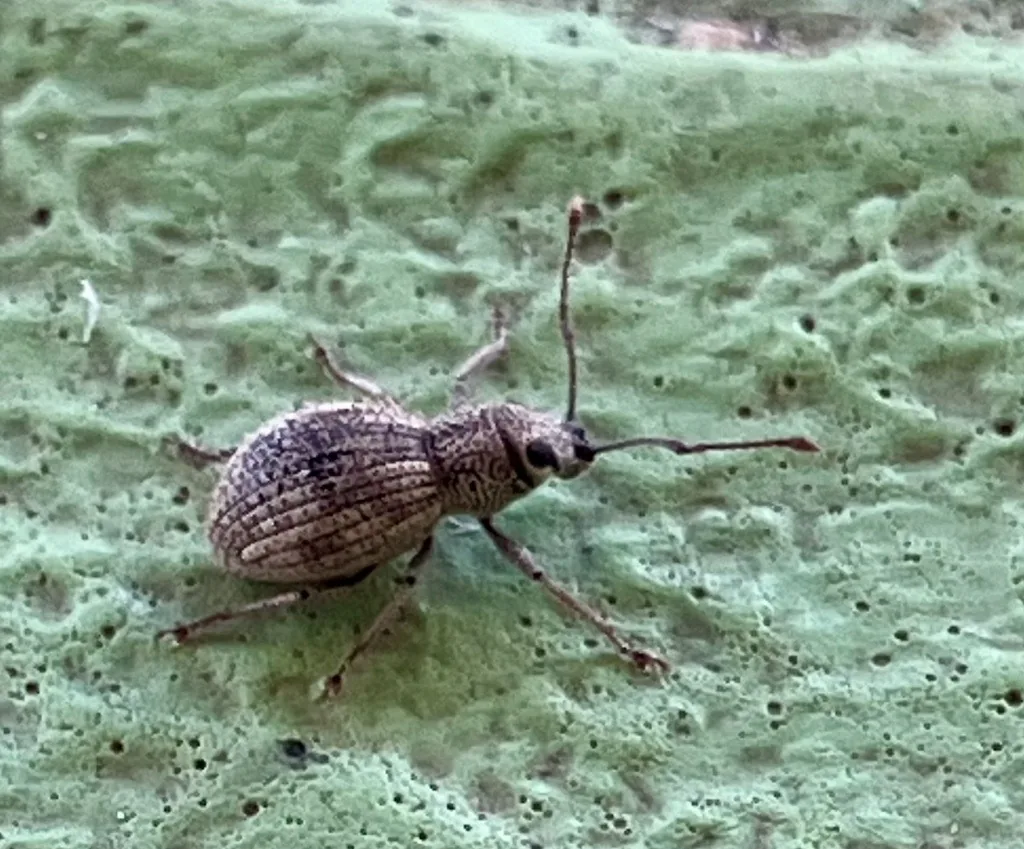
- Adults are dark-bodied and covered with grayish-brown scales, which look mottled gray; patches where scales are missing look like irregular black spots. Root weevils of the same size are black instead.[2][5][6]
- Seen from above and the side they have a characteristic light-bulb shape.[1]
- Like other weevils it has a distinct snout, with elbowed antennae that start partway down the snout.[5][6]
Look-alikes
| Look-alike | How to tell them apart |
|---|---|
| Strawberry root weevil | A close relative and an equally common accidental invader. Adults are black or dark brown with rows of pits along the back, not mottled gray.[1][2][5] |
Where it lives
UMass reports that it is native to Japan and was first recorded in the United States in New York in 1929, then in Connecticut in 1932 and later in Illinois, Iowa, Maryland, Massachusetts, Pennsylvania and Rhode Island. Iowa State has records since 1943 and calls it a common accidental invader there. Minnesota Extension finds it mainly in southern Minnesota.[4][6][1][2]
Biology and life cycle
Iowa State and UMass both report that the species is parthenogenetic: only females are known, and they reproduce without males. Adults cannot fly and only walk short distances, but they can be carried on clothing, vehicles, farm equipment, baled hay or nursery stock.[6][4]
In field cages, UMass reports that adults laid smooth white eggs 0.6 mm long, in groups of up to 5, an inch or less deep in the soil, and the eggs hatched in 8 to 12 days.[4]
Larvae live in the soil and feed on small roots and organic matter. Reported hosts include asters, clover, round-headed bush clover, showy tick trefoil, goldenrod and turfgrass, and Iowa State's crop guide adds alfalfa and several grasses. Larvae overwinter as deep as 11 inches, come back up by April and mature by mid-June at about 5 mm. Pupation takes about a week.[1][2][4][6]
Adults appear from late June into September or October and are most abundant in July and early August. They chew the upper surfaces and edges of the leaves of more than 100 plant species and leave saw-toothed leaf edges.[2][4][5]
Damage and signs
- Root feeding by larvae causes no apparent damage, and controlling them in the soil is neither practical nor necessary.[1]
- In soybean it is an occasional pest. In Iowa, large numbers have moved from bromegrass waterways into seedling soybeans in late June and early July. Even in huge populations the defoliation stays in the border rows, and most plants outgrow the weevils.[6][4]
- In a 2003 study, a weevil ate about 0.16 square centimeters of soybean leaf a day in the field and 0.21 in the lab, and injured leaflets photosynthesized just as well as uninjured ones.[7]
Health risk
None; they can't bite or sting, don't infest food and are only a nuisance.[1][2]
Control
Keep them out
Seal cracks and gaps, and make sure screens and doors fit snugly to keep adults out; check around doors and windows for entry points.[1][2][5]
Traps and physical control
Vacuum or sweep up weevils indoors. They don't feed or breed inside, household aerosol insecticides are not very effective, and pesticides indoors aren't necessary.[1][2][5]
Pesticides
When numbers are very high, Minnesota Extension says a residual insecticide such as permethrin or bifenthrin around the foundation may help somewhat, and Iowa State says a residual product labeled for beetles, sprayed on and along the foundation, may be of some benefit. Both say products sold to the public are not very effective against weevils.[1][2]
Common questions
- What are the small gray beetles with snouts in my house?
- In midsummer they are often imported longhorned weevils or strawberry root weevils wandering in from outside.[1][2]
- Are these weevils harmful?
- No. They don't damage the house or furnishings and can't bite or sting.[1]
- Will they come back next year?
- Numbers vary from year to year; a bad year doesn't mean another will follow.[2]
- Can imported longhorned weevils fly?
- No. Adults can't fly; they walk in from nearby plantings, and people sometimes carry them around on clothing, vehicles, hay or nursery stock.[6][4][5]
Sources
- Iowa State University Extension and Outreach (Yard and Garden), “Imported Longhorned Weevil.” yardandgarden.extension.iastate.edu/encyclopedia/imported-longhorned-weevil (accessed 2026-11-12)
- University of Minnesota Extension, “Home-invading weevils.” extension.umn.edu/garden-and-home/home-maintenance/household-insects/home-invading-weevils (accessed 2026-11-12)
- iNaturalist, “Calomycterus setarius taxon page (order and family).” www.inaturalist.org/taxa/215778 (accessed 2026-11-12)
- UMass Amherst Center for Agriculture, Food, and the Environment, “Calomycterus setarius, Insect & Mite Guide.” www.umass.edu/agriculture-food-environment/landscape/publications-resources/insect-mite-guide/calomycterus-setarius (accessed 2026-11-12)
- South Dakota State University Extension, “Root Weevils & Imported Longhorned Weevils Finding Their Way Inside.” extension.sdstate.edu/root-weevils-imported-longhorned-weevils-finding-their-way-inside (accessed 2026-11-12)
- Iowa State University Extension and Outreach, “Imported Longhorned Weevil, Integrated Crop Management encyclopedia.” crops.extension.iastate.edu/encyclopedia/imported-longhorned-weevil (accessed 2026-11-12)
- Journal of Economic Entomology, via PubMed, “Imported longhorned weevil injury to soybean: physiological response and injury guild-level economic injury levels (Hunt, Higley and Haile 2003).” pubmed.ncbi.nlm.nih.gov/14503588/ (accessed 2026-11-12). Cited from the PubMed abstract.