The short answer
- Hind legs: the western conifer seed bug has flattened, leaf-like flaps on its back legs. Stink bugs have plain legs; the brown marmorated stink bug's are marbled brown with faint white bands.[2][3][7]
- Body shape: the seed bug is long and narrow. Stink bugs are shield shaped, almost as wide as they are long, with a large triangular plate (the scutellum) in the middle of the back.[2][3][6][10][11]
- Back and antennae: the seed bug usually has a thin, jagged white line across the middle of its wings. The brown marmorated stink bug has two white bands on each antenna; native brown stink bugs lack them.[1][3][7][11]
- Flight: the seed bug flies readily with a loud buzz, much like a bumble bee, and flashes an orange-and-black abdomen. Neither one breeds indoors or damages the house.[1][3][4][7]
Profiles on this site
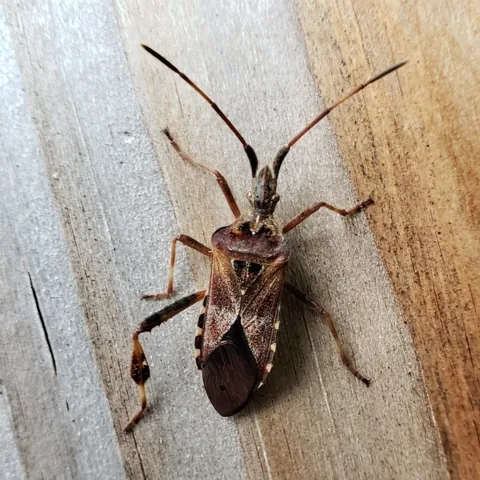 Western Conifer Seed Bug
Leptoglossus occidentalis
The western conifer seed bug is a leaf-footed bug that feeds on the seeds and cones of pines and other conifers. In fall, adults look for sheltered places to spend the winter, and many end up inside houses, where they are a nuisance but harmless.
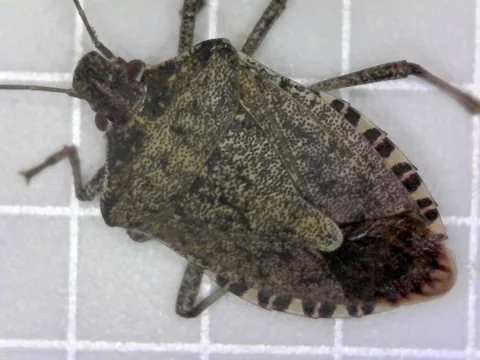 Brown Marmorated Stink Bug
Halyomorpha halys
The brown marmorated stink bug is an invasive insect from east Asia that damages fruit and vegetable crops and invades homes in fall looking for overwintering sites. Minnesota Extension says it feeds on about 200 plant species and, unlike the native stink bugs there, prefers to spend the winter in homes. Clemson notes that the bugs gather on outside walls before they move in.
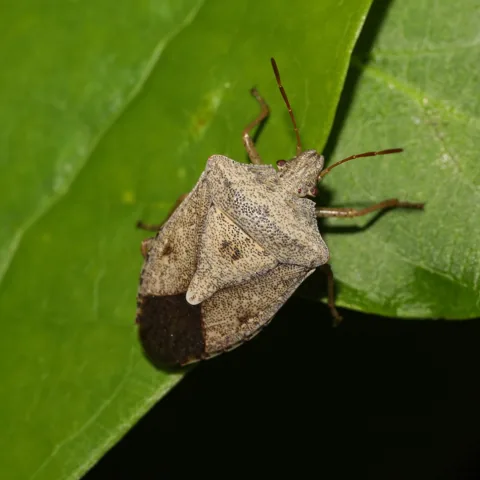 Brown Stink Bug
Euschistus servus
The brown stink bug is a native stink bug and often the first one to show up in Southern vegetable gardens, where it feeds on tomatoes, green beans and other crops. On farms it is a damaging pest of corn, cotton and soybeans, especially in the southeastern United States. The University of Florida calls it a serious pest of most seed, grain, nut and fruit crops in the southern U.S.
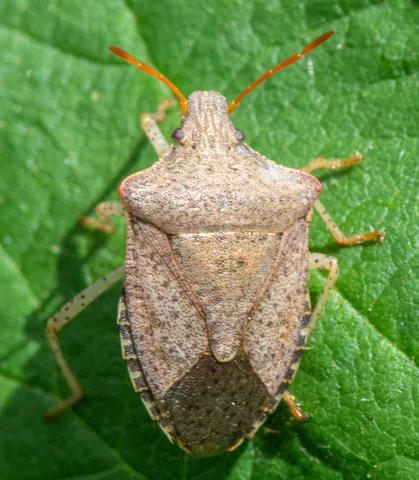 Consperse stink bug
Euschistus conspersus
The consperse stink bug is a native, shield-shaped stink bug about half an inch long that is the most common stink bug on California tomatoes and a pest of apples in the Pacific Northwest. Its feeding leaves pinprick spots on tomatoes and dimpled, corky patches on apples.
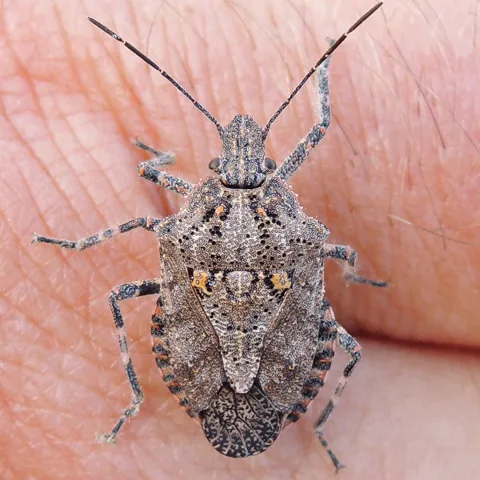 Rough Stink Bugs
Brochymena species
Rough stink bugs are commonly mistaken for the invasive brown marmorated stink bug, but they are partly predatory and aren't tied to significant plant damage.
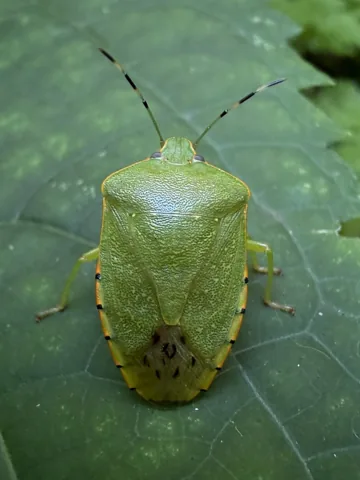 Green Stink Bugs
Chinavia hilaris (green stink bug) and Nezara viridula (southern green stink bug)
Two bright green stink bugs damage gardens and orchards in the U.S.: the green stink bug, a native of North America that feeds on a wide range of crops, and the southern green stink bug, one of the three most abundant stink bug pests in a North Florida tomato study. Both suck juices from developing fruit, seeds and shoots. UF/IFAS calls the green stink bug the most commonly encountered stink bug in North America.
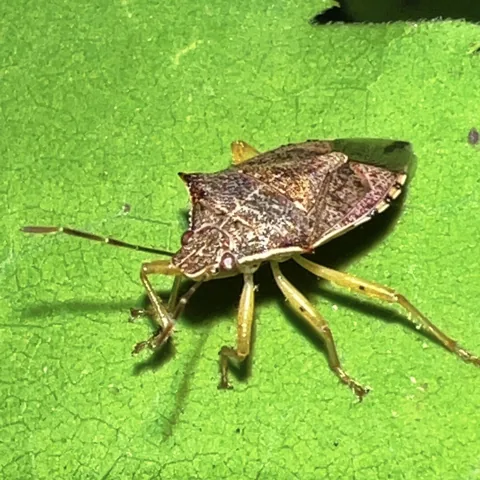 Spined Soldier Bug
Podisus maculiventris
The spined soldier bug is a beneficial predatory stink bug. It looks like the plant-feeding stink bugs gardeners fight, but it hunts caterpillars, beetle larvae and other slow-moving insects; UC IPM says it has been recorded feeding on more than 100 pest species.
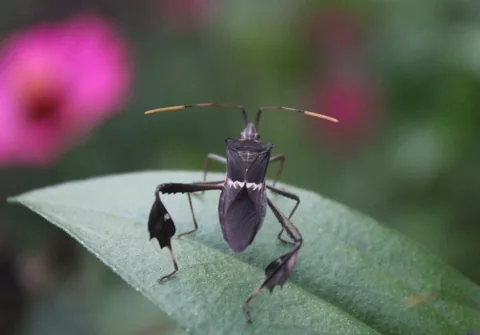 Leaffooted Bug
Leptoglossus zonatus
Leaffooted bugs are medium to large sap-feeding bugs named for the small leaf-like flaps on their hind legs. They pierce fruits, vegetables and nuts to feed, especially on the seeds, and gardeners most often find them on tomatoes and pomegranates.
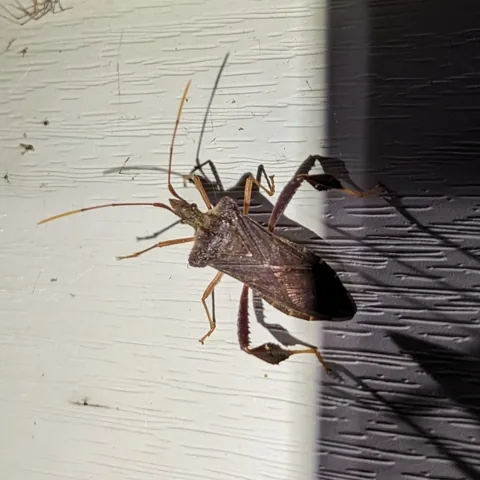 Magnolia Leaf-Footed Bug
Leptoglossus fulvicornis
Magnolia leaf-footed bugs feed only on magnolias, spotting the seeds without affecting tree health, so control is generally not needed.
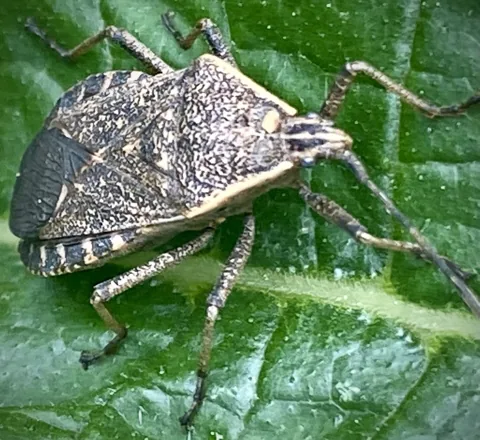 Squash Bug
Anasa tristis
The squash bug is a common vegetable garden pest that sucks sap from squash, pumpkins, melons and other cucurbits. Heavy feeding makes plants wilt and can kill young plants outright.
Side by side
Family: western conifer seed bug (Leptoglossus occidentalis) is a leaf-footed bug, family Coreidae. Brown marmorated stink bug (Halyomorpha halys) and the native brown and green stink bugs are family Pentatomidae.[1][12][11]
Size: western conifer seed bug about 3/4 inch (Penn State, Wisconsin and Minnesota); Colorado State gives 5/8 to 3/4 inch and Montana State 1/2 to 3/4 inch. Brown marmorated stink bug about 5/8 inch (UC IPM), or about 17 mm (0.66 in) in Penn State's description. Stink bugs as a family run up to about 3/4 inch depending on species.[1][2][3][4][5][7][6][11]
Shape: the seed bug is elongate and fairly robust, with a head narrower than the plate behind it. Stink bugs are shield shaped; UC IPM notes adults are wider relative to their length than most insects.[2][3][12][6][10]
Color and back pattern: the seed bug is reddish to dull or dark brown with a thin, jagged white line across the center of the wings; Penn State says the line can be darker or even missing. The rear halves of its front wings form a dark brown diamond. The brown marmorated stink bug is marbled brown, with dark bands at the tips of the wing membranes and coppery or bluish-metallic pits on the head and pronotum.[1][2][3][7][6]
Legs: the seed bug's hind legs are long with flat, leaf-like expansions. The brown marmorated stink bug's legs are marbled brown with faint white bands, and no stink bug has the leaf flaps.[1][2][3][7]
Antennae: leaf-footed bugs have 4 antennal segments, stink bugs 5. The seed bug's antennae are thin and, per Minnesota, reach less than half its body length. The brown marmorated stink bug's antennae have two white bands.[12][11][3][7]
Shoulders and head: the brown marmorated stink bug has a smooth shoulder margin and a blunt front edge to the head. That separates it from the rough stink bug, which has a rough shoulder edge and a head extended into two points.[7][9][13]
Edge of the abdomen: both can show a banded edge. The seed bug's upper abdomen shows alternating yellow or light orange and black patches along the wing edges; the brown marmorated stink bug has alternating light and dark bands along the outer margin of the abdomen.[1][7][11]
Flight and sound: flying seed bugs make a loud buzz and expose orange-and-black stripes on the abdomen, which Penn State suggests may mimic bees. Brown marmorated stink bugs also fly noisily around lit rooms indoors, so the sound alone is not a sure ID.[1][3][7]
Native stink bugs in the mix
Most stink bugs are plant feeders, drab brown, gray, tan or leaf green, and all share the shield shape and big triangular scutellum. Some, such as the spined soldier bug and the twospotted stink bug, are predators that eat pest insects.[11][10]
Brown native stink bugs are the ones most often mixed up with the brown marmorated stink bug. UC IPM separates them this way: the consperse stink bug has a banded abdominal edge but no bands on its antennae, dark spots on its legs and a length of about 1/2 inch; the rough stink bug has rough shoulders, a two-pointed head and no white antenna bands.[7]
Missouri and Minnesota both use the same two checks for the invasive species: white-banded antennae plus alternating light and dark bands along the abdomen edge.[11][9]
- Minnesota notes that, unlike the other stink bugs found there, the brown marmorated stink bug prefers to overwinter in homes.[9]
Other bugs that get confused with the seed bug
Kissing bugs (cone-nose bugs): Minnesota describes a more pear-shaped body with a thinner head and antennae, thin legs with no leaf-like parts, and light and dark bands along the abdomen edges. Montana State and Minnesota both note the seed bug is often mistaken for them; neither state has kissing bugs. The kissing bugs vs look-alikes guide covers them in detail.[3][5]
Other leaf-footed bugs: Penn State lists five more Leptoglossus species across eastern North America. The eastern leaf-footed bug and Leptoglossus oppositus are darker, with larger, more deeply scalloped leg flaps; the leaf-footed pine seed bug is darker brown with an all-black abdomen; the magnolia leaf-footed bug is plain brown with toothed shoulders.[1]
Squash bugs are also coreids but lack the flared hind-leg flaps, and they live on squash plants.[1]
- Cockroaches: Minnesota points out that a cockroach runs fast, hides by day and has antennae as long as or longer than its body, while the seed bug moves slowly, flies and is seen in daylight.[3]
When each one comes indoors
Both arrive at the same time of year. Wisconsin says seed bugs crawl up the sides of buildings in September and October, and Colorado State says most move from trees to buildings in those two months. Penn State says brown marmorated stink bugs start searching for overwintering sites in September and continue through October.[2][4][6]
Numbers differ. Brown marmorated stink bugs gather in large numbers on the sides of buildings in fall. Minnesota says seed bugs rarely build up like that and usually only one or a few are seen at a time, though Penn State notes that large numbers may emerge and fly around on warm fall and spring days.[7][3][1]
Smell, bites and harm
Odor: the seed bug has scent glands that give off a strong pine-like or piney odor when it is disturbed, which is why it gets called a stink bug. The brown marmorated stink bug releases an offensive odor when disturbed or crushed; NC State says an undisturbed one is not likely to stink.[2][4][7][8]
Seed bug bites: the seed bug eats seeds and does not generally bite. Only one case of a western conifer seed bug biting a person has been reported, in a 2017 journal note that called it the first such case.[4][1][14]
Stink bug health effects: UC IPM and NC State say the brown marmorated stink bug does not bite, sting or suck blood. A 2012 dermatology report on irritant contact dermatitis from the bug noted that no human disease had been reported and that fruit crop workers had complained of a slight allergic reaction to its chemicals; a 2012 allergy journal report described it as a new aeroallergen.[7][8][15][16]
House damage: neither bug breeds indoors or damages the structure. Montana State records one rare case of seed bugs puncturing cross-linked polyethylene plumbing tubing.[4][6][7][5]
- Garden: seed bug feeding on cones does not hurt the health of landscape trees, though heavy feeding cuts seed crops in conifer seed orchards. The brown marmorated stink bug is a garden and crop pest: Illinois Extension says it feeds on tree fruits, vegetables, crops and ornamentals and can cause significant damage.[1][3][2][13]
How to confirm which one you have
Photograph the bug from directly above with its legs and antennae in view. The leaf-like hind legs, the zigzag white line and a narrow body point to the seed bug; a wide shield, a big triangle in the middle of the back and white-banded antennae point to the brown marmorated stink bug.[1][3][7][10]
Count antenna segments on a close photo if the shape is unclear: four for leaf-footed bugs, five for stink bugs.[12][11]
What to do about each
The same plan works for both, because both are fall invaders that do no harm indoors. Seal them out before they arrive: repair loose screens, windows and doors, caulk around door and window frames, soffits, chimneys and under fascia, and screen attic, wall and chimney vents.[1][2][6]
NC State says to seal in summer, after the bugs have left, and not to bug-proof in fall, winter or early spring, which can trap stink bugs inside. Adult brown marmorated stink bugs fit through holes as small as 3 by 7 mm.[8]
Indoors, vacuum or pick bugs up by hand. Penn State warns the vacuum can hold the stink bug smell for a while, and NC State suggests a dedicated hand vacuum, a jar or a dish of soapy water, then freezing to kill them. Advice on release differs: Minnesota says vacuumed stink bugs can be deposited outside, while NC State says not to live-release them because they are likely to come back in.[2][5][6][8][9]
Don't spray indoors. Colorado State says not to use insecticides on seed bugs already in the home, and that seed bugs usually die in a week or two if they can't get water. NC State notes that dead stink bugs left in walls or attics can attract carpet beetles.[4][8]
Outdoor sprays are limited help. Penn State says exterior treatments for stink bugs give some minor relief and break down in sunlight, so they may not work much beyond several days or a week; Colorado State says insecticides have not been tested against seed bugs.[6][4]
- Penn State groups the seed bug with brown marmorated stink bugs, cluster flies and multicolored Asian lady beetles as fall home invaders; the fall home invaders guide has a month-by-month sealing calendar for all of them.[1]
Common questions
- Is a western conifer seed bug a stink bug?
- No. It is a leaf-footed bug (family Coreidae). It gets called a stink bug because it gives off a piney odor when disturbed.[2][1]
- What is the long brown bug with leaf-shaped back legs in my house?
- Most likely a western conifer seed bug, a pine-seed feeder about 3/4 inch long that comes indoors in fall and does not breed inside.[2][3][4]
- How can I tell a brown marmorated stink bug from a native brown stink bug?
- Look for two white bands on the antennae and alternating light and dark bands along the abdomen edge, with smooth shoulders.[7][11][9][13]
- Do western conifer seed bugs bite?
- Practically never. Only one bite on a person has been reported, in a 2017 journal note.[1][14]
- Why do they buzz like a bee?
- Flying western conifer seed bugs make a loud buzz and flash an orange-and-black abdomen; Penn State suggests this may mimic bees and help deter birds.[1][3]
Photo credits
- Western Conifer Seed Bug: (c) Gavin Slater, some rights reserved (CC BY) — via iNaturalist, CC BY 4.0
- Brown Marmorated Stink Bug: (c) Stan Rullman, some rights reserved (CC BY) — via iNaturalist, CC BY 4.0
- Brown Stink Bug: (c) Adrienne van den Beemt, some rights reserved (CC BY) — via iNaturalist, CC BY 4.0
- Consperse stink bug: (c) Don Loarie, some rights reserved (CC BY) — via iNaturalist, CC BY 4.0
- Rough Stink Bugs: (c) Bill Keim, some rights reserved (CC BY) — via iNaturalist, CC BY 4.0
- Green Stink Bugs: (c) Marc-Olivier Beausoleil, some rights reserved (CC BY) — via iNaturalist, CC BY 4.0
- Spined Soldier Bug: (c) Healthy Yards, some rights reserved (CC BY) — via iNaturalist, CC BY 4.0
- Leaffooted Bug: (c) Ricard Busquets Reverte, some rights reserved (CC BY) — via iNaturalist, CC BY 4.0
- Magnolia Leaf-Footed Bug: (c) ncb1221, some rights reserved (CC BY) — via iNaturalist, CC BY 4.0
- Squash Bug: Anne P, public domain (CC0), via iNaturalist
Sources
- Penn State Extension, “Western Conifer Seed Bug.” extension.psu.edu/western-conifer-seed-bug (accessed 2026-11-14)
- University of Wisconsin-Madison Extension, Wisconsin Horticulture, “Western conifer seed bug (XHT1052).” hort.extension.wisc.edu/articles/western-conifer-seed-bug/ (accessed 2026-11-14)
- University of Minnesota Extension, “Western conifer seed bug and hackberry psyllids.” extension.umn.edu/nuisance-insects/western-conifer-seed-bug-and-hackberry-psyllids (accessed 2026-11-14)
- Colorado State University Extension, “Conifer Seed Bugs.” extension.colostate.edu/resource/conifer-seed-bugs/ (accessed 2026-11-14)
- Montana State University Extension, Schutter Diagnostic Lab, “Western Conifer Seed Bug (November 2022 fact sheet).” urbanipm.montana.edu/entomology/resources/fact-sheets/nuisance_insect_pests/western.conifer.seedbug.html (accessed 2026-11-14)
- Penn State Extension, “Brown Marmorated Stink Bug.” extension.psu.edu/brown-marmorated-stink-bug (accessed 2026-11-14)
- University of California Statewide IPM Program, “Brown Marmorated Stink Bug (Pest Notes).” ipm.ucanr.edu/home-and-landscape/brown-marmorated-stink-bug/ (accessed 2026-11-14)
- NC State Extension, Department of Entomology and Plant Pathology, “FAQs: Brown Marmorated Stink Bug.” entomology.ces.ncsu.edu/faqs-brown-marmorated-stink-bug (accessed 2026-11-14)
- University of Minnesota Extension, “Brown marmorated stink bug.” extension.umn.edu/garden-and-home/yard-and-garden/yard-and-garden-insects/brown-marmorated-stink-bug (accessed 2026-11-14)
- University of California Statewide IPM Program, “Stink Bugs (Pest Notes).” ipm.ucanr.edu/home-and-landscape/stink-bugs/ (accessed 2026-11-14)
- Missouri Department of Conservation, “Stink Bugs.” mdc.mo.gov/discover-nature/field-guide/stink-bugs (accessed 2026-11-14)
- Missouri Department of Conservation, “Leaf-Footed Bugs (Coreids).” mdc.mo.gov/discover-nature/field-guide/leaf-footed-bugs (accessed 2026-11-14)
- University of Illinois Extension, “Fall house guests (news release, September 23, 2019).” extension.illinois.edu/news-releases/fall-house-guests (accessed 2026-11-14)
- Journal of Medical Entomology, via PubMed, “Hornok S, Kontschan J. The Western Conifer Seed Bug (Hemiptera: Coreidae) Has the Potential to Bite Humans. J Med Entomol 2017;54(4):1073-1075.” pubmed.ncbi.nlm.nih.gov/28399275/ (accessed 2026-11-14)
- Dermatitis, via PubMed, “Anderson BE, Miller JJ, Adams DR. Irritant contact dermatitis to the brown marmorated stink bug, Halyomorpha halys. Dermatitis 2012;23(4):170-2.” pubmed.ncbi.nlm.nih.gov/22828257/ (accessed 2026-11-14)
- Journal of Allergy and Clinical Immunology, via PubMed, “Mertz TL, Jacobs SB, Craig TJ, Ishmael FT. The brown marmorated stinkbug as a new aeroallergen. J Allergy Clin Immunol 2012;130(4):999-1001.” pubmed.ncbi.nlm.nih.gov/22835402/ (accessed 2026-11-14)