On this page
How to identify it
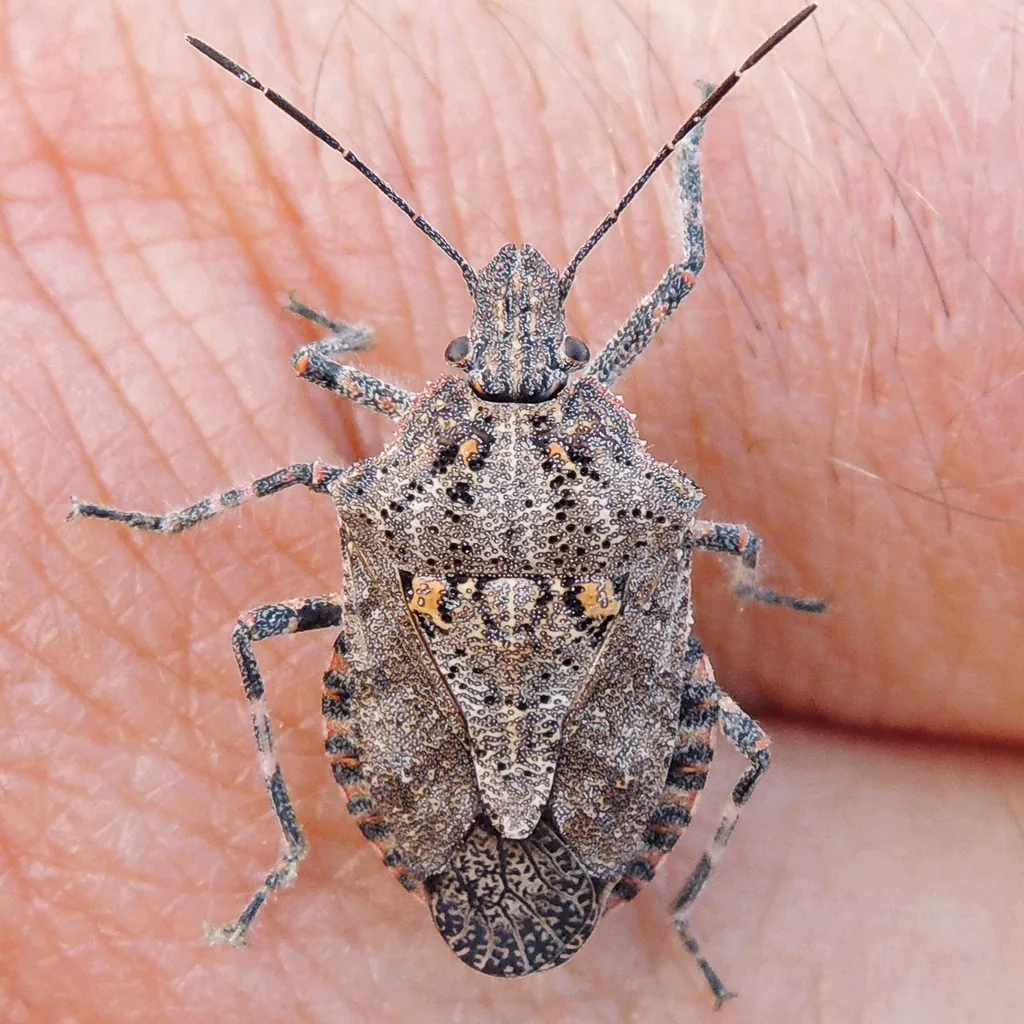
- Adults are broad, flattened, shield-shaped bugs, roughly 1/2 to 3/4 inch long or a bit more; the sources give slightly different ranges (below).[1][2]
- They're mottled gray or brownish with black and white, sometimes with orange or yellow, and blend in with tree bark.[1][2]
- The front edge of the thorax, the shoulders, is rough or toothed, which gives the group its name.[1][3][4]
- There is a point or tooth on each side of the face.[1][4][5]
- Eggs are pearly white, about 1/20 inch across, and laid in clusters of about 10 to 20; they turn gray before hatching.[1][2]
- First-stage nymphs are round and mostly blackish and pinkish white; older nymphs are oval and mottled gray with black and white and some orange or yellow.[1]
Look-alikes
| Look-alike | How to tell them apart |
|---|---|
| Brown marmorated stink bug | Rough stink bugs have two white bands on each hind leg, unbanded antennae, a pointed face and toothed shoulders. The brown marmorated stink bug has one hind-leg band, banded antennae, a blunt face and smooth shoulders; Utah State adds that rough stink bugs have less distinct bands along the edge of the abdomen.[1][3][4] |
| Consperse stink bug | Oregon State's look-alike chart shows the consperse stink bug as smaller, with light-colored antennae and an underside that can be green, while rough stink bugs have toothed shoulders.[3] |
Where it lives
They're most common in trees and shrubs. California has at least six Brochymena species, and in Colorado Brochymena sulcata is found statewide.[1][2]
Biology and life cycle
Nymphs go through four stages. First-stage nymphs stay together beside their empty egg shells at first, and in warm weather nymphs reach adulthood in 3 to 4 weeks.[1]
Adults live about two to three months, and a mated female can lay several hundred eggs when prey is plentiful.[1]
In mild-winter areas they can be active all year. Where winters are cold they overwinter as adults under loose bark, in logs or inside buildings, becoming active again in spring.[1][2]
Colorado populations have one generation a year: overwintered adults usually die by the end of June, nymphs develop through July, and new adults appear in August.[2]
Damage and signs
- They eat caterpillars, leaf beetle and sawfly larvae and other slow, soft-bodied insects that feed in the open.[1][2]
- They also feed on leaves, seeds and shoots of trees and shrubs such as ash, walnut, willow and boxelder, without significant injury.[2][1]
- Their bark coloring makes them easy to overlook, so they're most often found when they wander indoors in fall or come in on firewood.[2][1]
Health risk
None of these sources reports bites or other harm to people. The concern is mistaken identity: they are often confused with the brown marmorated stink bug.[2][1][4]
Control
Prevention
No treatment is needed outdoors; they cause no significant plant injury and eat some pest larvae.[2][1]
Check the shoulders, face and antennae before reporting a brown marmorated stink bug. Utah State says rough stink bugs are commonly mistaken for it, and they appear on Oregon State's look-alike chart.[4][3]
Keep them out
Expect a few indoors in fall, when adults look for winter shelter, and check firewood before bringing it in.[2][1]
Biological control
Controlling ants and avoiding persistent, broad-spectrum insecticides protects them along with other natural enemies; UC also suggests flowering plants that feed adult natural enemies.[1]
Where sources disagree
Diet: UC IPM lists them as natural enemies that eat caterpillars and other soft-bodied insects and feed only innocuously on plants; Colorado State says they feed primarily on tree leaves and developing seeds and are occasional predators; Utah State says they are considered both predators and pests.[1][2][4]
Size: UC gives 7/16 to 3/4 inch (11 to 18 mm); Colorado State gives 13 to 22 mm, about 1/2 to 7/8 inch.[1][2]
Egg hatch: UC says about 1 week after laying; Colorado State says about two weeks.[1][2]
Egg shape: UC calls the eggs barrel shaped; Colorado State calls them elongate.[1][2]
Common questions
- Is this a brown marmorated stink bug?
- Check the shoulders and antennae: toothed shoulders and unbanded antennae mean a rough stink bug; the brown marmorated stink bug has smooth shoulders and banded antennae.[1][3]
- Why is a rough stink bug in my house?
- Adults look for winter shelter in fall and sometimes come in on firewood.[2][1]
- Do rough stink bugs damage trees?
- They feed on tree leaves and seeds but aren't linked to significant injury, and they also eat caterpillars and leaf beetle larvae.[2][1]
- Are rough stink bugs pests or beneficials?
- Mostly harmless, and partly helpful. UC treats them as natural enemies, Colorado State as occasional predators, and Utah State notes they are considered both predators and pests.[1][2][4]
Sources
- University of California Statewide IPM Program, “Rough Stink Bugs (Natural Enemies Gallery).” ipm.ucanr.edu/natural-enemies/rough-stink-bugs/ (accessed 2026-11-11)
- Colorado State University Extension, “Colorado Insect of Interest: Rough Stink Bugs.” webdoc.agsci.colostate.edu/bspm/Hexapoda%20(Insects)/Rough%20Stink%20Bugs.pdf (accessed 2026-11-11)
- Oregon State University Extension Service, “Identifying brown marmorated stink bug (EM 9054).” extension.oregonstate.edu/sites/default/files/documents/em9054.pdf (accessed 2026-11-11)
- Utah State University Extension, “Invasive Insect Look-Alikes.” extension.usu.edu/pests/research/invasive-insect-lookalikes (accessed 2026-11-11)
- UMass Amherst Center for Agriculture, Food, and the Environment, “Brown Marmorated Stink Bug Identification.” www.umass.edu/agriculture-food-environment/fruit/fact-sheets/brown-marmorated-stink-bug-identification (accessed 2026-11-11)
- iNaturalist, “Brochymena taxon page (order and family).” www.inaturalist.org/taxa/127347 (accessed 2026-11-11)