On this page
How to identify it
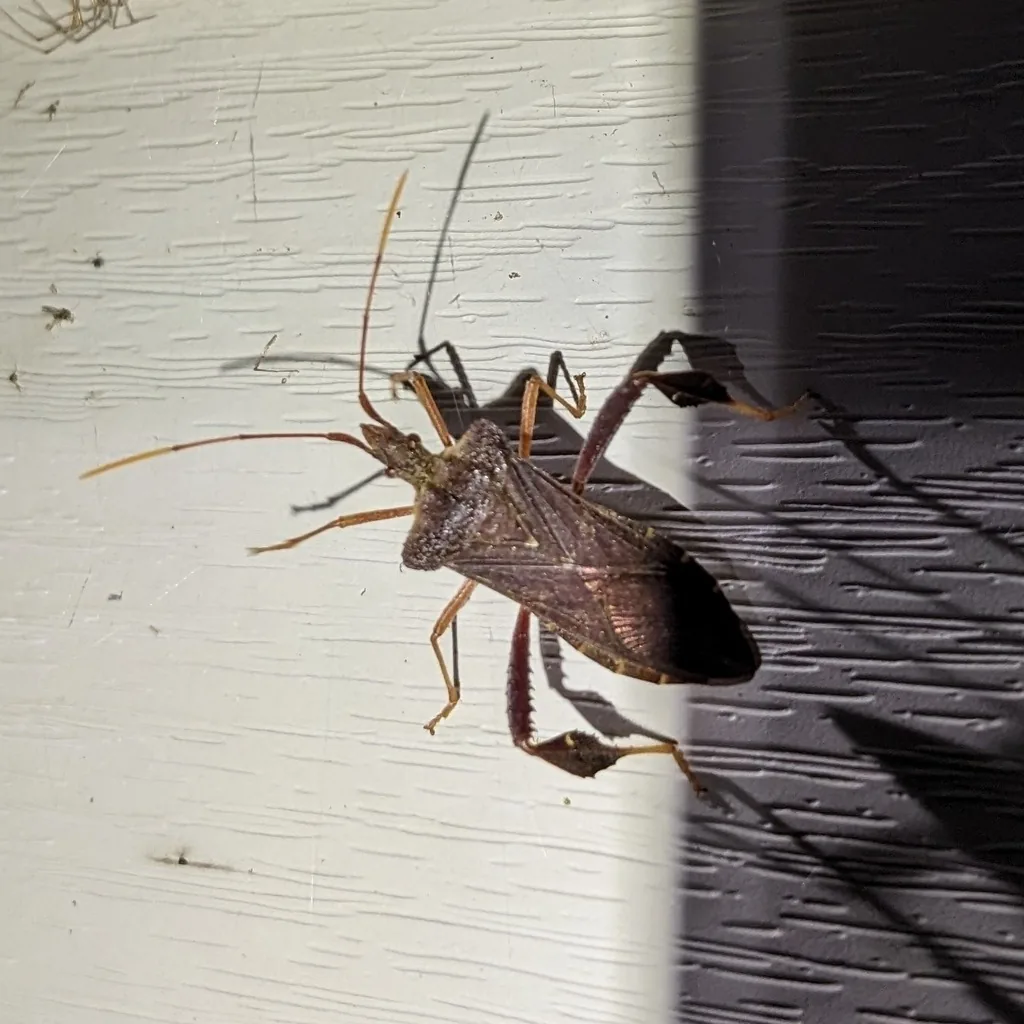
Look-alikes
| Look-alike | How to tell them apart |
|---|---|
| Western conifer seed bug | Has a transverse white stripe that the magnolia leaf-footed bug lacks.[1] |
| Leptoglossus oppositus | Also uniformly dark brown, but with smaller 'shoulders' and more scalloped flanges on the hind legs.[1] |
| Squash bug | Lacks the wide, leaf-like flanges on the hind legs entirely.[1] |
Where it lives
It's found in eastern North America from Ontario and Massachusetts to Florida and west to West Virginia, Arkansas and Texas, most commonly in the South. Penn State says overwintering adults haven't been found north of Pennsylvania, so it's unclear whether permanent breeding populations exist farther north, and an apparent westward spread may be real or an artifact of collecting.[1]
Biology and life cycle
Adults overwinter in leaf litter at the base of magnolias and become active when small fruits appear: as early as late April in the Southeast, late May in Tennessee and mid-June to early July in Pennsylvania (Penn State). Ohio State's BYGL reported adults already feeding on newly developing seed pods in southwest Ohio in early June, with nymphs appearing much later in the season.[1][2]
Eggs are laid in chains, usually along the midrib under a leaf, about 20 to 27 to a clutch.[1]
It feeds only on magnolias, recorded from southern, star, saucer, sweetbay, Kobus and Loebner magnolias, yulan, cucumber tree and umbrella tree. Adults and nymphs have rarely turned up on Russian apricot and shingle oak, but Penn State doubts they can reproduce off magnolia.[1]
Damage and signs
Health risk
It feeds only on magnolia seeds and fruit. A related plant-feeding bug, the western conifer seed bug, has been reported to bite a person in a single published case.[1][3]
Control
Sanitation
Removing leaf litter under magnolias in fall and spring takes out overwintering adults before they emerge.[1]
Traps and physical control
If you want control anyway, knock flightless young nymphs off the leaves with a strong jet of water.[1]
Biological control
Parasitic wasps (Gyron species) attack the eggs; the one study of this bug found 77 percent of egg masses and 31 percent of all eggs parasitized, and Penn State notes parasitic fly eggs have also been seen on adults. Penn State says control is generally not necessary.[1]
More from Ohio State Extension
Ohio State's Buckeye Yard & Garden onLine reports that landscapes with mature magnolias attract magnolia leaf-footed bugs, with adults found feeding on newly developing seed pods in southwest Ohio and nymphs appearing later in the season. It groups the bug with the western conifer seed bug and boxelder bug as seed and pod feeders that cause no appreciable harm to their host plants, though all three can become nuisances by entering homes in fall. Like other leaf-footed bugs, it can give off a strong, unpleasant odor when threatened.[2]
Common questions
- Are the brown bugs on my magnolia's seed pods harmful?
- Probably magnolia leaf-footed bugs; they spot the seeds but don't affect the tree's health.[1]
- Do magnolia leaf-footed bugs bite?
- Penn State says they feed and develop only on magnolia and are not expected to bite people. The only published bite report in this group involves the related western conifer seed bug.[1][3]
- Will magnolia leaf-footed bugs come into my house?
- Ohio State's BYGL groups it with the western conifer seed bug and boxelder bug as fall home invaders that can be nuisances, and Penn State calls it a possible nuisance pest; neither reports harm to the tree.[2][1]
Sources
- Penn State Extension, “Magnolia Leaf-Footed Bug.” extension.psu.edu/magnolia-leaf-footed-bug (accessed 2026-11-13)
- Ohio State University Extension (Buckeye Yard & Garden onLine), “A Buggy Alert: Boxelder Bugs and Leaf-Footed Bugs.” bygl.osu.edu/node/2375 (accessed 2026-11-13)
- Journal of Medical Entomology (via PubMed), “The Western Conifer Seed Bug (Hemiptera: Coreidae) Has the Potential to Bite Humans (Hornok and Kontschan 2017) (abstract).” pubmed.ncbi.nlm.nih.gov/28399275/ (accessed 2026-11-13)
- Global Biodiversity Information Facility (GBIF), “Leptoglossus fulvicornis (Westwood, 1842) (GBIF Backbone Taxonomy).” api.gbif.org/v1/species/5156101 (accessed 2026-11-13)