On this page
How to identify it
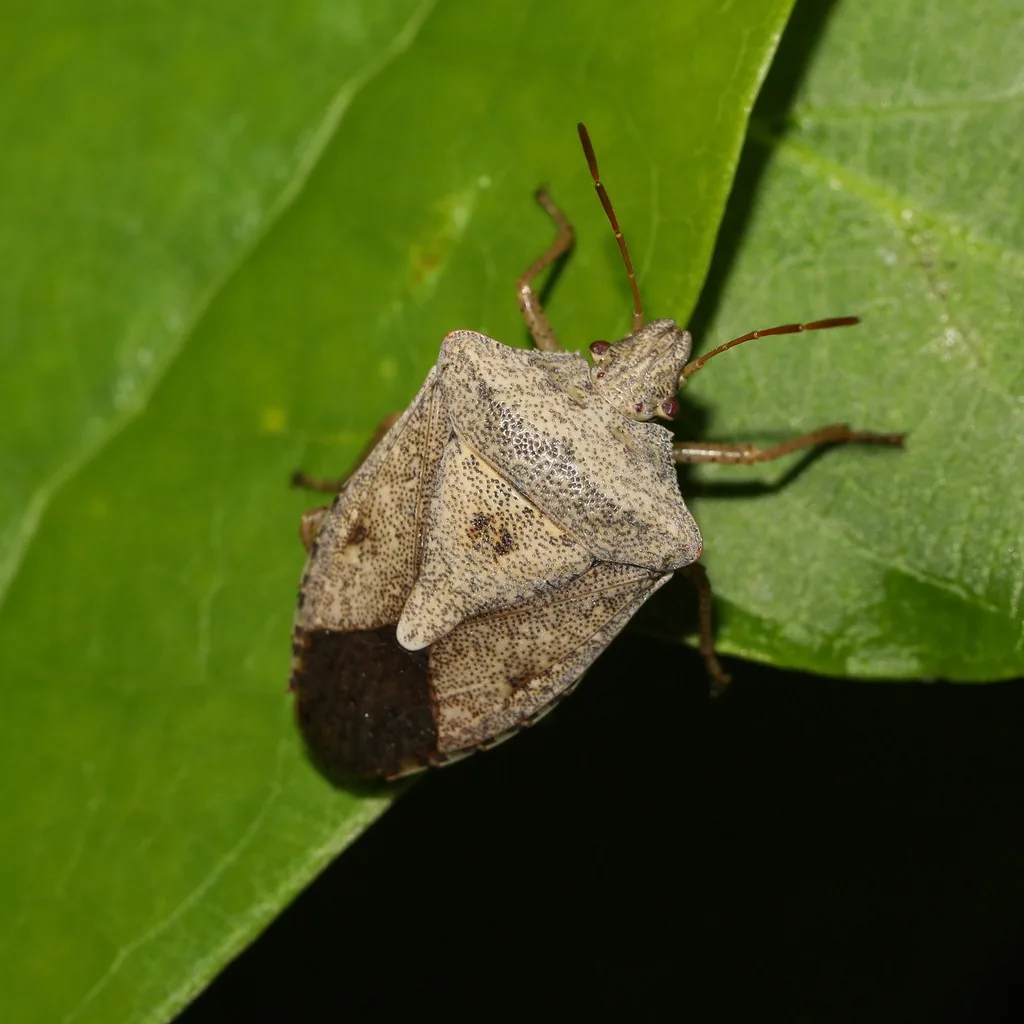
- Adults are brown, shield-shaped bugs about 1/2 inch long, with a yellow or light green underside and rounded, smooth shoulders (the corners of the pronotum). UF/IFAS gives 10 to 15 mm and describes it as grayish-yellow with dark punctures on the back and darker fourth and fifth antenna segments.[5][6][13]
- Seen from above, they show essentially no white, few abdominal segments stick out along the edges, and the wings have no black lines.[2][6]
- Nymphs look like small adults without fully developed wings; wing pads become visible as they grow.[7]
- Like other plant-feeding stink bugs, it has a thin beak; predatory stink bugs have a much stouter one.[6][2]
- Eggs are yellowish and translucent and turn light pink before hatching. Nymphs are smaller, oval and usually pale green, and pass through five stages in about 29 days.[13]
Look-alikes
| Look-alike | How to tell them apart |
|---|---|
| Brown marmorated stink bug | The invasive brown marmorated stink bug has alternating light and dark markings along the edges of the abdomen, white bands on the antennae and faint white bands on the legs. The brown stink bug shows essentially no white.[2][6] |
| Spined soldier bug | This beneficial predator has sharp, pointed shoulders, dark lines on the wing tips and a stouter beak. Leave it be: nymphs and adults eat caterpillars and other pest larvae.[6][2][7] |
| One-spotted stink bug | Euschistus variolarius, the brown stink bug Purdue most often finds in Indiana corn, looks much the same, but its shoulders are sharply pointed and often orange-tipped, and males have a dark spot near the tip of the underside.[7] |
Where it lives
Missouri Extension says it is more common in the South, and North Carolina and South Carolina research names it one of the main pests of field corn in the southeastern U.S. It also turns up farther north and west: Nebraska Extension includes it in its soybean insect guide, and Purdue lists it among the brown stink bugs found in Indiana corn. UF/IFAS says it occurs across southern Canada and much of North America, often active year-round in parts of the southern U.S., as two subspecies: one in the Southeast from Florida through Louisiana to California, the other across Canada and the northern U.S.[8][3][4][5][7][13]
Biology and life cycle
Adults spend the winter and come out in spring. In North Carolina the overwintered bugs move first to wheat, the earliest crop host, or to weeds in field borders, then shift into corn as the seedlings grow.[3]
They fly best soon after leaving their winter shelter. In flight-mill tests, flight potential was highest right after overwintering and lower during the cropping season; about 90 percent of fliers went no more than 1 km, but one flew 15.9 km.[9]
Both adults and nymphs feed, piercing plant tissue with their beaks and sucking up the juices; their saliva digests the tissue around the feeding site.[1][7][8]
Numbers build late in the season, both from breeding in the garden and from adults moving out of farm crops that have matured and are no longer attractive.[1]
UF/IFAS lists overwintering spots such as ditch banks, fence rows, ground cover, and under boards, dead weeds, stones and tree bark. The bugs become active on the first warm spring days above 21°C, and in mild winters they may stay active, feeding on winter annual weeds.[13]
The first generation usually develops on wild plants and the second on crops. Each female lays about 18 egg masses averaging 60 eggs over more than 100 days, and Florida can see four to five or more generations a year. Adults are strong fliers that move readily between weeds and other hosts.[13]
Damage and signs
- In gardens it is especially a problem on tomatoes and green beans early in the season; later, with other stink bugs, it can badly damage peas, beans, okra and tomatoes.[1]
- On ripening tomatoes, feeding shows as whitish-yellow spots or rings under the skin.[6]
- In soybeans, feeding leaves dark spots and can delay maturity and cause shriveled, deformed, undersized or aborted seeds.[5]
- In young corn, feeding can leave holes with yellow halos in the leaves, deformed or tillering plants and a killed growing point. Feeding before tasseling can cause deformed 'banana-shaped' ears; in South Carolina trials it cut grain yield by up to 92 percent.[7][4]
- In cotton it can make young bolls drop and lowers boll growth, seedcotton yield and seed germination.[10]
- UF/IFAS lists hosts including shrubs, vines and many broadleaf weeds, especially legumes, plus corn, soybean, sorghum, okra, millet, snap beans, peas and cotton.[13]
- Peach is one of the first food crops hit in spring, with bugs arriving around late bloom; the scarred, deformed fruit is called catfacing. In pecans it feeds on the kernels, mostly late in the season, and drought can bring much higher numbers onto fruit.[13]
- In grain crops UF/IFAS describes killed seedlings, stunted plants and 'suckering', tillers from the base of damaged plants that show up about 10 days after the feeding and may produce little grain.[13]
Health risk
It is a plant pest. Like all stink bugs, it gives off an offensive odor when handled.[8][1]
Control
Prevention
Scout early. Early-season adults and their injury in corn are patchy, so check several parts of a field or garden; Purdue samples 20 plants in each of 5 areas. UF/IFAS adds that adults aggregate, often along field edges, and lists beating trays, sweep nets and pheromone-baited stink bug traps for monitoring.[11][7][13]
Mowing or spraying weedy field borders lowered brown stink bug numbers in the weeds but did not reduce them in the neighboring corn in a North Carolina study, so border weed control alone isn't enough.[3]
UF/IFAS suggests trap crops such as triticale, buckwheat, sorghum, millet and sunflower around the outside of gardens and orchards to intercept stink bugs before they reach the main crop; small growers can raise them in large containers and move them where needed.[13]
Sanitation
Before planting corn, tillage removes the plant cover that shelters the bugs. In no-till fields, make sure seed slots close so bugs can't reach seedlings' growing points below ground.[7]
Traps and physical control
In small gardens, handpick and destroy adults, ideally before they lay eggs. Mississippi State says this can delay heavy buildup and calls handpicking the only good organic option.[1]
Biological control
Spare the spined soldier bug, the most common predatory bug in North America, which feeds on caterpillars and pest larvae.[6]
Eggs and nymphs suffer high mortality from parasites, predators and disease, according to UF/IFAS.[13]
Pesticides
Mississippi State names pyrethroids as the most effective garden treatment, somewhat less effective on brown stink bugs than on green species; acetamiprid is a non-pyrethroid option with a 7 day pre-harvest interval. Check each label's pre-harvest interval for the crop. UF/IFAS adds that stink bugs are relatively tolerant of most insecticides, which makes them hard to suppress, and that many crops have action thresholds to follow.[1][13]
Brown stink bugs and corn earworm
In South Carolina field trials, brown stink bug feeding on corn before tasseling cut the number of corn earworm larvae by 29 to 100 percent, the first study to show competition between these two major corn pests.[4]
Where sources disagree
Insecticides: Mississippi State calls pyrethroids reasonably effective on brown stink bugs, if somewhat less so than on green stink bugs; Missouri Extension says the brown stink bug, with its longer growing season in the South, is more resistant to insecticide applications.[1][8]
Corn damage: Purdue says economic damage is unlikely once Midwest corn reaches the late whorl stage, while South Carolina trials found feeding before tasseling caused deformed ears and yield losses of up to 92 percent.[7][4]
Underside color: Nebraska and Lincoln University guides describe a yellow or light green underside; UF/IFAS says it usually has a pinkish tinge.[5][6][13]
Weeds: UF/IFAS says getting rid of seed heads and broadleaf weeds helps keep numbers down, while a North Carolina study found mowing or spraying weedy field borders didn't lower numbers in the neighboring corn.[13][3]
Common questions
- What is the plain brown stink bug in my garden?
- Often the brown stink bug: brown, about 1/2 inch long, with rounded shoulders, a yellowish or light green underside and no white bands on the antennae or legs.[5][6][2]
- Where do they spend the winter?
- As adults. In spring the overwintered bugs move first into wheat or weedy field borders before crops such as corn; Purdue reports a close relative wintering in wooded areas, grassy crop borders and cover crops.[3][7]
- Is the brown stink bug the same as the brown marmorated stink bug?
- No. The brown marmorated stink bug is an invasive species from Asia with white-banded antennae and checkered abdomen edges; the brown stink bug is native and shows essentially no white.[2][6]
Sources
- Mississippi State University Extension, “Brown Stink Bug, Vol. 5, No. 11.” extension.msstate.edu/newsletters/bugs-eye-view/2019/brown-stink-bug-vol-5-no-11 (accessed 2026-11-11)
- University of Arkansas Division of Agriculture Cooperative Extension Service, “Brown Marmorated Stink Bug: A Potential Pest of Arkansas Row Crops (FSA7077).” www.uaex.uada.edu/publications/pdf/FSA-7077.pdf (accessed 2026-11-11)
- Environmental Entomology, via PubMed, “Babu, Reisig, Walgenbach, Heiniger and Everman (2019), Influence of weed manipulation in field borders on brown stink bug densities and damage in field corn.” pubmed.ncbi.nlm.nih.gov/30810746/ (accessed 2026-11-11)
- Environmental Entomology, via PubMed, “Bryant, Greene and Reay-Jones (2024), Competition between brown stink bug and corn earworm in field corn.” pubmed.ncbi.nlm.nih.gov/38965911/ (accessed 2026-11-11)
- University of Nebraska-Lincoln Extension, “Soybean Insects II (EC1575).” extensionpubs.unl.edu/publication/ec1575/2008/pdf/view/ec1575-2008.pdf (accessed 2026-11-11)
- Lincoln University Cooperative Extension, “The Good, The Bad and The Ugly: spined soldier bug, brown stink bug and brown marmorated stink bug (FS#18-C-2011).” www.lincolnu.edu/_files/publications/fs18c2011goodbaduglycw10112012pjdv2.pdf (accessed 2026-11-11)
- Purdue University Extension Entomology (Field Crops IPM), “Brown Stink Bug, Euschistus spp. (corn).” ag.purdue.edu/department/entm/extension/field-crops-ipm/_docs/brown-stinkbug_corn.pdf (accessed 2026-11-11)
- University of Missouri Extension, “Stink bugs (Cotton pests).” extension.missouri.edu/programs/cotton-extension/cotton-pests/stink-bugs (accessed 2026-11-11)
- Environmental Entomology, via PubMed, “Babu, Del Pozo-Valdivia and Reisig (2020), Baseline flight potential of Euschistus servus and its implications on local dispersal.” pubmed.ncbi.nlm.nih.gov/32307527/ (accessed 2026-11-11)
- Journal of Economic Entomology, via PubMed, “Willrich, Leonard and Temple (2004), Injury to preflowering and flowering cotton by brown stink bug and southern green stink bug.” pubmed.ncbi.nlm.nih.gov/15279273/ (accessed 2026-11-11)
- Environmental Entomology, via PubMed, “Bryant, Greene and Reay-Jones (2023), Within-field spatial patterns of Euschistus servus and Nezara viridula in field corn.” pubmed.ncbi.nlm.nih.gov/37177898/ (accessed 2026-11-11)
- iNaturalist, “Euschistus servus taxon page (order and family).” www.inaturalist.org/taxa/146627 (accessed 2026-10-06)
- University of Florida IFAS Extension, EDIS, “Brown Stink Bug, Euschistus servus (Say), EENY 433/IN796 (Featured Creatures).” ask.ifas.ufl.edu/publication/IN796 (accessed 2026-11-14)