On this page
How to identify it
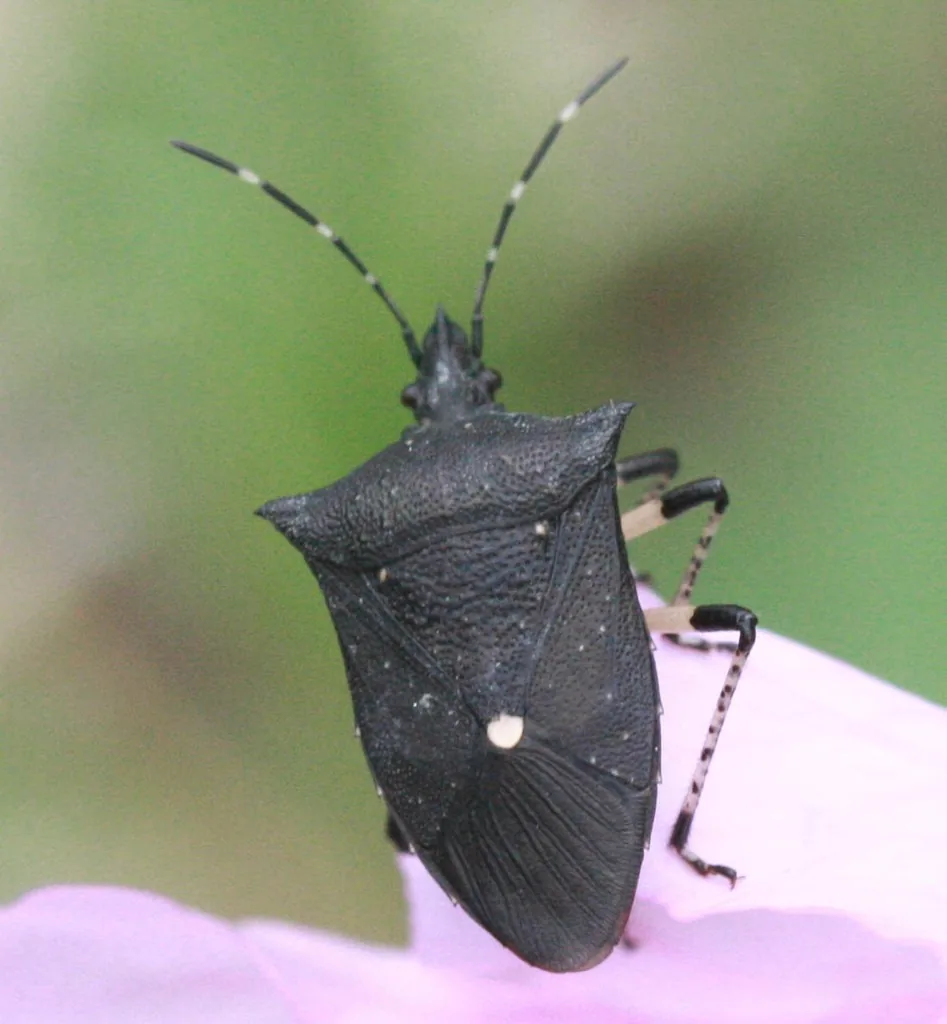
- Adults are black; see where the sources disagree on the legs.[1][2]
- The shoulders (the corners of the pronotum) are sharply pointed, and the head is pointed.[1][2]
- A small pale spot sits at the tip of the scutellum, the triangular plate in the middle of the back; see where the sources disagree on its color.[1][8]
- UF/IFAS gives the adult length as about 11 to 13 mm and separates it from other stink bugs by the shoulder spines pointing straight out to the sides, a sharp, upturned tip to the head that extends well past the plates beside it, and the black body with a spot at the tip of the scutellum.[8]
- Nymphs go through five stages and change from a light, see-through brown to the adult's black as they mature.[8]
- Eggs are white, slightly oval and about 1.05 mm long, laid singly or sometimes in pairs. UF/IFAS notes that all other North American stink bugs lay their eggs in clusters.[8]
Look-alikes
| Look-alike | How to tell them apart |
|---|---|
| Brown stink bug and other pest stink bugs | Pest stink bugs such as the brown stink bug are brown. The black stink bug has a black body, a pointed head, shoulder spines pointing straight out to the sides and a pale spot at the tip of the scutellum.[1][2][8] |
Where it lives
Clemson's cotton guide says it is commonly found from North Carolina south to Florida and west to Arizona; see where the sources disagree. GBIF has about 3,600 U.S. records since 1990, most from Texas and Florida, and records from Mexico south through Central America to Colombia and Ecuador; a 2015 study added it to Colombia's list. UF/IFAS gives its range as Central America, Brazil and the Caribbean islands of Puerto Rico, Santo Domingo and Cuba, and in the United States from North Carolina to southern Florida and west through southern Indiana and southern Illinois to Oklahoma and Texas.[2][3][4][5][8]
Biology and life cycle
In Georgia cotton-growing areas it congregates on tropical spiderwort, a weed.[2]
Adults spend the winter in forest leaf litter around and beneath logs, come out in June and begin laying eggs one to two weeks later. The complete life cycle has been estimated at 54 days; whether there are one or two generations a year is unclear.[8]
Adults feed and mate on the flower clusters and leaves of plants along the edges of lowland woods; in one experiment pairs stayed coupled for about 1.5 to 4 hours.[8]
It has been collected in cotton, soybean and citrus and has some association with dayflowers (Commelina). It is mainly a plant feeder but can also be predatory and has been found attacking insect larvae in cotton.[8]
Damage and signs
- Clemson's cotton guide says it is not considered a cotton pest at this time.[2]
- It sucks plant juices, which disfigures leaves and leaves discolored areas on stems, but because its populations never get high, UF/IFAS says the damage is usually insignificant and it does not appear to damage crops the way the important pest stink bugs do.[8]
Health risk
The Virginia Tech and Clemson field guides treat it as a plant-feeding stink bug and don't mention any risk to people or pets.[1][2]
Control
Prevention
No control is called for: Clemson's cotton guide does not consider it a pest.[2]
Where the sources disagree
Legs: the Virginia Tech field guide says the legs are ivory near the body, changing to black; Clemson's cotton guide describes black and cream legs. UF/IFAS also describes black and cream legs.[1][2][8]
Range: Clemson's cotton guide says it is commonly found from North Carolina south to Florida and west to Arizona. The Virginia Tech guide includes it among stink bugs of the upper southern and Mid-Atlantic states, and GBIF's U.S. records since 1990 include Virginia, Kentucky, Missouri, Illinois and Maryland but none from Arizona.[2][1][3]
Spot color: UF/IFAS describes a yellow spot at the tip of the scutellum; the Virginia Tech field guide describes a white spot.[8][1]
Western limit: UF/IFAS gives its U.S. range as west to Oklahoma and Texas; Clemson's cotton guide says west to Arizona.[8][2]
Common questions
- What is the black bug with sharp spines on its shoulders?
- Likely the black stink bug: all black, about 11 to 13 mm long, with sharply pointed shoulders and head and a small pale spot at the tip of its back.[1][2][8]
- Is the black stink bug a garden pest?
- Not usually. Clemson's cotton guide says it is not considered a cotton pest, and no source read for this page names it as a garden pest.[2][1]
- Does the black stink bug lay eggs in clusters?
- No. It lays its eggs one at a time or sometimes in pairs; UF/IFAS notes that all other North American stink bugs lay theirs in clusters.[8]
- Why is the black stink bug so conspicuous?
- UF/IFAS suggests its unusual coloring may signal to predators such as birds that it tastes bad, and notes that some predatory stink bugs are also black.[8]
Sources
- Virginia Cooperative Extension, hosted by USDA Agricultural Research Service, “Field Guide to Stink Bugs of Agricultural Importance in the Upper Southern Region and Mid-Atlantic States (Kamminga, Herbert, Malone, Kuhar and Greene).” www.ars.usda.gov/ARSUserFiles/30842/Field%20Guide%20to%20Stink%20Bugs.pdf (accessed 2026-11-14)
- Clemson University with Louisiana State University, New Mexico State University and the University of Georgia, “Identification and Management of Common Boll-Feeding Bugs in Cotton (EB 158, Greene, Bundy, Roberts and Leonard, August 2006).” www.cottoninc.com/wp-content/uploads/2015/12/Boll-Feeding-Cotton-Bugs-Mgmt.pdf (accessed 2026-11-14)
- Global Biodiversity Information Facility (GBIF), “Proxys punctulatus: U.S. occurrence records since 1990 by state (GBIF occurrence search).” api.gbif.org/v1/occurrence/search?taxonKey=2079131&country=US&hasGeospatialIssue=false&occurrenceStatus=PRESENT&year=1990%2C2026&facet=stateProvince&facetLimit=400&limit=0 (accessed 2026-11-13). Exact count at access: 3,606 U.S. records since 1990 (Texas 1,250; Florida 1,090; North Carolina 194; Louisiana 186; Georgia 165; Missouri 98; Oklahoma 90); none from Arizona.
- Global Biodiversity Information Facility (GBIF), “Proxys punctulatus: occurrence records since 1990 by country (GBIF occurrence search).” api.gbif.org/v1/occurrence/search?taxonKey=2079131&hasGeospatialIssue=false&occurrenceStatus=PRESENT&year=1990%2C2026&facet=country&limit=0 (accessed 2026-11-13). Exact count at access: 4,178 records (US 3,606; Mexico 207; Costa Rica 171; Honduras 80; Nicaragua 44; Panama 16; Colombia 14; Belize 8; El Salvador 8; Ecuador 4).
- Zootaxa 2015;3973(3):553-566, via PubMed, “New records of stink bugs (Hemiptera: Pentatomidae) from Colombia.” pubmed.ncbi.nlm.nih.gov/26249877/ (accessed 2026-11-13)
- Global Biodiversity Information Facility (GBIF), “Proxys punctulatus (Palisot, 1818) (GBIF Backbone Taxonomy).” api.gbif.org/v1/species/2079131 (accessed 2026-11-13)
- iNaturalist, “Proxys punctulatus taxon page (order and family).” www.inaturalist.org/taxa/55262 (accessed 2026-11-09)
- University of Florida IFAS Extension (EDIS), “Black Stink Bug, Proxys punctulatus (Palisot), EENY-432 (C. Gomez and R. F. Mizell III).” ask.ifas.ufl.edu/publication/IN795 (accessed 2026-11-14)