The short answer
- Shape: the brown marmorated stink bug is shield shaped, almost as wide as it is long. The boxelder bug is narrow; UC IPM says it is about one-third as wide as it is long, and its wings lie flat on its back.[2][3][6]
- Color: the stink bug is mottled (marbled) brown. The boxelder bug is black or dark brown with red or orange-red lines: three on the area behind the head and more along the wing edges.[1][3][8][10][11]
- Antennae and edges: the stink bug's antennae have light (white) bands, and a banded edge of the abdomen shows at the sides of its wings. Boxelder bug antennae are dark brown to black.[1][3][4][11]
- Where they come from: boxelder bugs build up on seed-bearing female boxelder trees and are seldom a nuisance without one nearby. Stink bugs feed on a long list of fruit, vegetable and ornamental plants.[10][9][2][1]
Profiles on this site
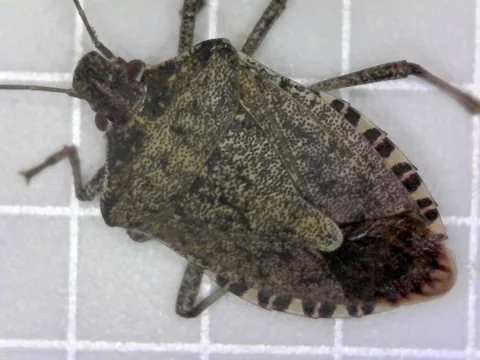 Brown Marmorated Stink Bug
Halyomorpha halys
The brown marmorated stink bug is an invasive insect from east Asia that damages fruit and vegetable crops and invades homes in fall looking for overwintering sites. Minnesota Extension says it feeds on about 200 plant species and, unlike the native stink bugs there, prefers to spend the winter in homes. Clemson notes that the bugs gather on outside walls before they move in.
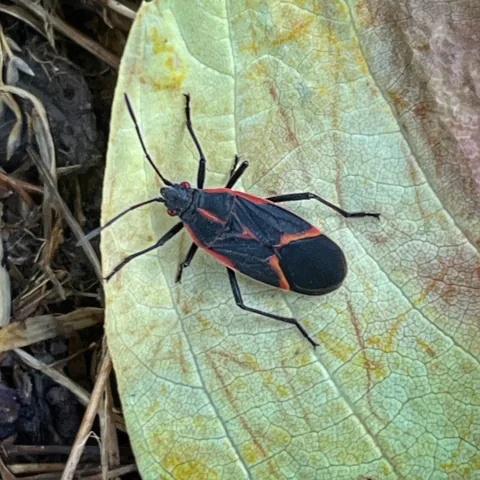 Boxelder Bug
Boisea trivittata
Boxelder bugs feed mainly on the seeds of female boxelder trees and become a nuisance in fall, when large numbers gather on and around homes looking for a place to spend the winter. Indoors they can stain fabrics and smell when crushed, but they don't damage the structure and don't breed inside.
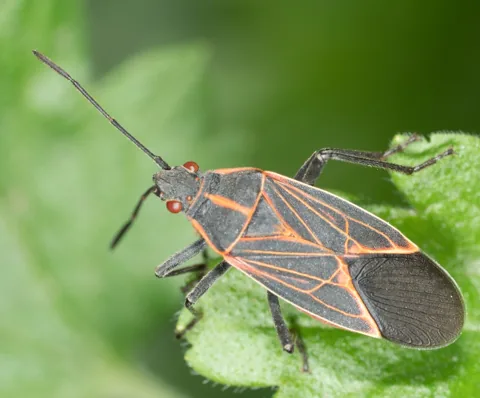 Western boxelder bug
Boisea rubrolineata
The western boxelder bug is a black-and-red true bug that feeds mostly on the leaves, flowers and seedpods of female box elder trees. It does little harm to plants. The trouble starts when clusters form on outside walls and then move into the house in fall and spring. Colorado State, writing about boxelder bugs in general, says they are a nuisance in and around homes from fall through early spring.
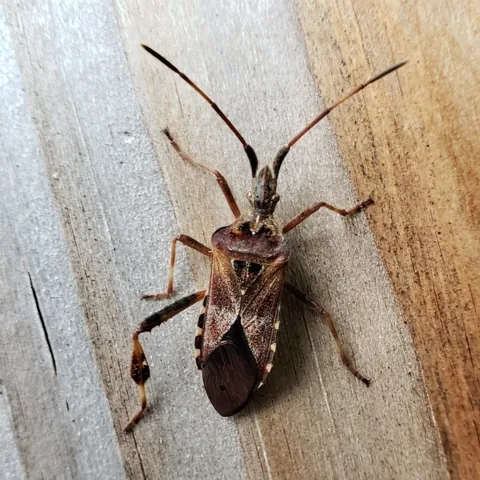 Western Conifer Seed Bug
Leptoglossus occidentalis
The western conifer seed bug is a leaf-footed bug that feeds on the seeds and cones of pines and other conifers. In fall, adults look for sheltered places to spend the winter, and many end up inside houses, where they are a nuisance but harmless.
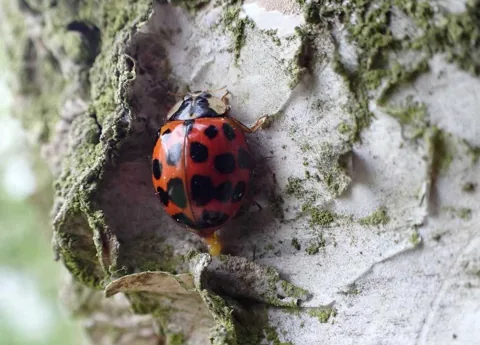 Multicolored Asian Lady Beetle
Harmonia axyridis
The multicolored Asian lady beetle is a beneficial aphid predator outdoors but becomes a nuisance when it flies to buildings in fall to overwinter and ends up indoors. Clemson and Colorado State extension both describe it as a valuable aphid predator on crops, trees and shrubs.
Side by side
Both are true bugs with piercing-sucking mouthparts, and neither breeds inside the house. Each line below compares the brown marmorated stink bug (BMSB) with the boxelder bug.[7][1][8]
- Size: UC IPM puts the adult stink bug at about 5/8 inch and Penn State at about 17 mm (0.66 inch). Boxelder bug adults are about 1/2 inch (Penn State: about 12 mm).[1][2][8][7]
- Shape: stink bug shield shaped, almost as wide as long, with a smooth, rounded shoulder. Boxelder bug elongate and flattened on top, about one-third as wide as long.[2][3][6][7]
- Color: stink bug shades of brown on top and underneath, marbled. Boxelder bug black or brownish-black with red or orange-red lines on the thorax and wing margins and a red abdomen under the wings.[2][1][6][7][10]
- Antennae: stink bug antennae carry two white bands (UC IPM) or alternating light and dark bands (Minnesota). Boxelder bug antennae and legs are dark brown to black.[1][3][11]
- Legs and wing tips: the stink bug's legs are marbled brown with faint white bands, and the clear rear part of the front wings has dark bands at the tip. Boxelder bug wings show fine red lines.[1][2][6]
- Young bugs (nymphs): boxelder nymphs are bright red and gain black markings and wing pads as they grow. Stink bug nymphs from the third stage on have a marbled brown head and thorax, a red, black and white abdomen and white bands on the antennae and legs.[6][8][1]
- Host plants: boxelder bugs feed mainly on the seeds of female boxelder trees, sometimes maple and ash, and occasionally fruit trees. BMSB feeds on apples, peaches, figs, citrus, beans, corn, tomatoes and many ornamental plants and weeds; UC IPM points to a host list of over 170 species.[10][9][6][2][1]
- Where they gather in fall: boxelder bugs collect on the south side of trees and buildings (Minnesota adds west-facing walls). Stink bugs gather on houses on warm fall days from September through October.[7][8][2]
- Bites: UC IPM says BMSB does not bite or sting. For boxelder bugs, Kentucky says they do not bite or sting, while Montana State says rare bites have been reported.[1][9][20]
Eastern vs western boxelder bugs
North America has two boxelder bugs. The USDA Forest Service says the eastern boxelder bug (Boisea trivittata) is found throughout the eastern United States west through the Great Plains, plus riparian areas of the central and southern Rocky Mountains, the Colorado Plateau and California's Central Valley. The western boxelder bug (B. rubrolineata) occurs from British Columbia south to California and east to Nevada, Utah and Texas.[11][14]
They look alike. The Forest Service says the orange-red bands of the western boxelder bug are slightly narrower and paler. The Pacific Northwest handbook describes it as about 0.5 inch, with dark gray to black front wings and thorax and thin bright red markings.[11][12]
Where both occur, New Mexico State says the western species is generally the less troublesome of the two. Both feed on boxelder, and to a lesser extent maple and ash, and both overwinter in cracks and under siding.[13][12][11]
Two other fall invaders that get mixed up with them
If the bug is neither shield shaped nor black and red, check these two before choosing a fix.[20][15]
- Western conifer seed bug: about 3/4 inch, longer than either, reddish to dull brown with a faint white zigzag line across the middle of the wings and flattened, leaf-like back legs. It feeds on pine and other conifer cones and can give off a strong pine-like odor; Minnesota says it does not bite or sting.[15][16][17]
- Multicolored Asian lady beetle: a beetle, not a true bug. It is oval and convex, about 1/4 inch (Penn State: 9/32 inch), tan to orange to red with a variable number of black spots and an M-shaped mark behind the head. When disturbed it releases a foul-smelling yellow fluid that can stain, and it occasionally bites.[18][19]
Why they come indoors
Both are looking for a protected place to spend the winter. Stink bugs move into buildings in late summer and early fall; in the wild they winter in cracks or under the peeling bark of older or dead trees. Boxelder bugs winter as adults in cracks and crevices of walls, doors, windows and foundations, especially on south and west exposures.[1][10][8]
Inside, they hide in wall voids, attics and similar spaces and come out on warm days or when the heat is turned up, so they often show up again in late winter and spring. Minnesota Extension says every boxelder bug seen indoors in winter and spring got in the previous fall, and that BMSB does not lay eggs or reproduce indoors in winter.[3][8][1]
Neither one starts a colony in the house. Boxelder bugs need their host trees to lay eggs, and the stink bugs leave in spring to feed and mate outdoors.[9][7][5]
Odor and staining
Both smell when crushed. UC IPM says BMSB emits an offensive odor when disturbed or crushed, and Penn State notes the smell is obvious if many are crushed or vacuumed up. Boxelder bugs also release an unpleasant odor when crushed.[1][2][8][9]
Staining is mainly a boxelder bug problem: their excrement can spot curtains, walls, furnishings, clothing and other light-colored surfaces.[8][6][9][20]
UC IPM says BMSB is not harmful to people, houses or pets and does not eat or bore into wood. Boxelder bugs do not injure people or pets and normally cause no property damage beyond stains.[1][6][8]
How to confirm which one you have
Get a clear look at the top of the bug, the shape of its outline and its antennae: the white antenna bands and the banded abdominal edge are the quickest stink bug checks, and the red lines behind the head are the boxelder bug check.[1][3][6]
University insect ID labs, such as Mississippi State's Extension Insect ID Lab, identify mailed specimens and digital photos. Hard-bodied insects such as true bugs can be wrapped in tissue in a small crush-proof container; dead, dry insects that rattle around often lose the legs and antennae needed for ID.[21]
Why the ID changes the plan
For boxelder bugs, the female boxelder tree is the source. Colorado State calls removing female boxelder trees the most permanent solution, and the Forest Service says seedless cultivars are not attractive to the bugs. Minnesota Extension disagrees, saying removing or spraying boxelder trees in your yard is not a good way to manage the bugs; it notes adults can fly several blocks and up to two miles, and that the trees' benefits outweigh occasional infestations.[10][11][8]
For stink bugs, there is no single tree to remove: they come from a wide range of crops, woods and landscape plants. NC State says that by summer most move outdoors to feed and mate in woods, landscaping and farms.[2][5]
For the lady beetle and the seed bug, see their own pages linked below; sealing is the first step for all four.[18][15]
What to do for each
Exclusion comes first for every fall invader. Seal cracks around windows, doors, siding, utility pipes, behind chimneys and under fascia with caulk or foam sealant, repair screens and screen attic and gable vents.[1][2][11]
- Timing: Minnesota sets the end of August for boxelder bug repairs. NC State says to let stink bugs leave on their own in spring and seal before they return in late August, and warns that sealing in fall, winter or early spring can trap them inside.[8][5]
- Stink bugs indoors: vacuum them up (some people keep a vacuum just for this because of the smell), or knock them into soapy water. NC State says not to squash them or release them outdoors. UC IPM describes a light trap made from a foil pan of soapy water with a lamp pointed into it in a dark room. Minnesota says pesticides are not recommended indoors.[1][5][3]
- Boxelder bugs indoors: vacuum or sweep them up. Minnesota says spraying in spring does not stop more from returning; the time for any outdoor spray is late summer and early fall when they first cluster outside. UC IPM says insecticide use is rarely justified, and Montana State says most exterior insecticides are not very effective against them.[8][7][6][20]
- Around the yard for boxelder bugs: UC IPM suggests sweeping or shop-vacuuming clusters and seeds on patios and driveways and clearing a 6- to 10-feet wide strip of leaves, weeds and grass along the house.[6]
Common questions
- Is a boxelder bug a stink bug?
- No. Boxelder bugs belong to the family Rhopalidae; stink bugs are Pentatomidae. Both are true bugs and both smell when crushed.[11][2][9]
- Do stink bugs or boxelder bugs breed in the house?
- No. Both overwinter indoors as adults and reproduce outdoors in spring and summer.[8][3][7]
- Which one stains curtains?
- Boxelder bugs. Their excrement can spot curtains, walls and other light surfaces.[8][6][9]
- What is the long brown bug with leaf-shaped back legs?
- Most likely a western conifer seed bug, a pine-feeding fall invader about 3/4 inch long that does not breed indoors.[16][17][15]
Photo credits
- Brown Marmorated Stink Bug: (c) Stan Rullman, some rights reserved (CC BY) — via iNaturalist, CC BY 4.0
- Boxelder Bug: (c) Alfonso Benítez-Mora, some rights reserved (CC BY) — via iNaturalist, CC BY 4.0
- Western boxelder bug: Jesse Rorabaugh, public domain (CC0), via iNaturalist
- Western Conifer Seed Bug: (c) Gavin Slater, some rights reserved (CC BY) — via iNaturalist, CC BY 4.0
- Multicolored Asian Lady Beetle: (c) Sascha Nunheim, some rights reserved (CC BY) — via iNaturalist, CC BY 4.0
Sources
- University of California Statewide IPM Program, “Pest Notes: Brown Marmorated Stink Bug.” ipm.ucanr.edu/home-and-landscape/brown-marmorated-stink-bug/ (accessed 2026-11-14)
- Penn State Extension, “Brown Marmorated Stink Bug.” extension.psu.edu/brown-marmorated-stink-bug (accessed 2026-11-14)
- University of Minnesota Extension, “Brown marmorated stink bug.” extension.umn.edu/garden-and-home/yard-and-garden/yard-and-garden-insects/brown-marmorated-stink-bug (accessed 2026-11-14)
- Clemson Cooperative Extension, Home & Garden Information Center, “Brown Marmorated Stink Bug in Structures (HGIC 2404).” hgic.clemson.edu/factsheet/brown-marmorated-stink-bug-in-structures/ (accessed 2026-11-14)
- NC State Extension, Department of Entomology and Plant Pathology, “FAQs: Brown Marmorated Stink Bug.” entomology.ces.ncsu.edu/faqs-brown-marmorated-stink-bug (accessed 2026-11-14)
- University of California Statewide IPM Program, “Pest Notes: Boxelder Bug.” ipm.ucanr.edu/home-and-landscape/boxelder-bug/ (accessed 2026-11-14)
- Penn State Extension, “Boxelder Bug.” extension.psu.edu/boxelder-bug (accessed 2026-11-14)
- University of Minnesota Extension, “Boxelder bugs.” extension.umn.edu/nuisance-insects/boxelder-bugs (accessed 2026-11-14)
- University of Kentucky Entomology, “ENTFACT-444: Boxelder Bugs.” entomology.mgcafe.uky.edu/ef444 (accessed 2026-11-14)
- Colorado State University Extension, “Boxelder Bugs.” extension.colostate.edu/resource/boxelder-bug/ (accessed 2026-11-14)
- USDA Forest Service, “Forest Insect & Disease Leaflet 95: Boxelder Bugs.” www.fs.usda.gov/foresthealth/docs/fidls/FIDL-95-BoxelderBugs.pdf (accessed 2026-11-14)
- Pacific Northwest Pest Management Handbooks, “Boxelder (Acer negundo)-Western boxelder bug.” pnwhandbooks.org/insect/hort/landscape/hosts-pests-landscape-plants/boxelder-acer-negundo-western-boxelder-bug (accessed 2026-11-14)
- New Mexico State University Cooperative Extension Service, “Boxelder Bugs (Ornamental Pest Guide O-04).” plantclinic.nmsu.edu/documents/o-04-boxelderbugs.pdf (accessed 2026-11-14)
- UC Davis Bohart Museum of Entomology, “Boxelder Bugs (Note 09).” bohart.ucdavis.edu/sites/g/files/dgvnsk4616/files/media/documents/note_09_boxelder_bugs.pdf (accessed 2026-11-14)
- Penn State Extension, “Western Conifer Seed Bug.” extension.psu.edu/western-conifer-seed-bug (accessed 2026-11-14)
- University of Wisconsin-Madison Extension, Wisconsin Horticulture, “Western Conifer Seed Bug.” hort.extension.wisc.edu/articles/western-conifer-seed-bug/ (accessed 2026-11-14)
- University of Minnesota Extension, “Western conifer seed bug and hackberry psyllids.” extension.umn.edu/nuisance-insects/western-conifer-seed-bug-and-hackberry-psyllids (accessed 2026-11-14)
- University of Kentucky Entomology, “ENTFACT-416: Asian Lady Beetle Infestation of Structures.” entomology.mgcafe.uky.edu/ef416 (accessed 2026-11-14)
- Penn State Extension, “Multicolored Asian Lady Beetle.” extension.psu.edu/multicolored-asian-lady-beetle (accessed 2026-11-14)
- Montana State University Extension, “Fall Home Invaders.” www.montana.edu/extension/lila_extn/lila_fall_23/FallHomeInvaders.html (accessed 2026-11-14)
- Mississippi State University Extension, “Insect Identification.” extension.msstate.edu/insects/insect-identification (accessed 2026-11-14)