The short answer
- Size: a kudzu bug is about 1/4 inch long, roughly lady beetle size. A brown marmorated stink bug is about 5/8 inch (17 mm), more than twice as long.[1][3][4][6]
- Shape: the kudzu bug is almost square or rounded-oblong, with a large plate covering its wings. The stink bug is shield-shaped, nearly as wide as long, with a smooth shoulder edge.[1][3][4][5][6]
- Color and markings: the kudzu bug is light brown with an olive-green hue and fine dark pits. The stink bug is mottled or marbled brown, with light bands on its antennae and alternating light and dark bands along the edge of its abdomen.[1][3][4][5][6]
- Where: kudzu bugs are a Southeastern insect, first found in Georgia in 2009. Brown marmorated stink bugs were first found in Pennsylvania and have since spread across wide areas of the eastern U.S. and into California.[1][2][4][7][6]
Bugs on this page
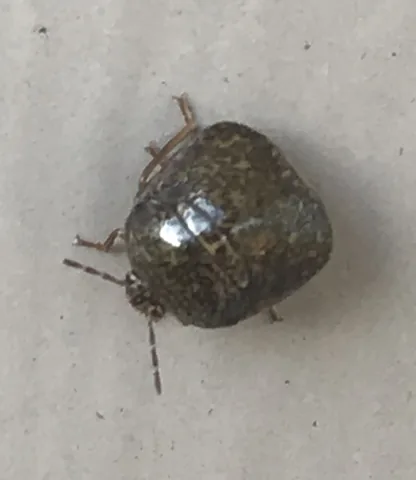 Kudzu Bug
Megacopta cribraria
The kudzu bug is an invasive Asian insect, related to stink bugs, that feeds on kudzu, wisteria and soybeans. In late summer and fall it gathers in large numbers on houses, especially light-colored ones, hunting for places to spend the winter. It is a nuisance rather than a danger: its secretions smell bad and stain fabric, walls and skin. Seal gaps before fall, vacuum bugs that get in instead of crushing them, and spray outdoors only where bugs land.
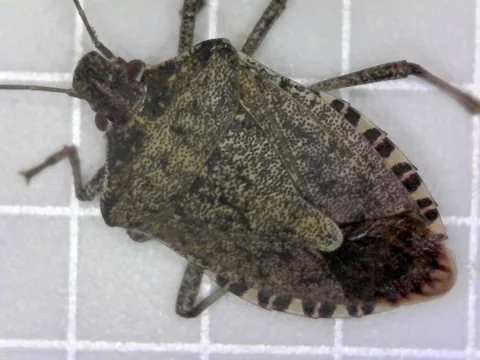 Brown Marmorated Stink Bug
Halyomorpha halys
The brown marmorated stink bug is an invasive insect from east Asia that damages fruit and vegetable crops and invades homes in fall looking for overwintering sites. Minnesota Extension says it feeds on about 200 plant species and, unlike the native stink bugs there, prefers to spend the winter in homes. Clemson notes that the bugs gather on outside walls before they move in.
Side by side
The kudzu bug, Megacopta cribraria, also called the bean plataspid or globular stinkbug, is in the family Plataspidae and is related to stink bugs. The brown marmorated stink bug, Halyomorpha halys, often shortened to BMSB, is a true stink bug.[2][3][1][6]
- Length, kudzu bug: about 1/4 inch by Clemson's measure; the University of Florida gives 3.5 to 6 mm.[1][3]
- Length, stink bug: about 5/8 inch (UC IPM) or approximately 17 mm (0.66 in) (Penn State). A medical case report gives a range of 14 to 17 mm.[6][4][8]
- Shape, kudzu bug: small and almost square-looking (Clemson), or rounded oblong (UF). UF points to its enlarged, squared-off scutellum, the plate that covers the wings.[1][3]
- Shape, stink bug: shield-shaped and almost as wide as long, with a smooth, rounded shoulder edge and a blunt front edge of the head.[4][5][6]
- Color, kudzu bug: light brown with an olive-green hue, the back covered with many dark pits.[1][3]
- Color, stink bug: mottled or marbled brown. The antennae carry light (white) bands, the abdomen edge has alternating light and dark bands, and the legs are marbled brown with faint white bands.[4][5][6]
- Eggs: kudzu bug eggs are light tan, barrel-shaped and laid in two rows on leaves. Stink bug eggs are barrel-shaped, white to pale green, and laid in clusters on leaves.[1][6]
- Young: both go through five nymph stages. Kudzu bug nymphs look hairy and are pale orange, olive green or light brown. Stink bug nymphs have red eyes, white-banded antennae and legs, and reddish brown, black and white abdomen markings in later stages.[2][3][6]
- Range, kudzu bug: from Asia, first detected in northeastern Georgia in October 2009 and now in Georgia, South Carolina and other southern states.[1][2]
- Range, stink bug: from eastern Asia. Penn State dates the first U.S. collection to 1998 in Allentown, Pennsylvania; a 2012 dermatology paper gives 1996. Minnesota first detected it in 2010, and a breeding population was found in the Los Angeles area in 2006.[4][7][5][6]
- Generations: two a year for kudzu bugs in the Southeast. Brown marmorated stink bugs have one or two a year in the mid-Atlantic and probably one in Pennsylvania, with more in warmer areas.[1][4][6]
- What they eat, kudzu bug: kudzu, wisteria, soybeans and most other bean plants. Stink bug: a wide range of fruits, vegetables, row crops and ornamental trees; Minnesota Extension puts it at about 200 plant species.[1][5][4][6]
Kudzu bug or lady beetle?
Many people take kudzu bugs for beetles. Clemson Extension says it is not a beetle but is more closely related to stink bugs, and that the adult is about the same size as an adult lady beetle. Its olive-brown, almost square body and its smell when disturbed point to kudzu bug. For lady beetles on the house, see the related pages below.[1]
On and in the house
Kudzu bugs: in fall, large numbers leave kudzu and other plants for sheltered spots to overwinter, such as leaf litter and crevices in trees and shrubs, and many land on houses. Clemson says research shows they prefer light colors, particularly white, and gather around window trim, door frames, gutters and sunlit, bright surfaces. UF notes the first U.S. finds came from aggregations on the outsides of houses in Georgia.[1][3][2]
Stink bugs: brown marmorated stink bugs come to the outsides of houses on warm fall days, starting in September through October in Pennsylvania, and can enter in large numbers. Minnesota Extension says that, unlike its native stink bugs, this one prefers to overwinter in homes. In spring the adults leave for host plants.[4][5][6]
Indoors, neither breeds. Penn State says stink bugs will not reproduce inside or damage the structure, and UC IPM says they do not bite, sting, suck blood, spread diseases of mammals, or eat wood.[4][6]
Odor and stains: both release a foul odor when disturbed or crushed. Clemson says kudzu bug secretions can stain fabrics and wall coverings, and UF says the defense chemical can stain houses, buildings and vehicles where they gather. Clemson adds that large numbers can leave a lasting odor and attract carpet beetles and ants.[1][3][5][6]
Skin, eyes and allergies
Brown marmorated stink bug: a Penn State dermatology team reported irritant contact dermatitis from this bug, and noted that fruit crop workers had complained of a slight allergic reaction to the chemicals it releases.[7]
Eyes: a 2017 case report describes a man whose eye was injured by stink bug fluid, with a corneal defect that healed over several days. The authors say the main chemicals in the fluid are aldehydes that can cause chemical burns to the eye, and that anyone who gets the fluid in an eye should rinse it thoroughly and seek medical care right away.[8]
Kudzu bug: we found no medical journal, CDC or health department report on kudzu bug skin reactions, so we make no health claims here. Clemson's advice for the house is to vacuum them up rather than crush them, which avoids the stains.[1]
Gardens and soybeans
Kudzu bugs are mainly a soybean and bean pest. NC State calls the kudzu bug a severe economic pest of soybean in Georgia, North Carolina and South Carolina. Adults and nymphs suck fluids from stems, leaf stalks and nodes, and sooty mold can grow on the sugary waste they leave on leaves. NC State says losses can be very high if they are left untreated over time, but large numbers for a short time are not cause for alarm.[2]
Kudzu bugs move into kudzu, wisteria or soybeans when they leave overwintering sites; in North Carolina that is March and April, with a second move by the first generation from July into mid-August. They favor early-planted soybeans.[2][1]
Brown marmorated stink bugs are mainly a fruit and vegetable pest. Feeding on apples causes the distorted "cat facing" that makes fruit unsellable, beans and okra get scarred, sunken areas and deformed pods, and tomatoes and peppers get spongy areas inside.[4][6]
UC IPM lists apple, pear, peach, nectarine, lima bean, snap pea, pepper, sweet corn, tomato, field corn and soybean as the most affected crops in the mid-Atlantic. Minnesota Extension had no reports of garden damage there, even with home infestations.[6][5]
How to confirm
Get a clear top-down photo next to something for scale, such as a coin or ruler. A bug about the size of a lady beetle with a nearly square, olive-brown body points to kudzu bug; a bug over half an inch long with a shield shape points to stink bug.[1][3][4][6]
Then zoom in on the antennae and the edge of the abdomen. White or light bands on the antennae and a banded abdomen edge mark the brown marmorated stink bug. Look-alikes such as the rough stink bug and consperse stink bug lack the antenna bands.[4][5][6]
Minnesota Extension points to a stink bug identification app with photos of look-alike species.[5]
Soybean growers check for kudzu bugs with a sweep net after mid-July; NC State advises waiting to spray until nymphs show up on the soybeans, because adults migrate in over several weeks.[2]
What to do about each
Seal first, for both. Penn State advises caulking cracks around windows, doors, siding, utility pipes, chimneys and fascia and repairing damaged screens. Clemson says sealing cracks and screening windows, doors, soffit vents and peak vents keeps kudzu bugs out.[4][1]
Indoors, vacuum, don't spray. Clemson says kudzu bugs indoors should be vacuumed, preferably with a shop vacuum, since odor can linger in a household one; discard the bag after. UC IPM notes people sometimes dedicate a vacuum to stink bugs or put a nylon stocking inside the hose to catch them.[1][6]
Penn State does not advise insecticides indoors once stink bugs are in wall voids or attics; foggers kill the ones in the room but more emerge soon after. Outdoor sprays give minor, short relief because sunlight breaks them down.[4]
For kudzu bugs, Clemson says most home insecticides kill them and suggests limiting sprays to small, targeted outdoor areas where they land, in daylight once nights cool to about 50°F, and notes rain and sun break the spray down. It also says it may be best to let them go without spraying. Cutting back kudzu and removable wisteria before fall also helps.[1]
In soybeans, NC State finds bifenthrin the most active insecticide against kudzu bug but warns the effective products are broad-spectrum and can wipe out beneficial insects, raising the risk of caterpillar pests later.[2]
Common questions
- Is a kudzu bug a stink bug?
- Not quite. It is in a related family, Plataspidae, and NC State lists 'globular stinkbug' as one of its names. Like stink bugs it gives off a foul odor.[2][3][1]
- Do kudzu bugs or stink bugs bite?
- UC IPM says brown marmorated stink bugs do not bite, sting or suck blood. Clemson calls large numbers of kudzu bugs a nuisance in and around buildings, through their odor and stains.[6][1]
- Why are kudzu bugs all over my white house?
- Clemson says research shows they prefer light colors, particularly white, and gather on sunlit, bright surfaces in fall while hunting for winter shelter.[1]
- Will either one breed inside my house?
- Penn State says stink bugs will not reproduce indoors. Kudzu bugs move into kudzu, wisteria or soybeans to mate and lay eggs after winter.[4][2]
- What gets rid of the smell?
- Avoid crushing them. Use a shop vacuum or a dedicated vacuum for bugs, since both Clemson and UC IPM note the odor can linger in a vacuum.[1][6]
Photo credits
- Kudzu Bug: (c) Cole Shoemaker, some rights reserved (CC BY) — via iNaturalist, CC BY 4.0
- Brown Marmorated Stink Bug: (c) Stan Rullman, some rights reserved (CC BY) — via iNaturalist, CC BY 4.0
Sources
- Clemson Cooperative Extension, Home & Garden Information Center, “Kudzu Bugs Around the Home.” hgic.clemson.edu/factsheet/kudzu-bugs-around-the-home/ (accessed 2026-11-14)
- NC State Extension, “Kudzu Bug.” content.ces.ncsu.edu/kudzu-bug (accessed 2026-11-14)
- University of Florida IFAS Extension, “Bean Plataspid: Megacopta cribraria (EENY527/IN939).” ask.ifas.ufl.edu/publication/IN939 (accessed 2026-11-14)
- Penn State Extension, “Brown Marmorated Stink Bug.” extension.psu.edu/brown-marmorated-stink-bug (accessed 2026-11-14)
- University of Minnesota Extension, “Brown marmorated stink bug.” extension.umn.edu/garden-and-home/yard-and-garden/yard-and-garden-insects/brown-marmorated-stink-bug (accessed 2026-11-14)
- University of California Statewide IPM Program, “Pest Notes: Brown Marmorated Stink Bug.” ipm.ucanr.edu/PMG/PESTNOTES/pn74169.html (accessed 2026-11-14)
- Anderson BE, Miller JJ, Adams DR (PubMed 22828257), “Irritant contact dermatitis to the brown marmorated stink bug, Halyomorpha halys (Dermatitis, 2012).” pubmed.ncbi.nlm.nih.gov/22828257/ (accessed 2026-11-14)
- Shen YS, Hu CC (PubMed 29296555), “Irritant contact keratitis caused by the bodily fluids of a brown marmorated stink bug (Taiwan J Ophthalmol, 2017).” pubmed.ncbi.nlm.nih.gov/29296555/ (accessed 2026-11-14)