The short answer
- Spots: every spotted lanternfly nymph has bright white spots, black on the young ones and red-and-black with black stripes on the last nymph stage. Boxelder bugs, milkweed bugs, harlequin bugs and wheel bug nymphs are red or orange and black, without those white dots.[4][1][3][13]
- Adult wings at rest: the lanternfly's front wings are gray to light brown with black spots, and the hind wings it flashes in flight are red with black spots and a black-and-white band. Underwing moths have bark-patterned front wings with wavy lines instead of spots.[6][1][19]
- Size and shape: adults are about 1 inch long and 1/2 inch wide at rest, and both adults and nymphs jump when you approach. Two of the moth look-alikes are much bigger: the giant leopard moth and the white-lined sphinx have wingspans of 2 1/4 to 3 1/2 inches.[6][4][5][21][20]
- Egg masses: lanternfly egg masses are about 1 inch long and look like gray-brown cracked mud. Spongy moth egg masses are larger, about 1 1/2 inches long, and covered in buff or yellowish hair.[4][1][17]
Insects on this page
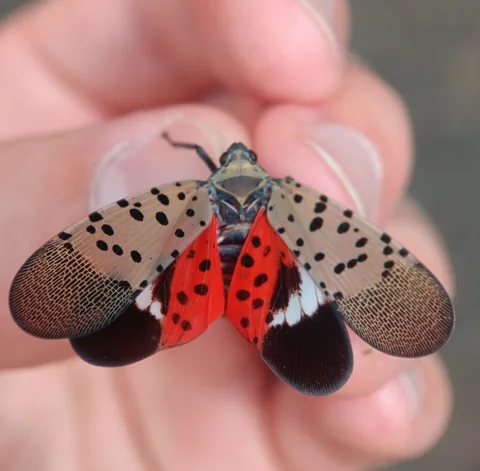 Spotted Lanternfly
Lycorma delicatula
The spotted lanternfly is an invasive planthopper from Asia that feeds on the sap of grapevines, hops, stone fruit trees, hardwoods and many landscape plants. It can't bite or sting, but it hitchhikes easily: females lay eggs on almost any hard outdoor surface, including vehicles, trailers, grills and firewood.
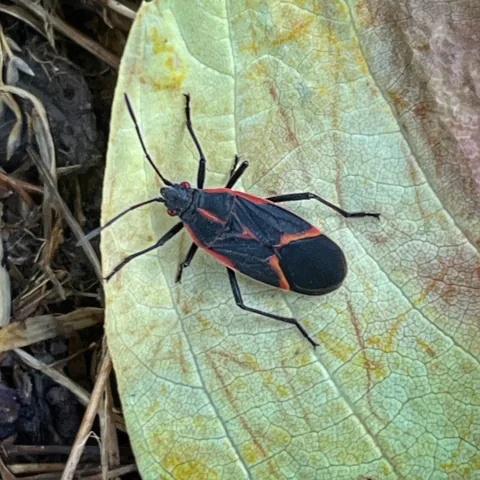 Boxelder Bug
Boisea trivittata
Boxelder bugs feed mainly on the seeds of female boxelder trees and become a nuisance in fall, when large numbers gather on and around homes looking for a place to spend the winter. Indoors they can stain fabrics and smell when crushed, but they don't damage the structure and don't breed inside.
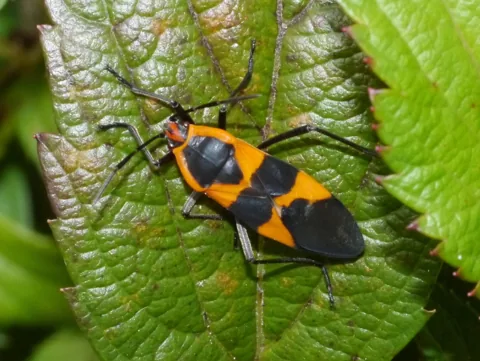 Large Milkweed Bug
Oncopeltus fasciatus
Large milkweed bugs are reddish-orange and black bugs that gather on milkweed seed pods in late summer. They feed mainly on the seeds, do little harm to the plants and don't bother monarch caterpillars.
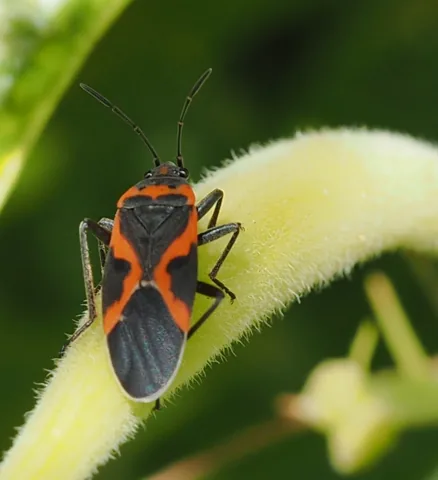 Small Milkweed Bug
Lygaeus kalmii
The small milkweed bug is a half-inch black bug with a reddish-orange X across its back and a reddish-orange band behind the head. It is one of the most common bugs on garden milkweeds.
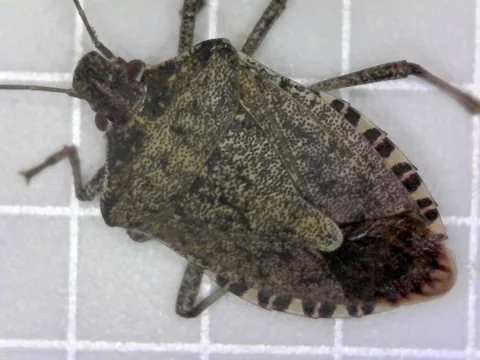 Brown Marmorated Stink Bug
Halyomorpha halys
The brown marmorated stink bug is an invasive insect from east Asia that damages fruit and vegetable crops and invades homes in fall looking for overwintering sites. Minnesota Extension says it feeds on about 200 plant species and, unlike the native stink bugs there, prefers to spend the winter in homes. Clemson notes that the bugs gather on outside walls before they move in.
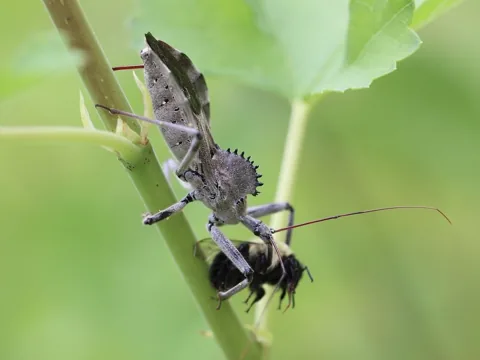 Wheel Bug
Arilus cristatus
The wheel bug is the largest assassin bug in North America, named for the toothed crest on its back. It hunts caterpillars and other insects, but it gives an immediately painful bite if handled carelessly.
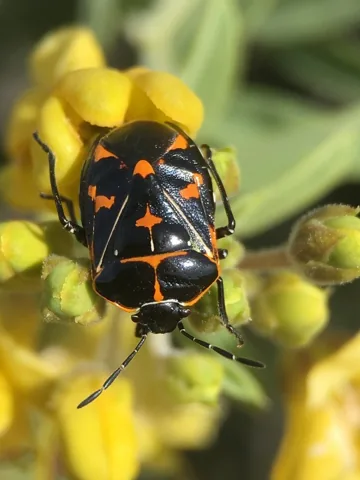 Harlequin Bug
Murgantia histrionica
The harlequin bug is a brightly colored stink bug that attacks cabbage, collards, kale, mustard and other cole crops. It sucks plant juices, and heavy infestations can wilt, brown and kill young plants or even whole fields.
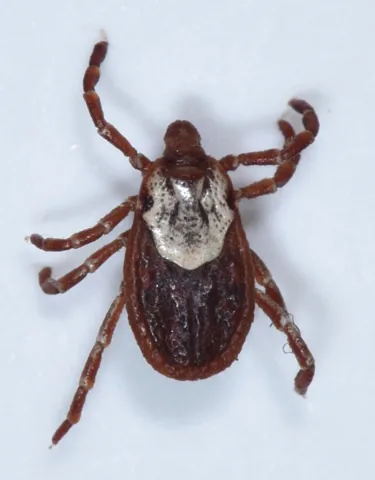 American Dog Tick
Dermacentor variabilis
The American dog tick, also called the wood tick, is widely distributed east of the Rocky Mountains. Adult females are the stage most likely to bite people, especially in spring and summer, and adults commonly climb to the crown of the head.
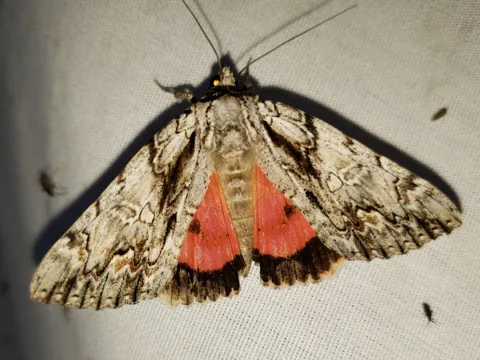 Underwing Moths
Catocala
Underwing moths are the large genus Catocala, with more than 100 species in North America north of Mexico. By day they sit on tree trunks, where their gray or brown forewings match the bark; when disturbed they flash hindwings banded in orange, red, yellow, pink, white or black, then seem to vanish when they land. The caterpillars feed at night on the leaves of deciduous trees and shrubs, and oak and hickory support the most species.
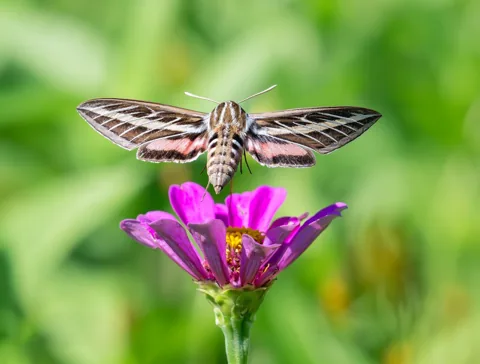 Whitelined Sphinx
Hyles lineata
The whitelined sphinx is a large hawk moth found across most of North America. It is the most common hornworm in Colorado and by far the most commonly seen 'hummingbird moth.'
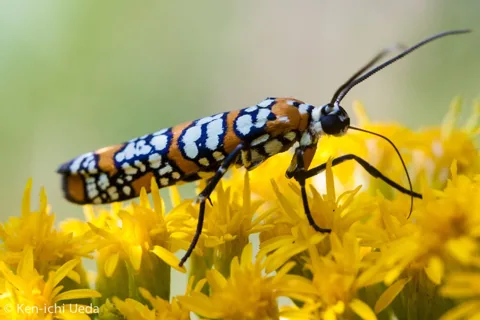 Ailanthus Webworm
Atteva aurea
The ailanthus webworm is a small, narrow orange moth with white black-ringed spots that visits flowers by day; its caterpillars live together in flimsy webs on tree-of-heaven (ailanthus). It is rarely numerous enough to defoliate its host.
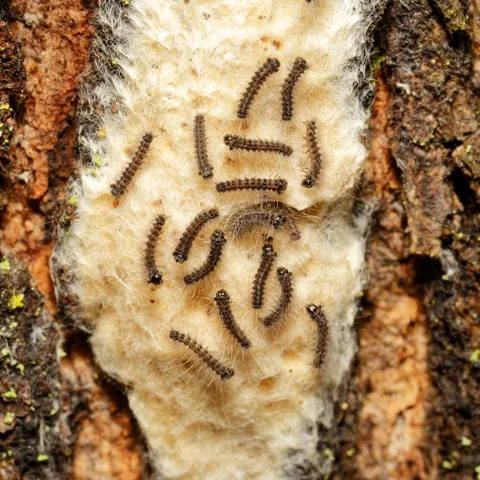 Spongy Moth
Lymantria dispar
The spongy moth, formerly called the gypsy moth, is an invasive defoliator from Europe whose caterpillars feed on the leaves of hundreds of kinds of trees and shrubs, oaks above all. Management changes with the season to target whichever life stage is present.
What a real spotted lanternfly looks like at each stage
There is one generation a year in Pennsylvania. Eggs overwinter, hatch in spring, and the young pass through four wingless nymph stages before turning into adults; adults die in winter.[4][5]
- Egg mass: about 1 inch long, laid on hard surfaces such as trees, stones and patio furniture. Fresh masses are covered in a white or light gray putty-like coating that ages to look like cracked mud; old masses lose the coating and show rows of seed-like eggs.[4][9][6]
- Eggs per mass: New Jersey and Utah State give 30 to 50 eggs; Penn State gives an average of about 35.[9][6][5]
- Early nymphs (first three stages): black bodies and legs covered in bright white spots, from a few millimeters to about 1/4 inch long. APHIS gives 1/8 to 1/4 inch. Penn State says the youngest are tiny enough to be mistaken for ticks.[4][1][3]
- Late nymph (fourth stage): about 1/2 inch, bright red with black stripes and white spots. It usually appears in July in Pennsylvania.[4][1][3]
- Adult: about 1 inch long and 1/2 inch wide at rest, with a black head. Front wings gray to light brown with black spots and wing tips of black blocks outlined in gray. Hind wings red, black and white, seen in flight. Abdomen yellow with broad black bands.[6][1][9]
- Behavior: nymphs and adults are strong jumpers. Adults can fly but often prefer to jump and glide, and they open their wings when gliding or frightened.[4][5]
- Season: New York's poster gives early nymphs May to July, late nymphs July to September and adults July to December. New Jersey says egg masses can be seen from September to June.[7][9]
- Where to look: APHIS calls tree-of-heaven one of the best places to look. Its bark is light brown to gray with a texture like cantaloupe skin, and its leaves are 1 to 4 feet long with many leaflets on both sides of a central stem.[1]
Nymph look-alikes
Penn State's list of nymph look-alikes in Pennsylvania covers the American dog tick, brown marmorated stink bug nymphs, boxelder bugs, wheel bug nymphs, harlequin bugs and both milkweed bugs. Georgia's sheet also pictures stink bug nymphs, the oak treehopper and its nymphs, and assassin bug nymphs.[3][10]
- American dog tick: about the size of a newly hatched lanternfly nymph, but a tick has eight legs and lacks the black-with-white-dots coloring.[3][7]
- Brown marmorated stink bug nymph: resembles a first-stage lanternfly nymph. Look for white bands on its antennae and legs rather than white dots on the body and legs.[3]
- Boxelder bug nymphs and adults: red and black. Nymphs are bright red; adults are black or brownish-black with red to reddish-orange lines on the plate behind the head and grow to about 1/2 inch. They gather near boxelder trees.[3][13][14]
- Wheel bug nymph: orange-red body with black legs; MDC says the nymphs can look antlike or spiderlike. Only adults have the cog-shaped crest on the back.[3][23]
- Harlequin bug: orange and black as adults and nymphs, commonly feeding on cabbage-family plants. It lacks the bright red body and white-spotted black lines and legs of a fourth-stage lanternfly nymph.[3][10]
- Large milkweed bug: orange and black with a broad black bar across the back and no white dots; about 1/2 to 1 inch long. Iowa State says they feed on milkweed seed pods in the second half of summer.[3][15][16]
- Small milkweed bug: a dark orange cross (an X) on the back, no white dots, and generally smaller, to about 1/2 inch.[3][15]
Adult look-alikes
Most adult look-alikes are moths with colorful hind wings. APHIS names the ailanthus webworm moth, a tiger moth (Arctia caja), the cinnabar moth, the white-lined sphinx, the ilia underwing, the boxelder bug, the large milkweed bug and the Asian longhorned beetle. New York and New Jersey add the figured tiger moth, buck moth, grapevine epimenis, pink underwing and slender clearwing; Georgia adds the giant leopard moth and ornate bella moth.[1][7][9][10]
- Underwing moths (Catocala): front wings dull tan, brown or gray with wavy lines that mimic bark, and hind wings that are almost always bright orange, red, yellow or pink with bold dark patterns. The lanternfly's front wings have black spots, not wavy lines.[19][6][1]
- Giant leopard moth: a large white moth whose front wings carry many black spots, often with hollow centers; wingspan 2 1/4 to 3 1/2 inches.[21][10]
- White-lined sphinx: dark olive-brown front wings with a tan stripe from base to tip and pale streaks along the veins; wingspan 2 1/2 to 3 1/2 inches. It hovers at flowers and is often taken for a hummingbird.[20][1]
- Ailanthus webworm moth: long and thin, with orange front wings marked with white spots outlined in black, curled lengthwise along the body. Its caterpillars live in webs in ailanthus, the tree-of-heaven that lanternflies favor, so both can turn up on the same tree.[22][1]
- Boxelder and milkweed bugs as adults: APHIS lists both as adult look-alikes. Boxelder bugs are mostly black with thin red stripes and milkweed bugs mostly orange-red with large black patches or bands; neither has the lanternfly's gray, black-spotted front wings.[1][13][6]
Egg masses: spotted lanternfly vs spongy moth
New York and New Jersey list the moth they still call gypsy moth (Lymantria dispar) among the look-alikes; APHIS now calls it the spongy moth. Both lay egg masses on trees, stones and outdoor items such as patio furniture, and both kinds of mass can be found through the winter.[7][9][17]
- Spotted lanternfly: about 1 inch, flat, with a putty or mud-like gray-brown covering that looks like cracked mud as it ages; 30 to 50 eggs.[4][5][9][6]
- Spongy moth: about 1 1/2 inches long and 3/4 inch wide, covered with buff or yellowish hair from the female's abdomen, with up to 1,000 eggs. UMass describes it as a brown or tan fuzzy mass of 500 or more eggs.[17][18]
- Hatched lanternfly masses: the covering wears off and leaves rows of seed-like eggs; Utah State says the eggs sit in 4 to 7 parallel rows.[4][6]
How and where to report a spotted lanternfly
APHIS says that in a state already known to have spotted lanternfly you should take a picture, note the location and report it to your state department of agriculture before killing it. If you think you've found it in a new state, capture one in a jar and freeze it so state officials can identify it.[1]
Rules differ by state: New York no longer wants reports from some counties, while Pennsylvania still takes reports by phone and online. Check your own state agriculture department first.[8][11]
- Pennsylvania: report sightings online through the Department of Agriculture or by calling 1-888-4BAD-FLY (1-888-422-3359). Penn State also says to report finds in new areas to your state's agriculture authorities or that number.[11][5]
- New York: residents of Dutchess, Nassau, Orange, Putnam, Rockland, Suffolk, Sullivan, Ulster and Westchester counties and New York City don't need to report sightings and should kill any they see. Elsewhere, take a photo, put a sample in the freezer or in rubbing alcohol or hand sanitizer, and contact the state's responders; the state poster gives spottedlanternfly@agriculture.ny.gov for photos and locations.[8][7]
- Georgia: report through the QR code on the state's look-alike sheet or email lanternfly@agr.georgia.gov.[10]
- Utah: Utah State Extension says to contact the Utah Plant Pest Diagnostic Lab if you suspect one.[6]
- Photo tips: Cornell IPM asks for pictures of the insect, egg masses or infestation and a note of the location. A clear shot of the wings at rest, or of the spots on a nymph, shows the field marks that separate it from look-alikes.[12][1][4]
Quarantines and moving outdoor items
APHIS says 19 states and the District of Columbia have some degree of infestation and that the insect lays eggs on grills, vehicles, trailers, firewood, outdoor furniture, bikes and toys. People in quarantine areas should check outdoor items before traveling, inspect vehicles before leaving a parking lot or work site, and destroy any eggs or insects found.[2]
Pennsylvania has a Spotted Lanternfly Quarantine Order and offers a checklist for inspecting vehicles, trailers and outdoor items before moving them within or out of quarantine areas. New York has had an external quarantine since October 2, 2018 restricting goods and vehicles that could carry the insect into the state from certain counties in Delaware, Maryland, New Jersey, Pennsylvania and Virginia.[11][8]
Why the ID matters
Penn State says misidentification can lead to unnecessary sprays or control efforts. Most of the look-alikes are native insects that need no treatment: Iowa State says milkweed bugs on seed pods are no cause for alarm, and the Missouri Department of Conservation says most people consider wheel bugs beneficial because they eat pest insects such as caterpillars.[3][16][23]
A real lanternfly is different. APHIS says it harms fruit and forest industries and that early detection is a critical step, and its sugary waste promotes sooty mold on plants beneath it. If you confirm one, our guide to getting rid of spotted lanternflies covers egg scraping, circle traps and tree-of-heaven.[2]
Common questions
- Is a red and black bug on my house a spotted lanternfly?
- Not if it has no white spots. Fourth-stage lanternfly nymphs are red with black stripes and white spots; boxelder bugs, a nuisance around homes near boxelder trees, are red and black without white dots.[4][3][13][14]
- Can a baby spotted lanternfly look like a tick?
- Yes. Penn State says first-stage nymphs are about the size of an American dog tick, but ticks have eight legs and no white spots on a black body. Lanternfly nymphs jump when disturbed.[3][4]
- What moth looks like a spotted lanternfly?
- APHIS, New York and New Jersey list underwing moths, tiger moths, the white-lined sphinx and the ailanthus webworm moth among others. Underwings, like lanternflies, have bright hind wings under duller front wings, but their front wings have wavy, bark-like lines, not black spots.[1][7][9][19][6]
- Should I kill it before reporting?
- APHIS says to photograph it, note the location and report it before killing it in a state where it's known, and to capture and freeze one if you think it's a new state. Some states, such as New York in its listed counties, now just ask you to kill it.[1][8]
Photo credits
- Spotted Lanternfly: (c) Tyler Ekholm, some rights reserved (CC BY) — via iNaturalist, CC BY 4.0
- Boxelder Bug: (c) Alfonso Benítez-Mora, some rights reserved (CC BY) — via iNaturalist, CC BY 4.0
- Large Milkweed Bug: (c) Matt Muir, some rights reserved (CC BY) — via iNaturalist, CC BY 4.0
- Small Milkweed Bug: mefisher, public domain (CC0), via iNaturalist
- Brown Marmorated Stink Bug: (c) Stan Rullman, some rights reserved (CC BY) — via iNaturalist, CC BY 4.0
- Wheel Bug: Andy Wilson, public domain (CC0), via iNaturalist
- Harlequin Bug: (c) Matt Berger, some rights reserved (CC BY) — via iNaturalist, CC BY 4.0
- American Dog Tick: (c) Don Loarie, some rights reserved (CC BY) — via iNaturalist, CC BY 4.0
- Underwing Moths: (c) Arturo Santos, some rights reserved (CC BY) — via iNaturalist, CC BY 4.0
- Whitelined Sphinx: (c) Karen Szafrajda, some rights reserved (CC BY) — via iNaturalist, CC BY 4.0
- Ailanthus Webworm: (c) Ken-ichi Ueda, some rights reserved (CC BY) — via iNaturalist, CC BY 4.0
- Spongy Moth: (c) Patrick Hanly, some rights reserved (CC BY) — via iNaturalist, CC BY 4.0
Sources
- USDA APHIS Plant Protection and Quarantine, “Have You Spotted a Spotted Lanternfly? / Is That a Spotted Lanternfly? (APHIS-22-034, revised July 2023).” www.aphis.usda.gov/sites/default/files/fs-slf-lookalikes.508.pdf (accessed 2026-11-14)
- USDA APHIS, “Spotted Lanternfly.” www.aphis.usda.gov/plant-pests-diseases/slf (accessed 2026-11-14)
- Penn State Extension, “Spotted Lanternfly Nymph Lookalikes.” extension.psu.edu/spotted-lanternfly-nymph-lookalikes (accessed 2026-11-14)
- Penn State Extension, “Spotted Lanternfly: What to Look For.” extension.psu.edu/spotted-lanternfly-what-to-look-for (accessed 2026-11-14)
- Penn State Extension, “Spotted Lanternfly Management Guide.” extension.psu.edu/spotted-lanternfly-management-guide (accessed 2026-11-14)
- Utah State University Extension, “Spotted Lanternfly (fact sheet, January 2019).” extension.usu.edu/planthealth/research/spotted-lanternfly (accessed 2026-11-14)
- New York State Department of Environmental Conservation and Department of Agriculture and Markets, “The Invasive Spotted Lanternfly (poster with look-alikes).” extapps.dec.ny.gov/docs/lands_forests_pdf/slfposter2.pdf (accessed 2026-11-14)
- New York State Department of Agriculture and Markets, “Spotted Lanternfly.” agriculture.ny.gov/spotted-lanternfly (accessed 2026-11-14)
- New Jersey Department of Agriculture, “About the Spotted Lanternfly.” www.nj.gov/agriculture/divisions/pi/prog/pests-diseases/spotted-lanternfly/about/ (accessed 2026-11-14)
- Georgia Department of Agriculture, Plant Protection Division, “Have you seen a Spotted Lanternfly? (look-alike handout).” agr.ga.gov/sites/default/files/documents/pests/spotted-lanternfly-look-alike-handout.pdf (accessed 2026-11-14)
- Pennsylvania Department of Agriculture, “Spotted Lanternfly.” www.pa.gov/agencies/pda/plants-land-water/spotted-lanternfly (accessed 2026-11-14)
- Cornell University New York State IPM Program, “Spotted Lanternfly.” cals.cornell.edu/integrated-pest-management/outreach-education/whats-bugging-you/spotted-lanternfly (accessed 2026-11-14)
- University of Kentucky Entomology, “Boxelder Bugs (EF444).” entomology.mgcafe.uky.edu/ef444 (accessed 2026-11-14)
- Penn State Extension, “Boxelder Bug.” extension.psu.edu/boxelder-bug (accessed 2026-11-14)
- Missouri Department of Conservation, “Large Milkweed Bug (field guide).” mdc.mo.gov/discover-nature/field-guide/large-milkweed-bug (accessed 2026-11-14)
- Iowa State University Extension and Outreach, Yard and Garden, “Large Milkweed Bugs.” yardandgarden.extension.iastate.edu/article/2018/08/large-milkweed-bugs (accessed 2026-11-14)
- USDA APHIS, “Spongy Moth.” www.aphis.usda.gov/plant-pests-diseases/spongy-moth (accessed 2026-11-14)
- UMass Amherst Center for Agriculture, Food, and the Environment, “Spongy Moth (landscape fact sheet).” www.umass.edu/agriculture-food-environment/landscape/fact-sheets/spongy-moth (accessed 2026-11-14)
- Missouri Department of Conservation, “Underwing Moths (field guide).” mdc.mo.gov/discover-nature/field-guide/underwing-moths (accessed 2026-11-14)
- Missouri Department of Conservation, “White-Lined Sphinx (field guide).” mdc.mo.gov/discover-nature/field-guide/white-lined-sphinx (accessed 2026-11-14)
- Missouri Department of Conservation, “Giant Leopard Moth (field guide).” mdc.mo.gov/discover-nature/field-guide/giant-leopard-moth (accessed 2026-11-14)
- Missouri Department of Conservation, “Ailanthus Webworm Moth (field guide).” mdc.mo.gov/discover-nature/field-guide/ailanthus-webworm-moth (accessed 2026-11-14)
- Missouri Department of Conservation, “Wheel Bug (field guide).” mdc.mo.gov/discover-nature/field-guide/wheel-bug (accessed 2026-11-14)