On this page
How to identify it
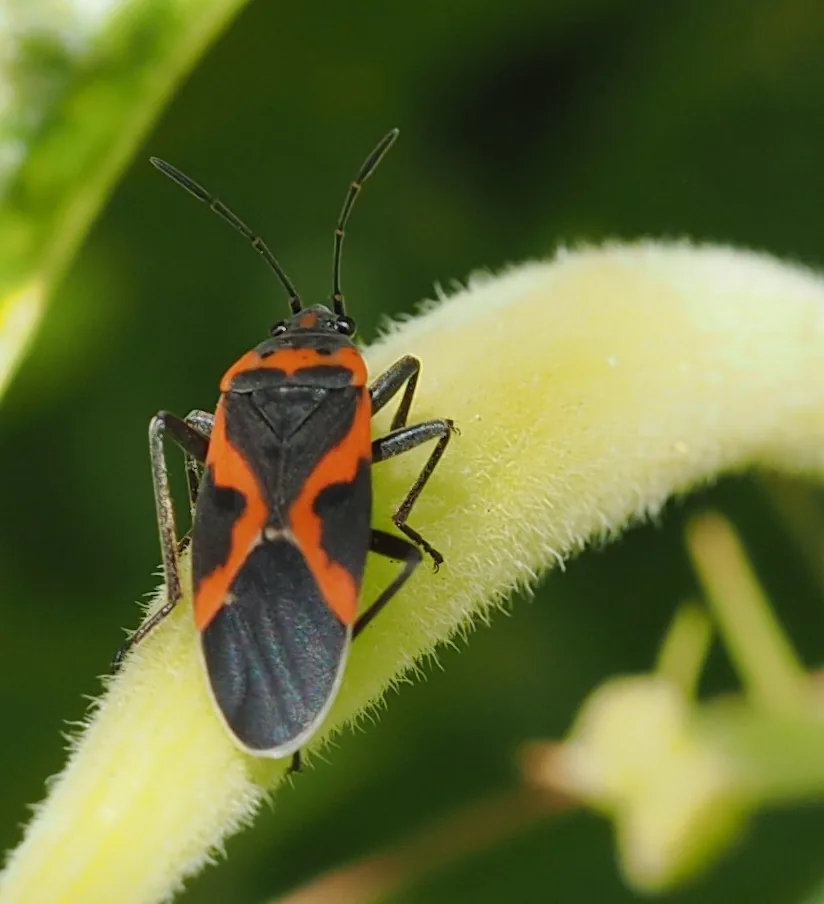
- Adults grow to about ½ inch. The band across the shield behind the head (pronotum) has two black spots on its front edge and two black half-circles on its back edge, which together with the black triangle in the middle of the back form a black heart shape.[1][3]
- The head is black with a red spot on top.[1]
- Wisconsin Extension adds white margins on the wings and sometimes small white spots in the middle of the wings.[4]
- Nymphs look much like large milkweed bug nymphs but are brighter red and have two diagonal black marks on the pronotum.[4]
Look-alikes
| Look-alike | How to tell them apart |
|---|---|
| Large milkweed bug | Larger, with a black band across an orange back instead of an X: Missouri's guide gives about ½ to 1 inch and Illinois Extension ¾ inch. Its pronotum has a black triangle bordered by orange rather than a red band.[1][3][4] |
| Boxelder bug | Its red markings can form an X too, but it has thin red lines running lengthwise on the pronotum instead of a wide band across it, and it lives on box elder trees.[1][5] |
| False milkweed bug | Very similar, but its black mark looks like two overlapping hearts or triangles and it has a T- or Y-shaped orange mark on the head. Its main host is false sunflower (Heliopsis helianthoides), not milkweed.[1][6] |
Where it lives
Wisconsin Extension says it occurs throughout North America. Missouri's guide calls it widespread and lists it statewide, and Illinois Extension calls it a permanent resident of Illinois.[4][1][3]
Biology and life cycle
Adults spend the winter; females lay eggs on milkweeds in spring, and there is at least one generation a year. Unlike the large milkweed bug, which migrates south in fall, the small milkweed bug stays put.[1][4][3]
In Missouri it is usually seen from June until the first hard freeze in October; Wisconsin Extension says milkweed bugs gather on milkweed mostly in late summer and fall.[1][4]
Its bright colors warn predators. It stores toxic cardenolides from milkweed in its body, and it carries the same gene change in its sodium pump that helps the monarch butterfly tolerate these toxins.[1][6][7]
It can live on other seeds. A study of two populations found one that scavenged many kinds of seeds when milkweed seeds weren't available and another that lived mainly on dandelion, though survival was lower on dandelion than on milkweed. Another study found it had more than 40 percent higher survival and growth on milkweed seeds than on false sunflower seeds.[8][6]
Damage and signs
- Once milkweed seeds ripen in midseason it feeds mainly on them, piercing the seeds with its strawlike beak. It also takes nectar and scavenged food.[1][4][3]
- Its beak only reaches the outer seeds in a pod, leaving many interior seeds intact.[4]
- It also preys on other insects: Missouri's guide lists caterpillars and the adults, larvae and pupae of flies, bees and beetles, and Wisconsin Extension says adults sometimes feed on monarch caterpillars or pupae or on insects trapped in milkweed flowers. Illinois Extension says it may eat other insects when food is scarce.[1][4][3]
Health risk
None of these sources lists it as a risk to people. The milkweed toxins it stores are a defense that sickens predators that eat it.[1][4]
Control
Prevention
Usually no control is needed. Feeding is mostly on seeds, and many seeds in each pod are left intact; Illinois and Wisconsin Extension describe it as one of the regular insects on milkweed alongside monarchs.[4][3]
Common questions
- What is the black bug with an orange X on my milkweed?
- Probably the small milkweed bug, a half-inch bug with a reddish-orange X on its back.[1][4]
- Is it a boxelder bug?
- No. Boxelder bugs have thin red lines running lengthwise on the shield behind the head and live on box elder trees.[1][5]
- Does it hurt milkweed or monarchs?
- It feeds mainly on ripening seeds and leaves many seeds intact. Adults sometimes feed on monarch caterpillars or pupae.[4][1]
Sources
- Missouri Department of Conservation, “Small Milkweed Bug (Field Guide).” mdc.mo.gov/discover-nature/field-guide/small-milkweed-bug (accessed 2026-11-11)
- iNaturalist, “Lygaeus kalmii taxon page (order and family).” www.inaturalist.org/taxa/1019598 (accessed 2026-11-11)
- University of Illinois Extension, “More than monarchs - What are those bugs on my milkweed? (Good Growing, July 30, 2021).” extension.illinois.edu/blogs/good-growing/2021-07-30-more-monarchs-what-are-those-bugs-my-milkweed (accessed 2026-11-11)
- University of Wisconsin-Madison Extension, “Common Milkweed Insects (Wisconsin Horticulture).” hort.extension.wisc.edu/articles/common-milkweed-insects/ (accessed 2026-11-11)
- University of California Statewide IPM Program, “Pest Notes: Boxelder Bug (Publication 74114).” ipm.ucanr.edu/home-and-landscape/boxelder-bug/ (accessed 2026-11-11)
- Proceedings of the National Academy of Sciences, via PubMed, “Carlson NJ, Hastings AP, Duplais C, Agrawal AA (2026), Divergent dietary and defensive adaptations of closely related coexisting seed bugs, Proceedings of the National Academy of Sciences 123(8):e2535697123.” pubmed.ncbi.nlm.nih.gov/41712643/ (accessed 2026-11-11). Cited from the PubMed abstract.
- Proceedings of the National Academy of Sciences, via PubMed, “Dobler S, Dalla S, Wagschal V, Agrawal AA (2012), Community-wide convergent evolution in insect adaptation to toxic cardenolides by substitutions in the Na,K-ATPase, Proceedings of the National Academy of Sciences 109(32):13040-13045.” pubmed.ncbi.nlm.nih.gov/22826239/ (accessed 2026-11-11). Cited from the PubMed abstract.
- Oecologia, via PubMed, “Fox CW, Caldwell RL (1994), Host-associated fitness trade-offs do not limit the evolution of diet breadth in the small milkweed bug Lygaeus kalmii, Oecologia 97(3):382-389.” pubmed.ncbi.nlm.nih.gov/28313634/ (accessed 2026-11-11). Cited from the PubMed abstract.