On this page
How to identify it
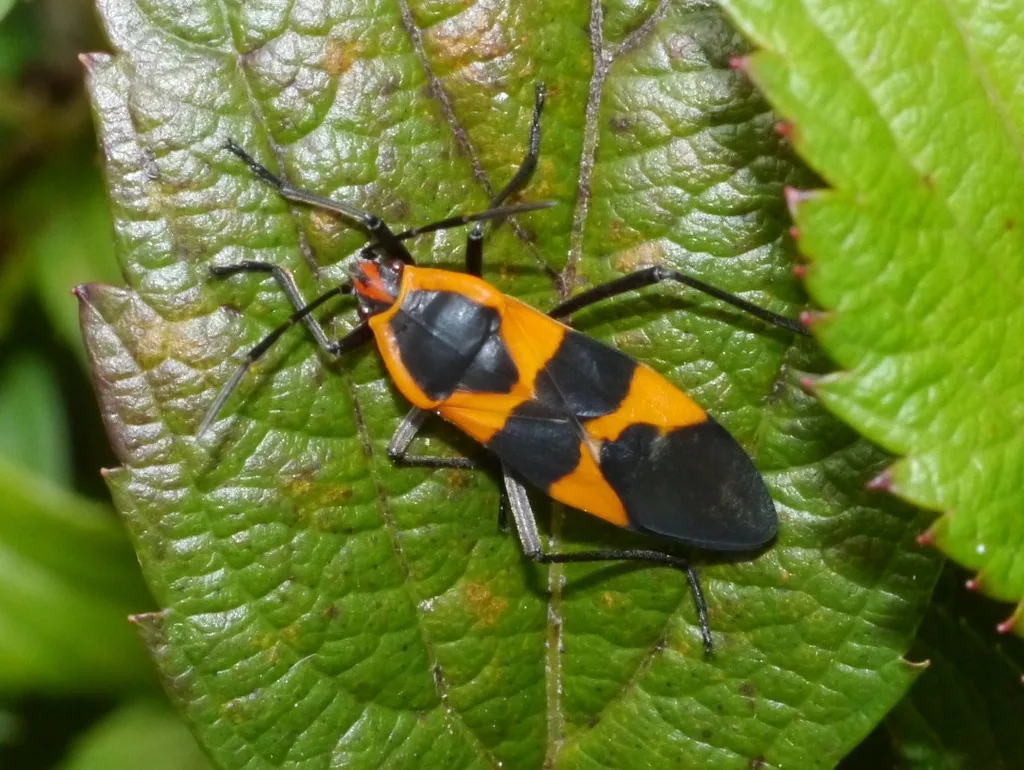
- Adults are reddish orange with a broad black band across the middle and a large diamond-shaped black patch at front and rear; NC State gives a length of 1/2 to 3/4 inch.[1][5]
- Behind the head, the pronotum is black with orange-red margins, forming a forward-pointing black triangle; the membranous wing tips are black.[3][5]
- Males have a black band on the underside of the fourth abdominal segment; females have two black spots there.[5]
- Nymphs are red to orange with black legs and antennae. They become more spotted as they grow, and their black wing pads lengthen with each molt.[1][5]
- Newly molted adults are yellow and black, turning reddish orange as they mature.[1]
Look-alikes
| Look-alike | How to tell them apart |
|---|---|
| Small milkweed bug | Smaller, to about 1/2 inch, with a reddish-orange X on the back and a red band across the pronotum. Unlike the large milkweed bug, it spends the winter as an adult in Wisconsin and Illinois.[3][5][4] |
| Boxelder bug | A little smaller and usually not on milkweed. It has three lengthwise red stripes on the pronotum and red wing edges, where the large milkweed bug has a crosswise red band and its bold banded pattern.[5] |
Where it lives
Wisconsin Extension gives a range from Central America to southern Canada. It can't survive winters in cold places, so the northern states are resettled every year by bugs moving up from the South. Iowa State, writing in 2018, called it a formerly southern and eastern species that had become much more abundant in Iowa. GBIF holds about 57,500 US records since 1990 from 40 states, counting the District of Columbia, most from Texas, California and Illinois.[5][3][2][8]
Biology and life cycle
Females lay eggs in small clusters in or among the seed pods, 25 to 35 a day by NC State's count, and the Missouri Department of Conservation says one female can lay more than 2,000 over an adult life of about a month.[1][3][5]
Eggs are light yellow and turn reddish to orange before hatching about five days later. Nymphs molt five times to become adults.[1][5]
They feed through a strawlike beak, mainly on milkweed seeds, which give the best growth and reproduction, and also take sap from leaves, flowers and young pods. The beak only reaches the outer seeds in a pod, so many inner seeds survive.[5][3]
In Missouri they are usually seen from July until the first hard freezes, after milkweed has formed seed pods.[3][1]
Wisconsin gets a single generation a year; in mild climates there can be up to three.[5]
The bright colors are a warning: the bugs store cardiac glycosides (cardenolides) from milkweed sap, and a predator that eats one is sickened and learns to avoid insects that look like it.[2][3][5]
In a 2023 lab study, bugs that stored more cardenolides had less of the antioxidant glutathione, and bugs with less glutathione had duller orange warning colors.[7]
Damage and signs
- They feed on sap from the seed pods and may further reduce the already low germination of milkweed seed saved for planting.[2]
- They do little plant damage and are present for only a month or so. They are not a problem for food crops.[1][3][5]
- By destroying some seeds before they can germinate, they help check the growth of milkweed populations.[3]
Health risk
Iowa State calls milkweed bugs harmless. The milkweed toxins they carry sicken predators that eat them; none of the sources reports a risk to people.[2][3]
Control
Prevention
In a butterfly garden it is usually better to live with the seed damage than to spray; the Missouri Department of Conservation calls the bugs more of a nuisance than a pest for people growing milkweed.[1][2][3]
Sanitation
NC State and Wisconsin Extension suggest removing leaf litter and spent milkweed stalks in fall to eliminate overwintering spots.[1][5]
Pesticides
If no monarch caterpillars are present, insecticidal soap kills the bugs and its dried residue is not especially toxic to caterpillars that hatch later. Wisconsin reserves treatment for very high numbers on plants grown for their seed.[1][5]
Where sources disagree
Where they spend the winter: the Missouri Department of Conservation, Illinois and Wisconsin Extension say northern adults fly south in fall to the southern Atlantic and Gulf Coast states and the North is recolonized each spring and summer. NC State describes new adults moving to sheltered spots for winter, spring and early summer, and both NC State and Wisconsin suggest fall cleanup to remove overwintering sites.[3][4][5][1]
What they eat: NC State says milkweed seeds seem to be their only food, apart from reports on oleander. The Missouri Department of Conservation lists the seeds, leaves and stems of milkweeds and dogbanes, and a 2023 study found that without milkweed seed the bugs ate other, non-toxic seeds and topped up on milkweed leaves and stems, which slowed their growth but let them store toxins.[1][3][6]
Size: NC State gives 1/2 to 3/4 inch, Wisconsin up to 3/4 inch, and the Missouri Department of Conservation about 1/2 to 1 inch.[1][5][3]
Common questions
- Do milkweed bugs hurt monarch caterpillars?
- No. They feed on the seed pods without disturbing monarch caterpillars on other parts of the plant.[2]
- Should I kill milkweed bugs?
- Usually not. They do little damage and last only a month or so, and insecticides can harm pollinators; monarch caterpillars may also be on the same plants.[1][2]
- Why are there suddenly so many milkweed bugs?
- They show up once milkweed sets seed pods, and large groups of all ages cluster together on the pods. Iowa State noted in 2018 that they had become more abundant there in recent years, possibly helped by warmer winters.[1][5][2]
- Where do they go in winter?
- In the North, adults migrate south in fall, much as monarchs do, and new generations work their way back north in spring and summer.[4][5][3]
Sources
- NC State Extension, “Milkweed Bug (PDIC Factsheet).” content.ces.ncsu.edu/milkweed-bug (accessed 2026-11-11)
- Iowa State University Extension and Outreach, “Large Milkweed Bugs (Yard and Garden, August 24, 2018).” yardandgarden.extension.iastate.edu/article/2018/08/large-milkweed-bugs (accessed 2026-11-11)
- Missouri Department of Conservation, “Large Milkweed Bug (field guide).” mdc.mo.gov/discover-nature/field-guide/large-milkweed-bug (accessed 2026-11-11)
- University of Illinois Extension, “More than monarchs: What are those bugs on my milkweed? (Good Growing, 2021).” extension.illinois.edu/blogs/good-growing/2021-07-30-more-monarchs-what-are-those-bugs-my-milkweed (accessed 2026-11-11)
- University of Wisconsin-Madison Extension (Wisconsin Horticulture), “Common Milkweed Insects.” hort.extension.wisc.edu/articles/common-milkweed-insects/ (accessed 2026-11-11)
- Proceedings of the Royal Society B, via PubMed, “A nutrition-defence trade-off drives diet choice in a toxic plant generalist (Carlson and Agrawal 2023).” pubmed.ncbi.nlm.nih.gov/37554038/ (accessed 2026-11-11). Cited from the PubMed abstract.
- Ecology and Evolution, via PubMed, “Antioxidant availability trades off with warning signals and toxin sequestration in the large milkweed bug (Heyworth et al. 2023).” pubmed.ncbi.nlm.nih.gov/37038513/ (accessed 2026-11-11). Cited from the PubMed abstract.
- Global Biodiversity Information Facility (GBIF), “Oncopeltus fasciatus: US occurrence records since 1990 by state (GBIF occurrence search API).” api.gbif.org/v1/occurrence/search?taxonKey=2007764&country=US&hasGeospatialIssue=false&occurrenceStatus=PRESENT&year=1990%2C2026&facet=stateProvince&facetLimit=400&limit=0 (accessed 2026-11-11). State counts are records reported (iNaturalist research-grade, museum specimens, surveys), not abundance.
- iNaturalist, “Oncopeltus fasciatus taxon page (order and family).” www.inaturalist.org/taxa/55556 (accessed 2026-11-11)