The short answer
- Size and back pattern: the elm seed bug is about 1/3 inch long, rusty red and black, with an upside-down black triangle behind the head set inside two rusty-red triangles. The boxelder bug is about 1/2 inch long and mostly black, with three red lines on the plate behind the head.[1][2][3][4][10]
- Edge of the body: the elm seed bug has white dots mixed with rusty-red and black dots along the wing edges. The boxelder bug has a red line along each side and a diagonal red line on each wing.[1][3][4]
- When they invade: elm seed bugs pour in during summer, mid-June through August or September, often driven by heat. Boxelder bugs are mainly a fall-through-early-spring problem.[1][2][3][4][9]
- Host tree and smell: elm seed bugs feed on elm seeds and smell like bitter almonds when crushed. Boxelder bugs depend on seed-bearing female boxelder trees and give off an unpleasant odor when crushed.[1][2][4][6]
Related profiles on this site
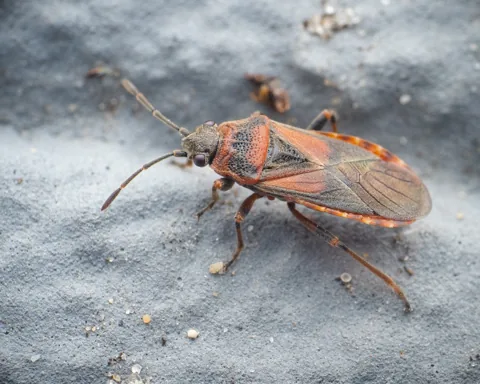 Elm Seed Bug
Arocatus melanocephalus
The elm seed bug is a small rusty-red and black true bug from Europe that feeds on elm seeds and moves into homes and buildings in great numbers. It doesn't bite, breed indoors or damage the house, but it leaves fecal spots and smells like bitter almonds when crushed. Unlike the boxelder bug, it peaks indoors in summer. The best fixes are sealing cracks outside and vacuuming the bugs inside.
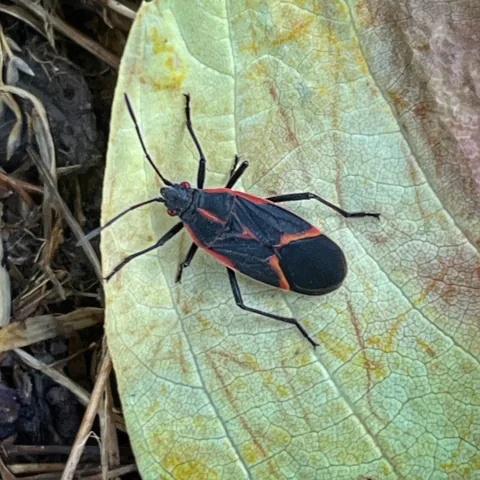 Boxelder Bug
Boisea trivittata
Boxelder bugs feed mainly on the seeds of female boxelder trees and become a nuisance in fall, when large numbers gather on and around homes looking for a place to spend the winter. Indoors they can stain fabrics and smell when crushed, but they don't damage the structure and don't breed inside.
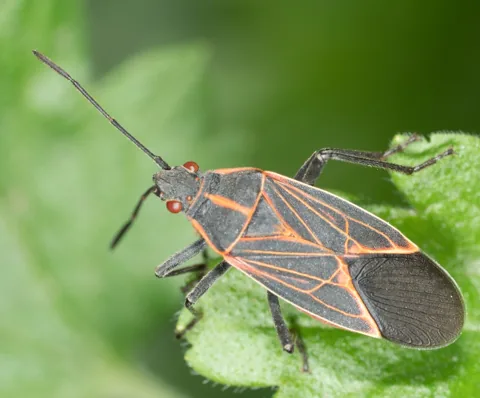 Western boxelder bug
Boisea rubrolineata
The western boxelder bug is a black-and-red true bug that feeds mostly on the leaves, flowers and seedpods of female box elder trees. It does little harm to plants. The trouble starts when clusters form on outside walls and then move into the house in fall and spring. Colorado State, writing about boxelder bugs in general, says they are a nuisance in and around homes from fall through early spring.
Side by side
If you can only check one thing, look just behind the head: a black triangle points to elm seed bug, three red lengthwise lines point to boxelder bug. Then check the month.[1][4][10]
- Size: elm seed bug about 1/3 inch (0.33 inch). Boxelder bug about 1/2 inch, or 12 mm in Penn State's figure. Colorado State calls the boxelder bug slightly larger.[1][2][3][4][5]
- Color on top: elm seed bug, dark rusty red and black, with a black upside-down triangle behind the head inside two rusty-red triangles; the crossed wings are half black and half red and black. Boxelder bug, black or brownish black with three red or reddish-orange stripes behind the head.[1][4][5][6]
- Sides and wings: elm seed bug, white dots mixed with rusty-red and black dots near the wing edges, and alternating dark and white marks along the edge of the abdomen. Boxelder bug, a red line along each side and a diagonal red line on each wing, or several fine red lines in UC IPM's description.[1][3][4][10]
- Underside: elm seed bug, red (Colorado State) or orange (Pacific Northwest handbook). Boxelder bug, the abdomen is reddish orange.[1][3][5]
- Nymphs: young elm seed bugs lack wings, grow black wing pads and have a lighter red abdomen with two black dots in the middle. Young boxelder bugs are wingless with black wing pads and bright red abdomens. Utah State warns that elm seed bug nymphs look like immature boxelder bugs.[1][2][5][4]
- Food: elm seed bug, mainly elm seeds, especially Siberian elm in Colorado, with reports on linden and oak. Boxelder bug, seed pods of female boxelder trees, and occasionally maple or ash.[1][3][4][7][10]
- Season indoors: elm seed bug, mid-June through August in Utah's peak, mid-June through September in Colorado, and they may stir in homes in winter during mild spells. Boxelder bug, fall through early spring, plus warm, sunny winter days.[2][1][4][9]
- Odor: elm seed bug, a pungent bitter-almond smell from abdominal scent glands; the Pacific Northwest handbook says both adults and nymphs give off an unpleasant odor. Boxelder bug, an unpleasant odor when crushed.[1][2][3][4][6]
- Marks they leave: elm seed bugs leave fecal spots on structures, such as window frames. Boxelder bugs may stain draperies and other light-colored surfaces.[2][4][6]
- Damage: neither damages the house. Colorado State says elm seed bugs cause little to no harm to tree health; Minnesota says boxelder bugs normally do not cause property damage.[1][3][6]
- Breeding indoors: neither reproduces in the home. Adults of both overwinter in and around buildings.[1][4][9]
Where each one lives
The elm seed bug is native to Europe and the Mediterranean region. It was first found in the United States in Idaho in 2012, and Colorado State lists later detections in Utah, Oregon, Washington, Colorado and New Mexico, as well as Canada.[1][2]
Utah's first confirmed record came in July 2014 from Salt Lake County; Utah State says the bug is now widely distributed along the Wasatch Front and in Cache County. Colorado's first detections were on the Western Slope in 2017, and it has since spread through much of the state, including the Front Range.[2][1]
The boxelder bug is far more widespread. Penn State says it occurs throughout the eastern United States west to Nevada, and Kentucky notes it follows boxelder trees, whose range runs from New York to central Florida and west to Texas.[5][7]
Summer heat vs fall shelter
Timing is the most useful clue after the markings. Utah State reported elm seed bug adults as early as the first week of June in Moab in 2017 and in the fourth week of June in Logan. Adults appear by mid-to-late June in northern Utah, mid-May to early June in southern Utah, and stay through fall into the next spring.[2]
Heat is what pushes elm seed bugs indoors in summer. Colorado State says extreme heat can trigger mass movement of nymphs and adults into homes, and that above 100 degrees F adults may bunch on the north side of buildings or in shade. The Pacific Northwest handbook describes them entering homes in July and August to escape the heat, again in fall seeking winter shelter, and in spring when they leave overwintering sites.[1][3]
Boxelder bugs follow the cooler season. They gather in fall on the south and west sides of buildings, trees and rocks warmed by the sun, then slip into cracks to overwinter; Minnesota says you may not notice them in summer at all.[4][5][6]
- Elm seed bugs do some of that too: Colorado State says that in fall they may cluster on the south side of buildings for warmth. A summer swarm points strongly to elm seed bugs; a fall swarm can be either species where both occur.[1]
Look at the trees nearby
Elm seed bugs lay eggs on elm flower cups when the trees bloom, and the nymphs feed on the developing seeds. When the seeds mature and drop, the bugs become more mobile and gather on trunks, the ground and buildings.[1]
Boxelder bugs rarely build up to nuisance numbers unless a female boxelder tree is in the neighborhood; Colorado State and UC IPM both say large numbers usually come from seed-bearing female trees, and Kentucky says they are rarely found on male trees.[4][10][7]
How to confirm which one you have
Photograph the top of an adult in good light, close enough to see the area just behind the head and the wing edges. A black triangle and white edge dots mean elm seed bug; three red lengthwise lines mean boxelder bug.[1][3][4][10]
Don't judge by the young alone. Nymphs of both are red and wingless, and Utah State notes elm seed bug nymphs also resemble false chinch bugs. Look for an adult in the group.[2][5]
Smell is a backup clue if one gets crushed by accident: a bitter-almond odor fits the elm seed bug.[1][2]
Why the ID changes the plan
The calendar shifts. Boxelder bug work centers on fall: Minnesota says the best time to act is fall, by sealing openings. With elm seed bugs, Utah State's peak runs mid-June through August, so sealing needs to be done by early summer.[6][2]
The entry points differ a little. Elm seed bugs come in mostly through windows and doors; Utah State found the two small gaps where sliding window rails meet let them in easily, and reports say they can even get between the glass and frame of picture windows.[2][1]
- Tree removal targets different trees. For boxelder bugs, removing seed-bearing female boxelder trees close to the house is the most lasting fix, though it may not be practical. For elm seed bugs, the Pacific Northwest handbook suggests removing elms from the home landscape only if the problem persists.[4][5][8][3]
What to do for each
Elm seed bugs: seal windows and doors with sealant, weather stripping, tight-fitting screens and door sweeps, paying close attention to where sliding windows meet. Windows you never open can be closed off with tape or removable caulk. Caulk cracks around siding, faucets and electrical fixtures too.[2][3]
Elm seed bugs: vacuum them up inside and outside. Utah State suggests a knee-high nylon stocking held in the hose end with a rubber band, then tied off and thrown away. The Pacific Northwest handbook warns the vacuum can pick up their smell. Rake or vacuum fallen elm seeds from siding, walkways and firewood, and check boxes, pots and firewood before bringing them in.[2][3]
Boxelder bugs: screen and seal cracks and other openings before fall, and caulk windows and doors. Indoors, Minnesota says physical removal is the only practical control.[4][9][6]
Boxelder bugs: use a shop vacuum or a hose attachment, and empty it right away so bugs don't crawl back out. Clemson advises against a household vacuum because the odor is hard to get out of the hose. A hard spray of water from a garden hose also knocks them off siding.[8][9]
For both, a wet-dry vacuum with some water and a little dish soap in the tank drowns the bugs.[2][8]
- Sprays: Utah State says a labeled pyrethroid perimeter treatment around foundations, windows, doors and eaves can help reduce elm seed bug entry. Colorado State says most exterior insecticides are not very effective against boxelder bugs. Follow the label if you use one; our perimeter spray guide covers timing and placement.[2][4]
Common questions
- Why are bugs that look like boxelder bugs coming in during July?
- In the West, summer invaders are likely elm seed bugs. They peak indoors from mid-June through August, while boxelder bugs are mostly a fall-to-spring nuisance.[2][1][4]
- Which bug smells like almonds?
- The elm seed bug. Colorado State and Utah State describe its scent-gland odor as similar to bitter almonds.[1][2]
- Do elm seed bugs or boxelder bugs damage the house?
- No. Colorado State says elm seed bugs don't damage structures, and Minnesota says boxelder bugs normally cause no property damage. Elm seed bugs can leave fecal spots and boxelder bugs can stain light-colored fabrics.[1][6][2][4]
- Will cutting down the elm or boxelder tree stop them?
- It can help but isn't guaranteed. Colorado State says removing one or two nearby female boxelder trees may help because the bugs overwinter near their food trees; the Pacific Northwest handbook suggests removing elms only if elm seed bug problems persist.[4][3]
- Are elm seed bugs found in the eastern U.S.?
- Sources list them in western states (Idaho, Utah, Oregon, Washington, Colorado and New Mexico) and Canada. The Pacific Northwest handbook notes they have been intercepted at eastern seaports on tile imported from Italy.[1][3]
Photo credits
- Elm Seed Bug: (c) Alexis Tinker-Tsavalas, some rights reserved (CC BY) — via iNaturalist, CC BY 4.0
- Boxelder Bug: (c) Alfonso Benítez-Mora, some rights reserved (CC BY) — via iNaturalist, CC BY 4.0
- Western boxelder bug: Jesse Rorabaugh, public domain (CC0), via iNaturalist
Sources
- Colorado State University Extension, “Elm Seed Bug: A Nuisance Pest in Colorado Homes.” extension.colostate.edu/resource/elm-seed-bug-a-nuisance-pest-in-colorado-homes/ (accessed 2026-11-14)
- Utah State University Extension (Plant Health), “Elm Seed Bug.” extension.usu.edu/planthealth/research/elm-seed-bug (accessed 2026-11-14)
- Pacific Northwest Pest Management Handbooks (Oregon State, Washington State and University of Idaho), “Elm seed bug (2009), Emerging Insect Pests in the Pacific Northwest.” pnwhandbooks.org/insect/emerging-insect-pests/emerging-insect/elm-seed-bug-2009 (accessed 2026-11-14)
- Colorado State University Extension, “Boxelder Bug.” extension.colostate.edu/resource/boxelder-bug/ (accessed 2026-11-14)
- Penn State Extension, “Boxelder Bug.” extension.psu.edu/boxelder-bug (accessed 2026-11-14)
- University of Minnesota Extension, “Boxelder bugs.” extension.umn.edu/garden-and-home/home-maintenance/household-insects/boxelder-bugs (accessed 2026-11-14)
- University of Kentucky Entomology, “Boxelder Bugs (EF444).” entomology.mgcafe.uky.edu/ef444 (accessed 2026-11-14)
- Clemson Cooperative Extension Home & Garden Information Center, “Boxelder Bugs.” hgic.clemson.edu/factsheet/boxelder-bug/ (accessed 2026-11-14)
- University of Wisconsin-Madison Extension, “Boxelder Bugs.” hort.extension.wisc.edu/articles/boxelder-bugs/ (accessed 2026-11-14)
- University of California Statewide IPM Program, “Pest Notes: Boxelder Bug.” ipm.ucanr.edu/legacy_assets/PDF/PESTNOTES/pnboxelderbug.pdf (accessed 2026-11-14)