On this page
How to identify it
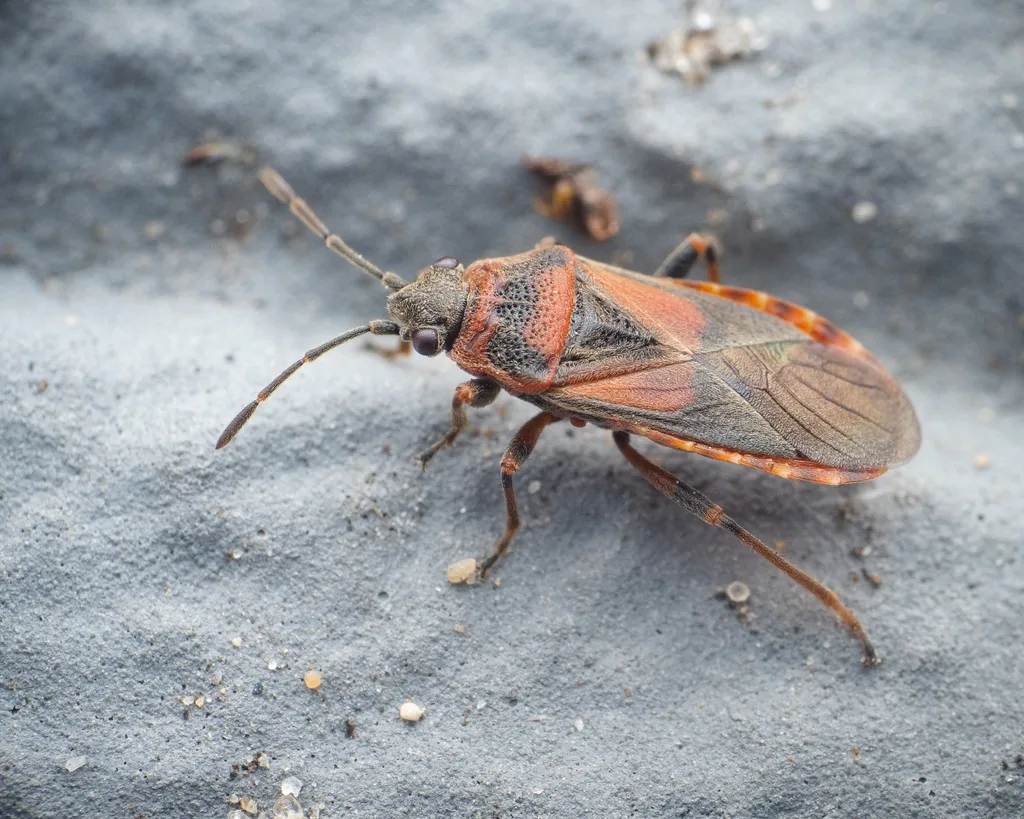
- Adults are about 1/3 inch long with dark, rusty-red and black coloring and a red underside.[1][2]
- Behind the head, the back shows an upside-down black triangle set inside two rusty-red triangles.[1][2]
- Wings cross over the back; near the wing edges there are noticeable white dots mixed with rusty-red and black dots.[1][2]
- Nymphs are wingless and smaller, developing black wing pads and a lighter red abdomen with two black dots in the middle as they grow.[2]
- PNW Handbooks describes it as a small (0.33 inch) bug with rusty red markings on the thorax, wings and legs, an orange underbelly, and alternating dark and white marks along the edge of the abdomen.[4]
Look-alikes
| Look-alike | How to tell them apart |
|---|---|
| Boxelder bug | Slightly larger with distinctive orange-red striping, and it shows up in homes mainly in fall, while elm seed bugs peak in summer.[2][1] |
| Western conifer seed bug | Another smelly seasonal invader, but it shows up in buildings in late summer and autumn, while elm seed bugs arrive as early as mid-June.[2] |
Where it lives
Native to Europe and the Mediterranean; first found in the U.S. in Idaho in 2012 and since detected in Utah, Oregon, Washington, Colorado, New Mexico and Canada.[2][1]
Biology and life cycle
Adults overwinter in and around buildings, woodpiles and the landscape, then move to elms in early spring.[2][1]
Eggs are laid on elm flower cups as the trees bloom, and nymphs feed on elm seeds through five growth stages.[1][2]
There is one generation a year; new adults appear in June and stay active through fall.[1][2]
After elm seeds drop, nymphs and adults gather in large numbers on trunks, the ground and buildings.[1][2]
In very hot weather, adults crowd onto the north or shady sides of buildings; in fall they gather on sunny south sides before moving indoors.[2][1]
Besides elms, adults and nymphs feed on the seeds of other trees such as oak and linden.[4][2]
Fun fact: no one knows exactly how it reached North America, but elm seed bugs have been intercepted at eastern seaports on tile imported from Italy.[4]
Damage and signs
- They feed on elm seeds and leaves with piercing-sucking mouthparts, but damage to the trees is negligible.[1][2]
- They don't damage buildings, but they leave unsightly fecal spots on walls and window frames.[2][1]
- They enter homes in July and August to escape the heat, again in autumn looking for winter shelter, and in spring as they leave their overwintering sites.[4]
- Indoors, they crawl on walls, ceilings, window sills and furniture and may land on people, but they don't reproduce inside.[1][2]
Health risk
Elm seed bugs are not a health threat. Crushed or handled bugs release a foul odor from scent glands.[1][2]
Control
Keep them out
Seal windows and doors tightly with weather stripping, tight screens and door sweeps, paying special attention to the gaps where sliding windows meet.[1][2]
Caulk all cracks and crevices around siding, windows, doorways, faucets and electrical fixtures, plus foundation cracks, soffit gaps and the spots where plumbing, gas and electrical lines enter.[1][2][4]
Sanitation
Rake or vacuum up fallen elm seeds and debris around the house; Utah State also suggests removing volunteer elms nearby.[1][4]
Traps and physical control
Vacuum bugs found indoors rather than crushing them, then empty the vacuum or freeze or toss the bag; PNW Handbooks warns that the vacuum itself can pick up the bugs' odor.[1][2][4]
Pesticides
Utah State and Colorado State list pyrethroid perimeter products containing beta-cyfluthrin, bifenthrin, deltamethrin, cyfluthrin, cypermethrin, lambda-cyhalothrin or permethrin. Apply by label directions around foundations, windows, doors, vents and under eaves; it may reduce entry but may not stop all bugs.[1][2]
Spraying or cutting down elm trees is unlikely to help where elms and bugs are both widespread, as on Colorado's Western Slope.[2]
Where sources disagree
Removing elms: PNW Handbooks says to consider removing elms from your landscape if the problem persists, while Colorado State says spraying or cutting down elms is unlikely to help where elms and bugs are widespread, as on the Western Slope.[4][2]
Underside color: Colorado State calls it red; PNW Handbooks calls it orange.[2][4]
Common questions
- Why do I have elm seed bugs in summer instead of fall?
- Unlike boxelder bugs, elm seed bugs are most active indoors from mid-June through August or September, and heat waves can drive them inside.[1][2]
- Do elm seed bugs bite or breed in the house?
- No. They may land and crawl on people, but they are not a health threat and don't reproduce indoors.[1][2]
- What spray keeps elm seed bugs out?
- Utah State and Colorado State list outdoor pyrethroid perimeter products with active ingredients such as beta-cyfluthrin, bifenthrin, deltamethrin, cyfluthrin, cypermethrin, lambda-cyhalothrin and permethrin. Sprays may reduce entry but won't stop every bug, so sealing gaps comes first.[1][2]
Sources
- Utah State University Extension, “Elm Seed Bug.” extension.usu.edu/planthealth/research/elm-seed-bug (accessed 2026-11-12)
- Colorado State University Extension, “Elm Seed Bug: A Nuisance Pest in Colorado Homes (Fact Sheet 5.619).” extension.colostate.edu/resource/elm-seed-bug-a-nuisance-pest-in-colorado-homes/ (accessed 2026-11-12)
- iNaturalist, “Arocatus melanocephalus taxon page (order and family).” www.inaturalist.org/taxa/505749 (accessed 2026-11-12)
- Pacific Northwest Pest Management Handbooks (Oregon State, Washington State and University of Idaho), “Elm seed bug (2009), Emerging insect pests.” pnwhandbooks.org/insect/emerging-insect-pests/emerging-insect/elm-seed-bug-2009 (accessed 2026-11-12)