The short answer
- Check the legs. Kissing bug legs are all thin and long with no thicker parts. Leaf-footed bugs, the western conifer seed bug and their relatives have flattened, leaf-like hind legs, and most assassin bugs have a thickened first segment on the front legs.[6][17][16]
- Check the beak. A kissing bug's mouthparts are thin and straight and usually tucked under the body. Predatory assassin bugs such as the wheel bug have a strong, thick, curved beak.[6][9][15]
- Check the back and edge of the body. A wheel bug has a cog-like crest on its back; a kissing bug has none. U.S. kissing bugs are mainly black or very dark brown with red, orange or yellow stripes around the flat outer edge of the body.[8][7]
- Still unsure? Don't touch it with bare hands. Catch it in a bag or container and send a photo to an identification service before worrying about Chagas disease.[6][14][13]
Kissing bugs and look-alikes on this site
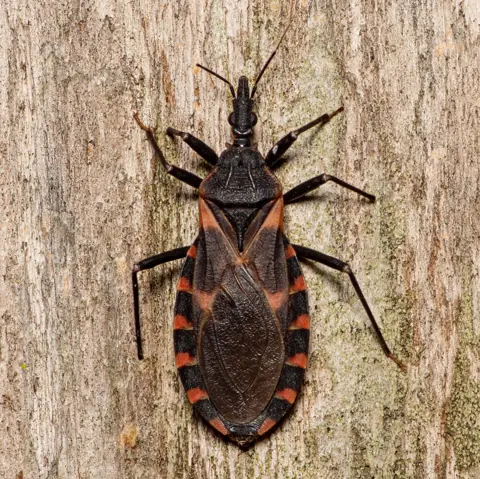 Eastern Bloodsucking Conenose
Triatoma spp. (shown: T. sanguisuga)
Kissing bugs are blood-feeding insects, active mostly at night, that can carry Trypanosoma cruzi, the parasite that causes Chagas disease. They have been found in 29 U.S. states, and studies of bugs collected in the United States have found the parasite in roughly one in six to nearly two in three of those tested, depending on the place.
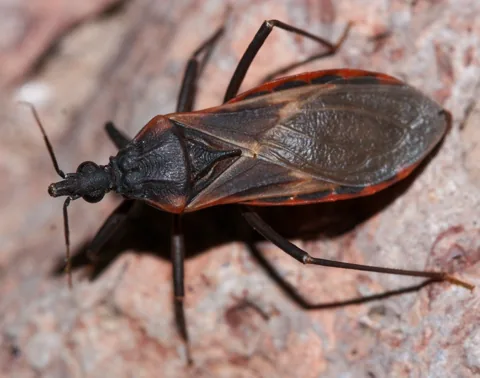 Triatoma rubida (Arizona's most abundant kissing bug)
Triatoma rubida
Triatoma rubida is the kissing bug most people in Arizona actually meet: the most abundant species in the state, most prevalent in the foothills around Phoenix and Tucson, and one of the three species that cause the most trouble around homes. It is a large, dark true bug with reddish or brownish-red markings along the sides of the abdomen, living mainly in pack rat nests but flying to porch lights on warm, calm evenings from May through July. Its bites are painless at first and then raise welts, repeated bites can sensitize people to dangerous allergic reactions, and a high share of bugs carry the Chagas parasite, though transmission to people in the United States is rare. Sealing the house and managing lights and rodent nests are the defenses.
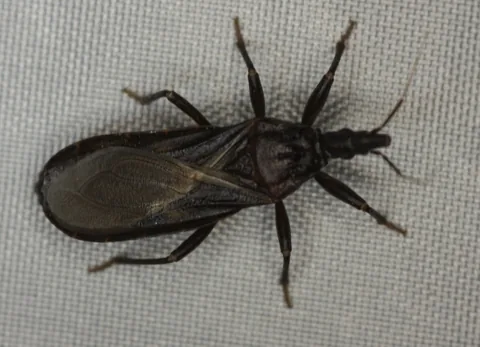 Western bloodsucking conenose
Hospesneotomae protracta
The western bloodsucking conenose (Hospesneotomae protracta, formerly Triatoma protracta) is the most important kissing bug in California and one of the three species most often found around homes in Arizona. It normally lives in the nests of wood rats (pack rats) and other wildlife, but adults fly to lights at night, get into houses and may feed on sleeping people. The bite is painless, yet it can leave itchy, swollen welts, and in people who become allergic it can trigger anaphylaxis.
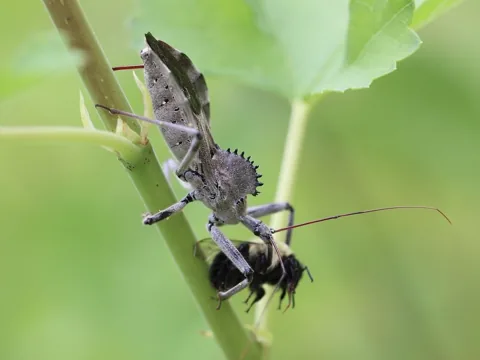 Wheel Bug
Arilus cristatus
The wheel bug is the largest assassin bug in North America, named for the toothed crest on its back. It hunts caterpillars and other insects, but it gives an immediately painful bite if handled carelessly.
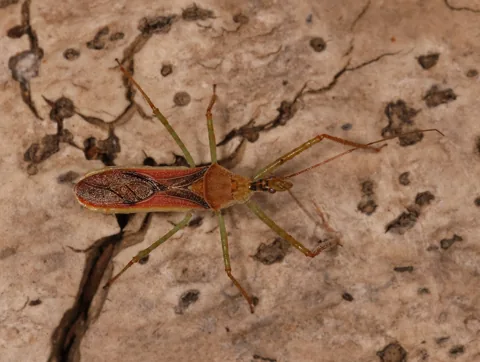 Assassin Bugs
Zelus and Sinea species (shown: Zelus renardii)
Assassin bugs are stalking and ambushing predators with a needlelike beak. They kill caterpillars, other bugs and bees alike, and they can deliver a painful bite if handled.
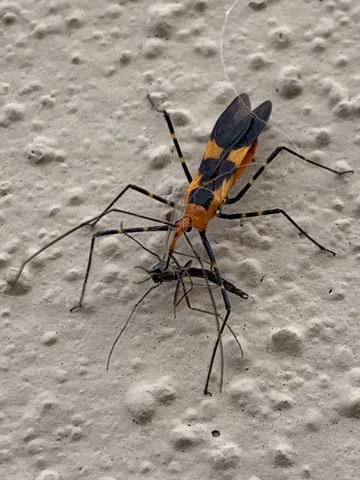 Milkweed assassin bug
Zelus longipes
The milkweed assassin bug is a long-legged, orange and black predator of gardens and fields. Some color forms may mimic the milkweed bug. It is a beneficial insect, but like other assassin bugs it can give a painful bite if handled carelessly. UF/IFAS says it is also called the longlegged assassin bug or Zelus assassin bug, and that it hunts by day.
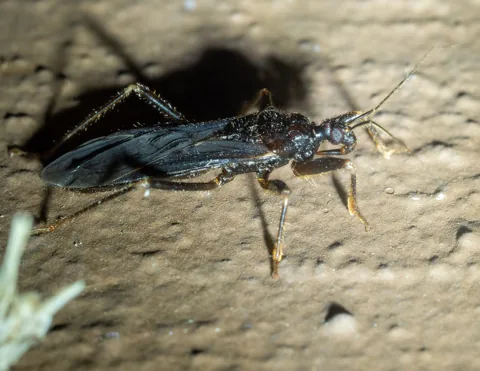 Masked Hunter
Reduvius personatus
The masked hunter is a predatory assassin bug that often lives inside homes and hunts other insects at night. It doesn't feed on blood, and indoors it is mainly a nuisance and a sign that other insects are present.
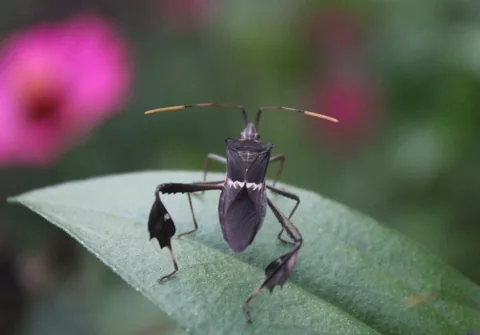 Leaffooted Bug
Leptoglossus zonatus
Leaffooted bugs are medium to large sap-feeding bugs named for the small leaf-like flaps on their hind legs. They pierce fruits, vegetables and nuts to feed, especially on the seeds, and gardeners most often find them on tomatoes and pomegranates.
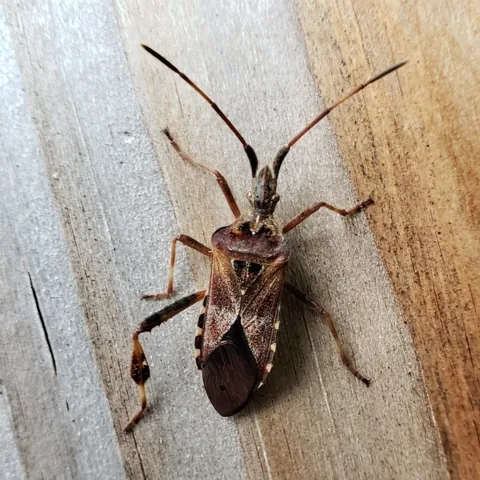 Western Conifer Seed Bug
Leptoglossus occidentalis
The western conifer seed bug is a leaf-footed bug that feeds on the seeds and cones of pines and other conifers. In fall, adults look for sheltered places to spend the winter, and many end up inside houses, where they are a nuisance but harmless.
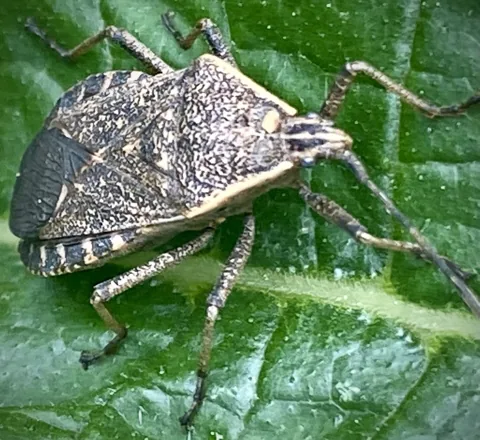 Squash Bug
Anasa tristis
The squash bug is a common vegetable garden pest that sucks sap from squash, pumpkins, melons and other cucurbits. Heavy feeding makes plants wilt and can kill young plants outright.
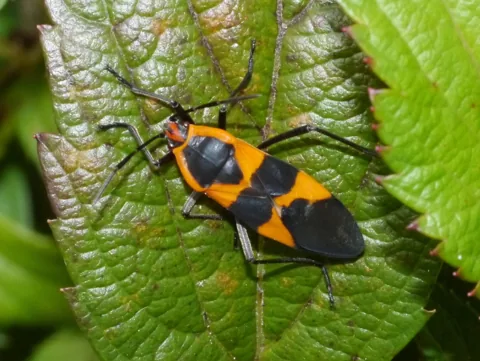 Large Milkweed Bug
Oncopeltus fasciatus
Large milkweed bugs are reddish-orange and black bugs that gather on milkweed seed pods in late summer. They feed mainly on the seeds, do little harm to the plants and don't bother monarch caterpillars.
Why so many bugs get mistaken for kissing bugs
Kissing bugs belong to the assassin bug family, Reduviidae. Texas A&M notes that most other members of the family eat insects or plant juices rather than blood, and many have strong, thick mouthparts that can give a very painful bite.[6][16]
CDC lists the wheel bug, the western corsair and leaf-footed bugs as bugs commonly confused with triatomine bugs, and says they do not carry the Chagas parasite. Texas A&M's look-alike gallery adds squash bugs and other assassin bugs, and says no insects other than kissing bugs are known to carry the parasite.[1][7]
Several look-alikes turn up at the same places and times as kissing bugs: on porches and walls near lights at night, or indoors in fall. The western corsair is drawn to lights around homes, and the western conifer seed bug and leaf-footed bugs move into buildings and other sheltered spots to spend the winter.[9][19][10]
The kissing bug, for reference
- Size: about 1/2 to 1 inch long from the tip of the 'nose' to the end of the body (Texas A&M). UC IPM gives 1/2 to 3/4 inch for the western bloodsucking conenose, Triatoma protracta.[6][9]
- Head and beak: long, cone-shaped head with thin antennae; the beak is straight and usually tucked back under the body.[7][6][9]
- Legs: all six thin and long, with no thicker areas.[6][7]
- Color: mainly black or very dark brown with red, orange or yellow stripes around the edge of the body. Triatoma protracta in the Southwest may have a single light band or no markings at all; UC IPM describes its abdominal edge as sometimes tan.[7][6][9]
- Wings: adults hold them flat over the back. Nymphs have no wings; only adults can fly.[9][6]
- Where and when: active mostly at night. Indoors they hide in cracks during the day; outdoors they live in rodent nests, animal burrows and outdoor dog houses or kennels. UC IPM says adults fly to outside lights at night.[6][1][9]
- Bite: usually not painful, because the bugs try to feed without being noticed. UC IPM says bites happen at night, often several on the face, neck or arms, and can later itch and swell.[7][9]
- Range: CDC says 11 species have been found in the southern United States. Texas A&M reports kissing bugs from 29 states; a 2025 review in CDC's Emerging Infectious Diseases journal says 32 states.[1][5][4]
Side by side: the common look-alikes
Each entry below gives the field marks that separate the look-alike from a kissing bug, with each publisher's size where they differ.[7][1]
- Wheel bug (Arilus cristatus): gray, about 1 1/4 inches long, with a cog-like crest on the top of the thorax like the blade of a circular saw. Kissing bugs have the same long head but no crest, and have orange and black markings where the abdomen sticks out past the wings.[8][16][15]
- Wheel bug, other differences: a claw-like three-segment beak and a thickened first segment on the front legs. The nymphs are red with black legs and can look ant-like or spider-like. Adults appear around midsummer and mate in autumn.[15][16]
- Wheel bug bite: the bite is immediately and intensely painful, and crushing or slapping at one usually makes it bite. A kissing bug bite is generally not painful.[8][15][7]
- Western corsair (Rasahus thoracicus): an assassin bug in the West that comes to lights around homes. It is shaped somewhat like a conenose bug but is orange and black with an orange spot on each wing. It eats other insects and does not need a blood meal.[9][1]
- Other assassin bugs (Zelus, bee assassins, Microtomus and others): most are gray, black or brownish, some brightly colored, up to about 1 1/2 inches depending on species. Look for the thickened front-leg segment and thick beak. Texas A&M notes that at least one Zelus species comes indoors in fall and winter.[8][16][7]
- Leaf-footed bugs (Leptoglossus and relatives): plant feeders named for the flattened, leaf-like extensions on the hind legs. UC IPM gives about 0.75 to 1 inch and a narrow brown body with a white zigzag across the wings; Missouri says most are 1/2 to 3/4 inch, some to 1 1/4 inches. Many give off a bad odor when disturbed.[10][17]
- Leaf-footed bugs, where and when: found on tomatoes, pomegranates and other plants in the garden, and overwintering as adults in woodpiles, barns and other buildings, under bark and in tree cracks.[10][17]
- Western conifer seed bug (Leptoglossus occidentalis): about 3/4 inch long (Penn State, Minnesota, Wisconsin; Colorado State gives 5/8 to 3/4 inch), reddish to dull brown, with a faint white zigzag line across the center of the wings and flattened, leaf-like hind legs.[19][21][20][22]
- Western conifer seed bug, where and when: feeds on pine and Douglas-fir cones in summer and moves into homes in fall to overwinter. It gives off a piney odor when disturbed, does not bite or cause damage in the home, and does not breed indoors.[19][21][20][22]
- Squash bug (Anasa tristis): flattened, about 5/8 inch (Minnesota) or 0.65 inch (UC IPM), dark gray to dark brown with orange and brown stripes along the edges of the abdomen. That striped edge is what makes it look like a kissing bug; check the leaves it is on.[23][11][7]
- Squash bug, where and when: on squash, pumpkins and melons in summer, grouping on squash fruits in fall, and spending the winter as adults under plant debris, around buildings or under rocks.[23][11]
How to confirm what you found
Go through the checks in order: legs (any leaf-like or thickened parts rule out a kissing bug), beak (thick and curved points to a predatory assassin bug), back (a cog crest means wheel bug), then the striped body edge.[6][16][8]
Note where it was. A bug on squash or pumpkin vines, on pine cones or clustered on a sunny wall in fall points to a plant feeder. CDC says a kissing bug indoors is most often found near where pets sleep, where rodents are present, or around beds, especially near mattresses or nightstands.[23][19][1]
Photograph it from above in good light. Texas A&M's kissing bug program can usually identify the kind of bug from a photo and takes photos and bugs from across the United States through the form on its website. The Texas health department asks for a photo before anyone mails a bug, because many other bugs resemble kissing bugs.[6][5][13]
Arizona residents can send a photo, where the bug was found and any exposure to their county health department or the Arizona Department of Health Services, which forwards approved bugs to the state lab and CDC.[14]
Why the difference matters
Only kissing bugs carry the parasite that causes Chagas disease. The parasite is in the bug's droppings, not its saliva; infection happens when droppings get rubbed into the bite, a cut, the eyes or the mouth.[6][1][2]
A look-alike may still bite. Wheel bugs and other assassin bugs bite hard if handled, while leaf-footed bugs, squash bugs and the western conifer seed bug are plant feeders that Penn State and Colorado State call no medical risk or harmless to people.[15][18][19][22]
The fixes differ too. Squash and leaf-footed bugs are garden problems, the western conifer seed bug is a fall home invader handled by sealing gaps, and assassin bugs eat garden pests. CDC says there are no insecticides approved specifically for triatomine bugs in the United States and suggests talking with a pest control expert first.[23][10][22][18][3]
What to do with each one
- Possible kissing bug: don't touch it with bare hands and try not to squish it, since the parasite may be in the droppings and on the bug's body. Use a glove or small plastic bag, seal it in a bag, vial or small container, and freeze it for a few hours or leave it in the sun to kill it.[6][7][14]
- Record the date, time of day, whether it was indoors or out and any possible bites on people or pets, then send a photo to Texas A&M or your state health department. Texas residents can submit bugs that bit a person to the Texas Department of State Health Services; do not use alcohol or other preservatives.[6][13]
- If a bug got squished, pick it up with a plastic bag, throw it away where others won't touch it, and consider cleaning the surface with a bleach solution.[7][6]
- Keeping kissing bugs out: seal cracks and gaps around windows, walls, roofs and doors, have pets sleep indoors at night, and turn off outside lights where it is safe. CDC notes that roach traps don't work on triatomine bugs.[3][6]
- Wheel bugs and other assassin bugs: leave them alone outdoors, where they eat garden pests, and move one with a jar or container rather than your hands.[18][15][16]
- Western conifer seed bugs and leaf-footed bugs indoors: they don't breed inside, so seal exterior openings in late summer and early fall to keep them out.[22][19]
- Squash bugs: pick them off plants, remove plant debris and see our squash bug guide.[23][17]
Chagas disease: what the health agencies say
Chagas disease is caused by the parasite Trypanosoma cruzi and spreads to people mainly through kissing bug droppings, not from person to person. Only a healthcare provider can diagnose it, with a blood test.[2][1]
Texas DSHS points out that being exposed to an infected kissing bug does not mean the parasite was passed on. If you are worried about a bite, Texas A&M advises talking with a doctor, who can get more information from the local or state health department.[13][6]
Our kissing bug and Chagas guide covers symptoms, testing and who should be tested.[2][12]
Dogs and other pets
Kissing bugs spread Chagas disease among animals, and the Merck Veterinary Manual says infection has been found in more than 100 kinds of mammals. Dogs that eat infected bugs or material contaminated with bug droppings can be infected that way.[26][24]
Merck says Chagas heart disease in dogs is most often identified in southern states such as Texas, and dogs with signs commonly show right-sided congestive heart failure. There is no vaccine, so control depends on reducing the bugs.[25][24][26]
Texas DSHS says outdoor dogs are at much higher risk, because outdoor kennels can become infested; it advises clearing brush and rock piles and keeping dog houses clean. Talk with your veterinarian if a dog may have eaten or been bitten by a kissing bug.[12][26]
Common questions
- Is it a kissing bug or a wheel bug?
- Look at the back. A wheel bug has a cog-like crest on its thorax and is gray; a kissing bug has no crest and is mostly black or dark brown with a red, orange or yellow striped edge.[8][7]
- Is a leaf-footed bug or western conifer seed bug dangerous?
- No. Both are plant feeders with flattened, leaf-like hind legs. Penn State says the western conifer seed bug does not generally bite people and is not a medical risk.[17][19][20]
- Why does a squash bug look like a kissing bug?
- Its abdomen has orange and brown stripes along the edge, like a kissing bug. Squash bugs are flatter and feed on squash and pumpkin plants.[23][11][7]
- Can a wheel bug or assassin bug give you Chagas disease?
- No. CDC says the wheel bug and other look-alikes do not carry the Chagas parasite, though assassin bugs can give a painful bite if handled.[1][16]
- What should I do with a bug I think is a kissing bug?
- Don't touch it with bare hands or squash it. Seal it in a bag or container, freeze it, note where and when you found it, and send a photo to Texas A&M or your state health department.[6][14][13]
Photo credits
- Eastern Bloodsucking Conenose: (c) Justin Williams, some rights reserved (CC BY) — via iNaturalist, CC BY 4.0
- Triatoma rubida (Arizona's most abundant kissing bug): (c) Andrew Meeds, some rights reserved (CC BY) — via iNaturalist, CC BY 4.0
- Western bloodsucking conenose: (c) Andrew Meeds, some rights reserved (CC BY) — via iNaturalist, CC BY 4.0
- Wheel Bug: Andy Wilson, public domain (CC0), via iNaturalist
- Assassin Bugs: (c) Joey Bom, some rights reserved (CC BY) — via iNaturalist, CC BY 4.0
- Milkweed assassin bug: (c) Sandra H Statner, some rights reserved (CC BY) — via iNaturalist, CC BY 4.0
- Masked Hunter: (c) Forest Botial-Jarvis, some rights reserved (CC BY) — via iNaturalist, CC BY 4.0
- Leaffooted Bug: (c) Ricard Busquets Reverte, some rights reserved (CC BY) — via iNaturalist, CC BY 4.0
- Western Conifer Seed Bug: (c) Gavin Slater, some rights reserved (CC BY) — via iNaturalist, CC BY 4.0
- Squash Bug: Anne P, public domain (CC0), via iNaturalist
- Large Milkweed Bug: (c) Matt Muir, some rights reserved (CC BY) — via iNaturalist, CC BY 4.0
Sources
- CDC, “How Chagas Disease Spreads.” www.cdc.gov/chagas/spreads/index.html (accessed 2026-11-14)
- CDC, “About Chagas Disease.” www.cdc.gov/chagas/about/index.html (accessed 2026-11-14)
- CDC, “Preventing Chagas Disease.” www.cdc.gov/chagas/prevention/index.html (accessed 2026-11-14)
- CDC, Emerging Infectious Diseases journal, “Chagas Disease, an Endemic Disease in the United States (Emerging Infectious Diseases 31(9), 2025).” wwwnc.cdc.gov/eid/article/31/9/24-1700_article (accessed 2026-11-14)
- Texas A&M University, “Kissing Bugs & Chagas Disease (Community Science Program).” kissingbug.tamu.edu/ (accessed 2026-11-14)
- Texas A&M University, “Frequently Asked Questions - Kissing Bugs & Chagas Disease.” kissingbug.tamu.edu/faq/ (accessed 2026-11-14)
- Texas A&M University, “Found a Bug? - Kissing Bugs & Chagas Disease.” kissingbug.tamu.edu/found-a-bug/ (accessed 2026-11-14)
- Texas A&M AgriLife Extension, “Assassin bugs (ENT-1003).” citybugs.tamu.edu/factsheets/landscape/others/ent-1003/ (accessed 2026-11-14)
- University of California Statewide IPM Program, “Conenose Bugs (Home and Landscape).” ipm.ucanr.edu/home-and-landscape/conenose-bugs/ (accessed 2026-11-14)
- University of California Statewide IPM Program, “Leaffooted Bug (Home and Landscape).” ipm.ucanr.edu/home-and-landscape/leaffooted-bug/ (accessed 2026-11-14)
- University of California Statewide IPM Program, “Squash Bug (Cucurbits: Pest Management Guidelines).” ipm.ucanr.edu/agriculture/cucurbits/squash-bug/ (accessed 2026-11-14)
- Texas Department of State Health Services, “Chagas Disease.” www.dshs.texas.gov/chagas-disease (accessed 2026-11-14)
- Texas Department of State Health Services, “Triatomine Submission and Testing.” www.dshs.texas.gov/notifiable-conditions/zoonosis-control/zoonosis-control-diseases-and-conditions/triatomine-testing (accessed 2026-11-14)
- Arizona Department of Health Services, “ADHS Kissing Bug Submission Protocol.” www.azdhs.gov/documents/preparedness/epidemiology-disease-control/vector-borne-zoonotic-diseases/kissing-bug-testing-protocol.pdf (accessed 2026-11-14)
- Missouri Department of Conservation, “Wheel Bug.” mdc.mo.gov/discover-nature/field-guide/wheel-bug (accessed 2026-11-14)
- Missouri Department of Conservation, “Assassin Bugs.” mdc.mo.gov/discover-nature/field-guide/assassin-bugs (accessed 2026-11-14)
- Missouri Department of Conservation, “Leaf-Footed Bugs (Coreids).” mdc.mo.gov/discover-nature/field-guide/leaf-footed-bugs (accessed 2026-11-14)
- Clemson Cooperative Extension, Home & Garden Information Center, “Assassin Bugs.” hgic.clemson.edu/factsheet/assassin-bugs/ (accessed 2026-11-14)
- Penn State Extension, “Western Conifer Seed Bug.” extension.psu.edu/western-conifer-seed-bug (accessed 2026-11-14)
- University of Wisconsin-Madison Extension, Wisconsin Horticulture, “Western Conifer Seed Bug.” hort.extension.wisc.edu/articles/western-conifer-seed-bug/ (accessed 2026-11-14)
- University of Minnesota Extension, “Western conifer seed bug and hackberry psyllids.” extension.umn.edu/nuisance-insects/western-conifer-seed-bug-and-hackberry-psyllids (accessed 2026-11-14)
- Colorado State University Extension, “Conifer Seed Bugs.” extension.colostate.edu/resource/conifer-seed-bugs (accessed 2026-11-14)
- University of Minnesota Extension, “Squash bugs.” extension.umn.edu/yard-and-garden-insects/squash-bugs (accessed 2026-11-14)
- Merck Veterinary Manual, “Trypanosomiasis in Animals.” www.merckvetmanual.com/circulatory-system/blood-parasites/trypanosomiasis-in-animals (accessed 2026-11-14)
- Merck Veterinary Manual, “Myocarditis in Dogs and Cats.” www.merckvetmanual.com/circulatory-system/various-heart-diseases-in-dogs-and-cats/myocarditis-in-dogs-and-cats (accessed 2026-11-14)
- Merck Veterinary Manual, “Blood Parasites of Dogs (Dog Owners).” www.merckvetmanual.com/dog-owners/blood-disorders-of-dogs/blood-parasites-of-dogs (accessed 2026-11-14)