On this page
How to identify it
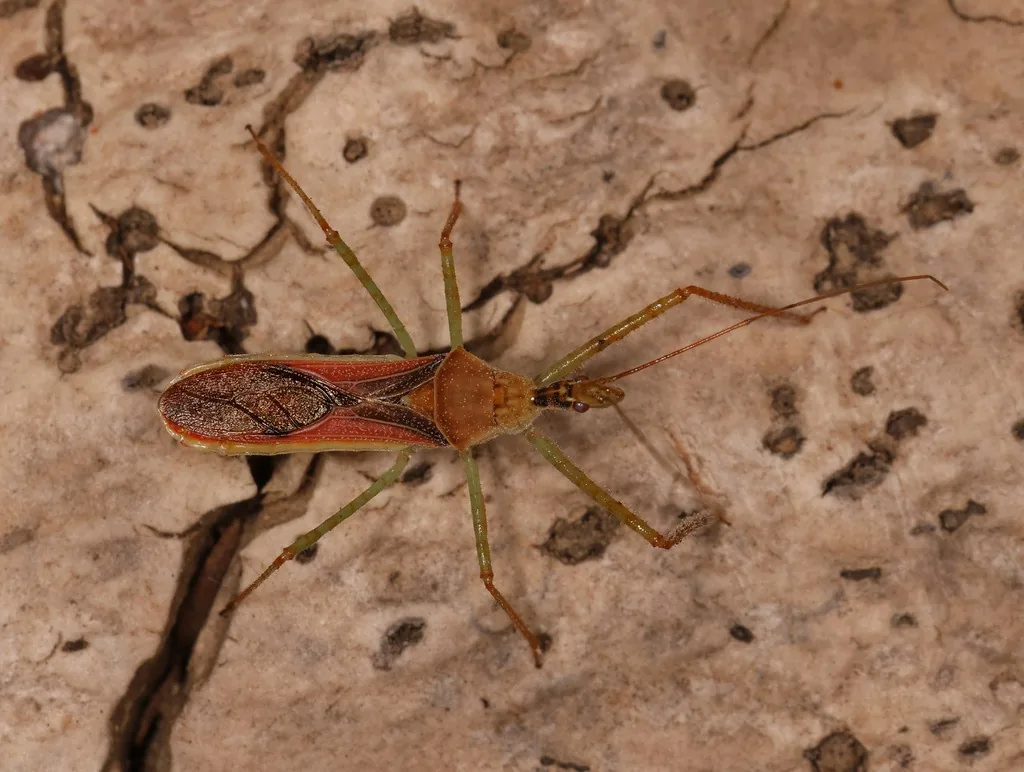
- Adults and nymphs have a long, narrow head with round, beady eyes, a long body and long legs.[1][3]
- The mouthparts form a long, hinged, needlelike beak; the Missouri Department of Conservation describes it as three-segmented and folding into a groove under the body. Both adults and nymphs can walk fast when disturbed.[1][3]
- Color varies a lot by species: blackish, black and orange, brown, gray or pale, and adults run about 1/5 to 1-1/4 inches long. In Zelus the abdomen is fairly parallel-sided, while in Sinea it is wider toward the rear.[1]
- Zelus have sticky hairs on the front legs that help them catch small prey such as flies and leafhoppers.[2]
- Leafhopper assassin bug eggs are oblong and dark brown with a white cap, laid in groups glued to plants. Young nymphs often look like ants or baby praying mantises.[1][3]
Look-alikes
| Look-alike | How to tell them apart |
|---|---|
| Leaffooted bug nymphs | Young Zelus have pale legs and antennae; leaffooted bug nymphs have dark legs and antennae and later grow flat, leaflike hind legs. Leaffooted bugs eat plants.[1][3] |
| Wheel bug | The wheel bug is the largest North American assassin bug, gray and about 1-1/4 inches long, with a cog-like crest on its back.[4][3] |
| Kissing bugs | Kissing bugs (conenose bugs) are assassin bugs that feed on mammal blood. They have no crest and show orange and black marks along the edge of the abdomen.[4][1] |
Where it lives
Assassin bugs live on almost any land plant, in crops, gardens and landscapes. The leafhopper assassin bug is common across California and the rest of the Western Hemisphere and has also settled in many Mediterranean countries. GBIF holds about 55,800 U.S. records of Zelus since 1990, the most from Texas, California and Florida, plus about 5,400 from Canada and about 3,100 from Spain.[1][5][6][7]
Biology and life cycle
They grow from egg through five wingless nymph stages to a winged adult, with no pupa.[1][3]
Most species have one or two generations a year, and Zelus adults often overwinter, sheltering on walls and windows in fall; Texas A&M notes at least one Zelus species has been reported as a household invader in fall and winter.[1][4]
Nymphs and adults ambush or stalk prey, stab it with the beak, inject venom and suck out the body contents. One study cited by Mississippi State found the leafhopper assassin bug consumed 72 to 99 percent of the body weight of caterpillar prey.[1][2]
Sources disagree on flight: UC IPM says adults tend not to fly, while the Missouri Department of Conservation calls assassin bugs good flyers and walkers.[1][3]
Species counts differ too: Texas A&M gives about 150 species in North America, the Missouri Department of Conservation nearly 200 north of Mexico, and Mississippi State hundreds in the U.S.; the genus Zelus alone has 71 New World species.[4][3][2][8]
Damage and signs
Health risk
They bite when handled, crushed or trapped against skin, and Mississippi State says the bite of some species is as painful as or more painful than a bee or wasp sting. Medical advice for insect bites in general is on this page under 'If you are bitten'.[2][3][4]
Control
Prevention
Texas A&M doesn't recommend controlling them: they're beneficial predators, rarely abundant, and need no insecticide sprays.[4]
Don't pick them up or slap at them. If one lands on you, brush it off; most bites happen when someone handles or crushes one.[4][3]
Biological control
Their value as pest control is disputed. UC IPM says they aren't important biological control agents because they also eat bees, lacewings, lady beetles and other beneficials, and Mississippi State says they are rarely numerous enough to matter; Texas A&M and the Missouri Department of Conservation call them beneficial, and Italian researchers rate the leafhopper assassin bug a major integrated pest management component against olive pests and the insects that spread Xylella.[1][2][4][3][5]
If you are bitten
MedlinePlus's general advice for insect bites and stings is to wash the site with soap and water, apply ice wrapped in a cloth for 10 minutes on and 10 minutes off, use an antihistamine or anti-itch cream if needed, and watch over the next several days for signs of infection such as increasing redness, swelling or pain.[9]
Call 911 or the local emergency number for trouble breathing, wheezing, swelling of the face or mouth, or throat tightness, which can be signs of a severe allergic reaction.[9]
Common questions
- Will an assassin bug bite me?
- Only in self-defense. They bite when mishandled or trapped against skin, and the bite can hurt as much as a bee sting.[2][3]
- Are assassin bugs good for my garden?
- Partly. They eat many pests, but they're general predators that also take bees and other beneficial insects, and Mississippi State says they're rarely numerous enough to matter much.[2][1]
- Is this the same as a kissing bug?
- Kissing bugs belong to the same family but feed on blood. Garden assassin bugs such as Zelus hunt insects.[1][4]
Sources
- University of California Statewide IPM Program, “Assassin Bugs (Natural Enemies Gallery).” ipm.ucanr.edu/natural-enemies/assassin-bugs/ (accessed 2026-11-11)
- Mississippi State University Extension Service, “Bug's Eye View: Assassin Bug, No. 18.” extension.msstate.edu/newsletters/bugs-eye-view/2015/assassin-bug-no-18 (accessed 2026-11-11)
- Missouri Department of Conservation, “Assassin Bugs (Field Guide).” mdc.mo.gov/discover-nature/field-guide/assassin-bugs (accessed 2026-11-11)
- Texas A&M AgriLife Extension Service, “Wheel bugs and other assassin bugs (ENT-1003).” citybugs.tamu.edu/factsheets/landscape/others/ent-1003/ (accessed 2026-11-11)
- Insects, via PubMed, “Zelus renardii roaming in southern Italy (Lahbib et al. 2022).” pubmed.ncbi.nlm.nih.gov/35206731/ (accessed 2026-11-11)
- Global Biodiversity Information Facility (GBIF), “Zelus (genus): U.S. occurrence records since 1990 by state (GBIF occurrence search).” api.gbif.org/v1/occurrence/search?taxonKey=2008836&country=US&hasGeospatialIssue=false&occurrenceStatus=PRESENT&year=1990%2C2026&facet=stateProvince&facetLimit=400&limit=0 (accessed 2026-11-11). Exact count at access: 55,849 U.S. records since 1990 (Texas 9,316; California 5,617; Florida 3,880).
- Global Biodiversity Information Facility (GBIF), “Zelus (genus): occurrence records since 1990 by country (GBIF occurrence search).” api.gbif.org/v1/occurrence/search?taxonKey=2008836&hasGeospatialIssue=false&occurrenceStatus=PRESENT&year=1990%2C2026&facet=country&limit=0 (accessed 2026-11-11). Exact counts at access: 74,417 records since 1990; United States 55,849, Canada 5,439, Spain 3,114, Mexico 2,320, France 1,318, Italy 918.
- Biodiversity Data Journal, via PubMed, “A taxonomic monograph of the assassin bug genus Zelus Fabricius: 71 species based on 10,000 specimens (Zhang, Hart and Weirauch 2016).” pubmed.ncbi.nlm.nih.gov/27651730/ (accessed 2026-11-11)
- MedlinePlus, U.S. National Library of Medicine, “Insect bites and stings (Medical Encyclopedia).” medlineplus.gov/ency/article/000033.htm (accessed 2026-11-11)
- iNaturalist, “Zelus renardii taxon page (order and family).” www.inaturalist.org/taxa/1318470 (accessed 2026-10-06)