On this page
How to identify it
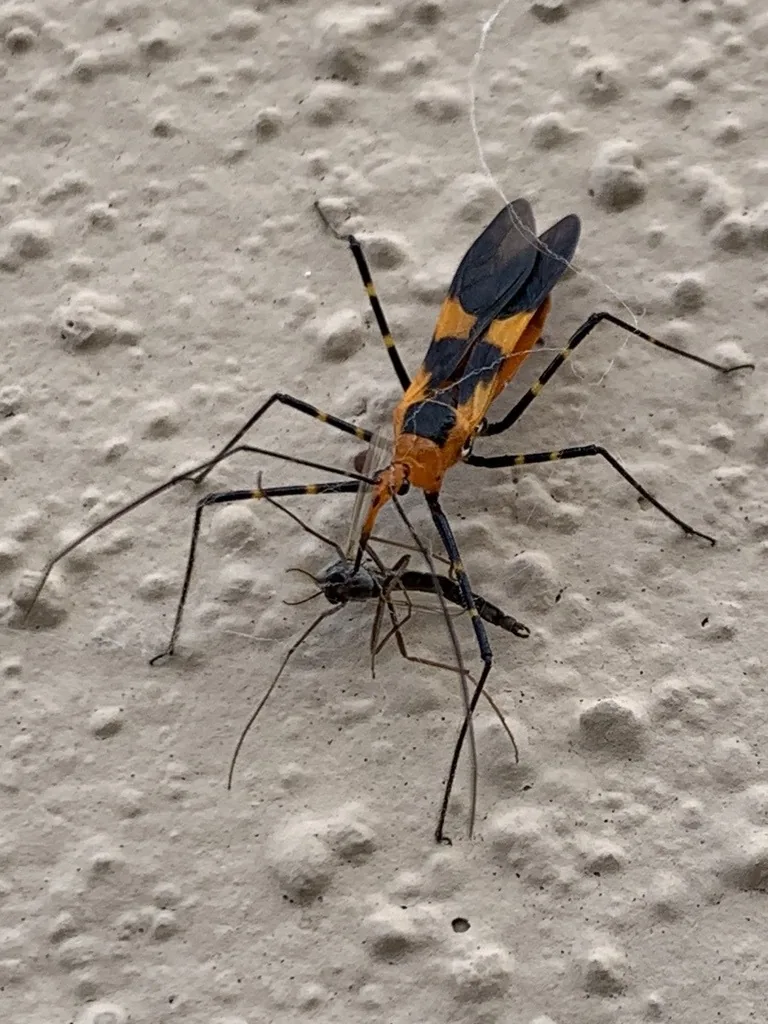
- The black and red (orange) coloring is distinctive, though highly variable: the usual form has alternating orange and black areas on the back, an orange or reddish-brown belly with each segment black at the front, and black legs with two yellow rings. UF/IFAS says U.S. populations are distinctively orange and black, while West Indies populations may be orange-brown, brownish-black or entirely black. Adults and nymphs have a pear-shaped head, a narrow neck and long hairy legs, and the three-segmented beak folds into a groove under the thorax at rest.[1][4]
- Females run about 15 to 18 mm long and males about 14 to 18 mm, roughly 1/2 to 3/4 inch, with a slender body, slender legs and a long, cylindrical head. UF/IFAS gives averages of 16.1 mm for males and 18.4 mm for females in California and Arizona, and 16.8 mm and 18.2 mm on the Gulf Coast.[1][4]
- The rear corners of the shoulder plate (pronotum) are rounded, without spines, and the front part of the shoulder plate is raised; together with size and color, these separate it from similar species.[1]
- Like other assassin bugs it has stout, curved, strawlike mouthparts used to stab prey.[2][5]
- UF/IFAS says the eggs are brown, elongate cylinders with a light brown cap, each 2.0 to 2.3 mm long, laid in clusters of 15 or more that are cemented down and coated with a sticky layer.[4]
- UF/IFAS says nymphs pass through five instars, from light brown with reddish-brown eyes and 2.61 mm long when newly hatched to an orange fifth instar 11.29 mm long with conspicuous black eyes.[4]
Look-alikes
| Look-alike | How to tell them apart |
|---|---|
| Large milkweed bug | Some color forms of the milkweed assassin bug may mimic the milkweed bug. The assassin bug has a long, narrow head with a stout beak, a slimmer body and longer, slender legs. UF/IFAS says the common name comes from its close resemblance to the milkweed bug, Oncopeltus fasciatus.[1][2][4] |
| Pale green assassin bug and other Zelus | Several Zelus species live in Texas, and Texas A&M calls the milkweed assassin bug the most distinctive of them. The pale green assassin bug is green, with a pair of spines on the back corners of the shoulder plate; the milkweed assassin bug's corners are rounded.[2][5][1] |
Where it lives
The southern US, Mexico, Central America, the Caribbean, northern South America, Paraguay and southern Brazil. Texas A&M lists it among the most common assassin bugs around Galveston County. GBIF's US records since 1990 come mainly from Florida and Texas, then Louisiana, the Carolinas, Georgia, Alabama and Mississippi, with fewer from California. UF/IFAS lists the Gulf Coast and South Atlantic states, southern California and southwestern Arizona in the United States.[1][2][6][4]
Biology and life cycle
Assassin bugs catch prey with a quick stab of the beak, inject a paralyzing venom that liquefies the prey's tissues, and suck up the fluids.[2][5]
It is a generalist predator. In south Florida sweet corn it hunts the picture-winged flies whose maggots damage ears, eating about five flies a day in lab feeding tests.[7]
In those Florida corn fields the bugs moved up the plant over the day with their prey: low and middle leaves in the morning, ears at midday and the top and tassel by late afternoon.[7]
In lab tests with fall armyworm caterpillars it attacked small, medium and large larvae equally often but succeeded more often with small ones, and given a choice it mostly killed the small ones, probably because bigger prey risks injury.[8]
Genus-wide, Zelus assassin bugs don't stick to particular host plants, which fits their generalist hunting.[1]
UF/IFAS describes a sticky-trap strategy: it hides in foliage with its front legs raised, and those legs carry a glue-like coating that holds prey on contact. It then paralyzes the prey with its stylets and digests it outside its body, sucking up the dissolved tissue.[4]
UF/IFAS says it can feed on prey up to six times its own size, but bigger prey takes longer to handle and leaves the bug more exposed to its own predators.[4]
UF/IFAS lists prey such as mosquitoes, flies, earthworms, cucumber beetles and caterpillars, and names it as a predator of fall armyworm, Asian citrus psyllid and genista broom moth. It eats other predators too: a UF/IFAS photo shows a newly hatched nymph feeding on a minute pirate bug nymph.[4]
Adults overwinter, UF/IFAS says.[4]
Damage and signs
- It does not feed on plants. Texas A&M describes assassin bugs as predatory insects of great benefit to gardeners.[2]
Health risk
It can deliver a painful bite if handled carelessly; Clemson says the pain comes from toxic saliva the bug uses to digest prey, and the Missouri Department of Conservation says crushing or slapping at assassin bugs usually causes them to bite. For an insect bite, MedlinePlus advises washing the site with soap and water, applying ice wrapped in a washcloth 10 minutes on and 10 minutes off, and watching over the next several days for signs of infection. Call 911 for trouble breathing, throat tightness, or swelling of the face or mouth.[3][5][9]
Control
Prevention
No control is needed. Texas A&M recommends against controlling assassin bugs in gardens because they are beneficial predators that are seldom abundant enough to need spraying.[2]
To avoid a bite, don't pick one up or slap at it; if one lands on you, brush it off.[2][5]
As a natural pest control
Florida corn researchers call it a promising biological control agent for picture-winged flies, though its numbers can vary between seasons. Texas A&M notes that assassin bugs are generally not very abundant.[7][2]
Where the sources disagree
South American range: UF/IFAS says it reaches all of South America except Chile, as far south as central Argentina, while the 2016 Zelus monograph lists northern South America, Paraguay and southern Brazil.[4][1]
Common questions
- Is the long-legged orange and black bug on my plants a milkweed bug?
- It may be a milkweed assassin bug, a predator whose color forms may mimic the milkweed bug. The assassin bug has a long, narrow head, a stout beak and long, slender legs.[1][2]
- Does the milkweed assassin bug bite?
- It can if you handle it carelessly or crush it against your skin, and assassin bug bites are painful. Wash the bite, use a cold pack, and get emergency help for trouble breathing or facial swelling.[3][5][9]
- What does the milkweed assassin bug eat?
- Other insects. Assassin bugs take bugs, bees, flies and caterpillars, and studies of this species show it eating picture-winged flies in corn and fall armyworm caterpillars.[2][7][8]
- Is the milkweed assassin bug active at night?
- No. UF/IFAS says Zelus assassin bugs are active by day, hiding in foliage with their sticky front legs raised to ambush prey.[4]
Sources
- Biodiversity Data Journal (Pensoft), “A taxonomic monograph of the assassin bug genus Zelus Fabricius: 71 species based on 10,000 specimens (Zhang, Hart & Weirauch 2016), Zelus longipes account.” doi.org/10.3897/BDJ.4.e8150 (accessed 2026-11-14)
- Texas A&M AgriLife Extension Service, “Wheel bugs and other assassin bugs, ENT-1003 (M. Merchant).” citybugs.tamu.edu/factsheets/landscape/others/ent-1003/ (accessed 2026-11-11)
- Clemson Cooperative Extension Home & Garden Information Center, “Assassin Bugs (HGIC 2472).” hgic.clemson.edu/factsheet/assassin-bugs/ (accessed 2026-11-11)
- University of Florida IFAS Extension (EDIS), “Milkweed Assassin Bug (Suggested Common Name) Zelus longipes Linnaeus, EENY489/IN883 (Featured Creatures; M. Kalsi and D. R. Seal).” ask.ifas.ufl.edu/publication/IN883 (accessed 2026-11-14)
- Missouri Department of Conservation, “Assassin Bugs, Field Guide.” mdc.mo.gov/discover-nature/field-guide/assassin-bugs (accessed 2026-11-11)
- Global Biodiversity Information Facility (GBIF), “Zelus longipes: US occurrence records since 1990 by state (GBIF occurrence search API).” api.gbif.org/v1/occurrence/search?taxonKey=2008843&country=US&hasGeospatialIssue=false&occurrenceStatus=PRESENT&year=1990%2C2026&facet=stateProvince&facetLimit=400&limit=0 (accessed 2026-11-11)
- Environmental Entomology, via PubMed, “Distribution of Zelus longipes in south Florida corn fields and its functional response to corn-infesting picture-winged flies (Kalsi et al. 2014).” pubmed.ncbi.nlm.nih.gov/25203811/ (accessed 2026-11-11)
- Journal of Applied Entomology (Wiley), via Crossref, “Influence of prey size on predation success by Zelus longipes L. (Cogni, Freitas & Amaral Filho 2002), abstract.” doi.org/10.1046/j.1439-0418.2002.00593.x (accessed 2026-11-11)
- MedlinePlus, U.S. National Library of Medicine, “Insect bites and stings (Medical Encyclopedia).” medlineplus.gov/ency/article/000033.htm (accessed 2026-11-11)
- iNaturalist, “Zelus longipes taxon page (order and family).” www.inaturalist.org/taxa/133826 (accessed 2026-11-11)