On this page
How to identify it
- Colorado State gives adult females an average length of 16 mm and males about 14 mm; Missouri gives a length of up to about 3/4 inch.[1][2]
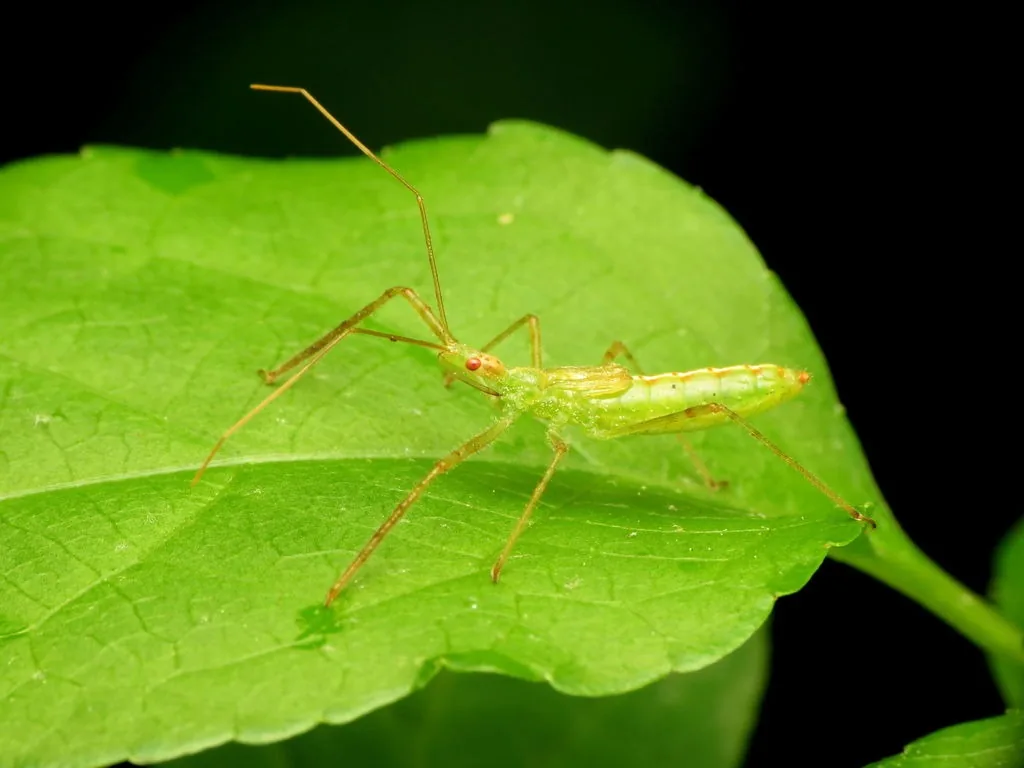
- The body is green; Colorado State says coloring varies from yellow-green to yellow or reddish brown. The wings may be tan or brown, the leg joints are often reddish, and there is a pair of spines on the back corners of the shoulder plate. The head is narrow and carries a beaklike mouthpart.[1][2]
- Nymphs are narrower, wingless and green.[1]
- The egg mass is the stage most often noticed: eggs stand on end in groups of a couple of dozen, glued together with sticky brownish material into a cone with a flat top. Colorado State says each mass holds up to 4 dozen eggs.[1]
Look-alikes
| Look-alike | How to tell them apart |
|---|---|
| Leaffooted bug nymphs | Young Zelus assassin bugs can be confused with young leaffooted bugs. Zelus nymphs have pale legs and antennae, leaffooted nymphs dark ones, and older leaffooted bugs develop flat, leaflike widenings on the hind legs.[4] |
| Other Zelus assassin bugs | Colorado also has Z. tetracanthus, which is more common, and Z. renardii, found only in the south of the state. The leafhopper assassin bug, Z. renardii, lays oblong dark brown eggs with a white cap, unlike the flat-topped cone of the pale green assassin bug.[1][4] |
Where it lives
Colorado State associates it with deciduous trees and shrubs in forests and residential areas and calls it common along Colorado's Front Range, with records from the Tri-River area of western Colorado. Missouri includes it in its statewide field guide.[1][2]
Biology and life cycle
Colorado State says it spends winter as a late-stage nymph among fallen leaves or other protected sites, with adults appearing in late spring. UC IPM says Zelus assassin bugs in general commonly overwinter as adults and may show up on walls and windows in fall.[1][4]
After mating, females lay a series of egg masses, typically about ten, roughly a week apart from late June through August.[1]
Newly hatched nymphs cluster around the egg mass for several days and may feed together in the first week, then scatter and hunt alone through five nymphal stages. There is one generation a year.[1]
It ambushes prey from leaves or hunts actively, taking small flies, wasps and sawflies as well as slower insects such as caterpillars.[1]
Its front legs are sticky. Newly hatched nymphs coat their forelegs with the sticky coating of the egg mass; older nymphs and adults have special 'sundew' hairs that make the sticky fluid. Mississippi State notes these sticky hairs help Zelus catch small prey such as tiny flies and leafhoppers.[1][5]
Damage and signs
Health risk
It hunts insects and doesn't feed on people, but assassin bugs can deliver a painful bite if handled carelessly or trapped between skin and clothing. For any insect bite, MedlinePlus advises washing the site with soap and water, applying wrapped ice 10 minutes on and 10 minutes off, and using an antihistamine or anti-itch cream if needed; call 911 for trouble breathing or swelling of the face or mouth.[1][6][5][7]
Control
Prevention
No control is needed; it is a natural enemy of plant-feeding insects. Clemson's advice for assassin bugs is to treat them with respect and not smash them.[1][6]
Avoid handling it. Assassin bugs bite when handled carelessly or trapped between skin and clothing.[6][5]
Common questions
- What is the skinny green bug with long legs on my shrubs?
- Possibly a pale green assassin bug, a slender green predator up to about 3/4 inch long with a narrow head and two small spines on the shoulders.[1][2]
- What are the little cone-shaped egg clusters on leaves?
- Often pale green assassin bug egg masses: a couple of dozen eggs standing on end, glued into a flat-topped cone.[1]
- Does the pale green assassin bug bite?
- It doesn't seek out people, but assassin bugs can bite painfully if handled carelessly or trapped in clothing. Wash a bite with soap and water and use a cold pack.[6][5][7]
- Does it harm plants?
- No. It eats other insects and doesn't feed on plants.[1]
Sources
- Colorado State University Extension (Colorado Insects of Interest, W. Cranshaw), “Zelus luridus, A Common Assassin Bug (Colorado Insect of Interest).” wci.extension.colostate.edu/wp-content/uploads/sites/14/2017/04/Zelus.luridus-1.pdf (accessed 2026-11-11)
- Missouri Department of Conservation, “Pale Green Assassin Bug (Field Guide).” mdc.mo.gov/discover-nature/field-guide/pale-green-assassin-bug (accessed 2026-11-11)
- iNaturalist, “Zelus luridus taxon page (order and family).” www.inaturalist.org/taxa/1580611 (accessed 2026-11-11)
- University of California Statewide IPM Program, “Assassin Bugs (Natural Enemies Gallery).” ipm.ucanr.edu/natural-enemies/assassin-bugs/ (accessed 2026-11-11)
- Mississippi State University Extension Service, “Bug's Eye View: Assassin Bug, No. 18.” extension.msstate.edu/newsletters/bugs-eye-view/2015/assassin-bug-no-18 (accessed 2026-11-11)
- Clemson Cooperative Extension, Home & Garden Information Center, “Assassin Bugs, HGIC 2472 (A. Hagerty, P. Zungoli and E. Benson).” hgic.clemson.edu/factsheet/assassin-bugs/ (accessed 2026-11-11)
- MedlinePlus, U.S. National Library of Medicine, “Insect bites and stings (Medical Encyclopedia 000033).” medlineplus.gov/ency/article/000033.htm (accessed 2026-11-11)